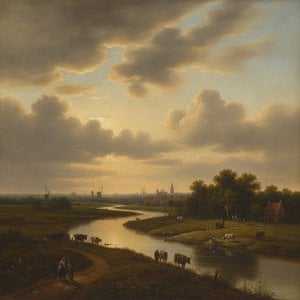
A Refined Vision of the Dutch Golden Age: Pieter van der Werff
Pieter van der Werff, a name perhaps less immediately recognized than those of Rembrandt or Vermeer, nevertheless occupies a significant and fascinating niche within the pantheon of Dutch Golden Age painters. Born in The Hague in 1665 and passing away in Rotterdam in 1722, his career unfolded during a period of immense artistic flourishing in the Netherlands, yet he carved out a distinctive style characterized by elegance, meticulous detail, and an early embrace of innovative pigments. His life was deeply intertwined with that of his older brother, Adriaen van der Werff, who served as both mentor and foundational influence, shaping Pieter’s trajectory from its earliest stages. While Adriaen achieved considerable renown – even securing a prestigious position at the court of the Elector Palatine – Pieter established himself primarily in Rotterdam, becoming the favored portraitist of the city's affluent citizenry and leaving behind a legacy that offers invaluable insights into the social fabric and aesthetic sensibilities of his time.Early Life and Artistic Training
Pieter van der Werff’s formative years were profoundly shaped by familial bonds. His brother, Adriaen, already an established painter with considerable acclaim – even securing a prestigious position at the court of the Elector Palatine – provided not only technical instruction but also a crucial introduction to the prevailing artistic currents of the day. This early tutelage instilled in Pieter a commitment to precision and refinement, qualities that would become hallmarks of his mature style. He quickly distinguished himself through an extraordinary ability to capture likenesses with both accuracy and psychological depth. His portraits weren’t merely representations of physical appearance; they were carefully constructed portrayals of status, personality, and social standing – reflecting the values held dear by the elite circles of Rotterdam. The Baroque aesthetic, dominant during this era, exerted a powerful influence on his artistic development, manifesting in dramatic compositions, rich color palettes, and a heightened sense of emotional intensity. This stylistic inheritance would permeate his entire oeuvre, shaping his approach to depicting human subjects and architectural spaces alike.Style and Technique: Mastering Light and Color
Pieter van der Werff’s distinctive style was characterized by an unwavering dedication to realism combined with subtle expressive gestures. He possessed a remarkable talent for capturing the nuances of light and shadow, skillfully employing chiaroscuro – dramatic contrasts between light and dark – to imbue his paintings with depth and atmosphere. Like Adriaen, he meticulously studied anatomy and perspective, ensuring that his depictions were both accurate and aesthetically compelling. However, Pieter’s artistic vision transcended mere technical proficiency; it was infused with a sensitivity to psychological characterization—a hallmark of the Baroque tradition—that distinguished him from many of his contemporaries. He achieved this feat through painstaking observation and an intuitive understanding of human emotion, conveying inner states with remarkable subtlety and nuance. His use of color was equally noteworthy, particularly his pioneering incorporation of Prussian blue – a pigment newly available in the early 18th century – which he skillfully deployed to create luminous hues and heighten emotional impact. This bold chromatic choice became synonymous with his artistic signature, elevating his paintings to levels of visual splendor rarely achieved by other artists of his time.Notable Works and Artistic Legacy
Pieter van der Werff’s artistic output spanned a diverse range of subjects—portraiture, mythological scenes, historical narratives, and genre depictions—demonstrating his versatility as an artist. Among his most celebrated achievements are monumental portraits of prominent figures such as Paulus Verschuur, Burgomaster of Rotterdam, and Peter the Great of Russia – works that exemplify his mastery of likeness and psychological portraiture. Furthermore, he undertook ambitious projects exploring classical mythology and history, producing captivating depictions of tales from Greek and Roman antiquity. His paintings also captured scenes from everyday life—such as “Bellen blazen (Bubble Blowing)”—revealing a keen awareness of human interaction and social dynamics. These works stand as enduring testaments to his artistic skill and contribute significantly to our understanding of the cultural landscape of Rotterdam during the Dutch Golden Age. His legacy endures as a testament to the refined aesthetic sensibilities of the Baroque period, and as an exemplar of meticulous technique combined with profound psychological insight—a distinction that secures Pieter van der Werff’s place among the most influential artists of his era. His paintings continue to inspire admiration for their elegance, precision, and emotional resonance, offering invaluable glimpses into a pivotal moment in European art history.Spørsmål og svar
Hvor kan jeg se kunstverkene til Pieter van der Werff i kronologisk rekkefølge?
Det finnes en tidslinje over Pieter van der Werff sine verk: kunstnerens Tidslinje for kunstverk-side sorterer kunstverkene etter produksjonsdato.
Hvordan finner jeg verk av Pieter van der Werff innenfor et spesifikt tema?
Pieter van der Werff sine verk kan utforskes via nøkkelord på kunstnerens Etter nøkkelord-side. Hvert nøkkelord grupperer de relaterte kunstverkene.
Hvor mange kunstverk av Pieter van der Werff er tilgjengelige for gjennomgang?
Du kan bla gjennom 64 kunstverk verk av Pieter van der Werff på siden Alle kunstverk.