Pierre Nicolas Huilliot (1674 - 1751): A Baroque Master of Light and Shadow
Pierre Nicolas Huilliot, born in Paris in 1674, was a pivotal figure in the French Baroque artistic landscape—a painter whose meticulous technique and profound understanding of chiaroscuro cemented his place as one of the era’s most respected artists. His father, Claude Huilliot (c. 1632-1702), established a lineage of painters known for their dedication to still life compositions, and Pierre Nicolas inherited this artistic tradition, honing his skills under his father's tutelage before enrolling in the Académie Royale de peinture et de sculpture in Paris in 1721. This formative experience undoubtedly shaped his stylistic sensibilities and propelled him toward a distinguished career marked by royal patronage and prolific output.
Early Life and Artistic Training
Claude Huilliot’s influence extended beyond mere instruction; he instilled in Pierre Nicolas a deep appreciation for observation and an unwavering commitment to capturing the subtleties of light and texture—principles that would become hallmarks of Huilliot's oeuvre. While biographical details surrounding Huilliot’s early life remain scarce, records indicate he possessed considerable talent from a young age, demonstrating an aptitude for drawing and painting that foreshadowed his future accomplishments. His father’s studio served as a crucible for artistic innovation, fostering experimentation with new pigments and techniques—a spirit of inquiry that would characterize Huilliot's entire artistic journey.
Style and Technique: The Language of Baroque Light
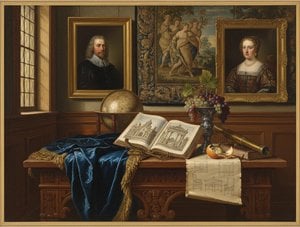
Huilliot’s artistic style is undeniably rooted in the Baroque tradition, characterized by dramatic contrasts between light and dark—a masterful manipulation of chiaroscuro that elevates his paintings beyond mere representation to convey emotion and psychological depth. He excelled at depicting scenes of religious fervor and musical instruments with remarkable precision, capturing not only their visual appearance but also their inherent atmosphere. His canvases pulsate with vitality, infused with a palpable sense of movement and imbued with an ethereal quality—a testament to his exceptional draughtsmanship and his profound understanding of artistic principles.
Notable Works and Patronage
Huilliot’s prolific output produced numerous paintings that graced the halls of royal palaces and aristocratic residences throughout France. Among his most celebrated works are depictions of musical instruments, particularly harpsichords and virginals—instruments revered for their beauty and symbolic significance within the Baroque aesthetic. These compositions exemplify Huilliot's meticulous attention to detail and his ability to convey both visual splendor and emotional resonance. Furthermore, he served as court painter to Louis XV and François Boucher, securing royal commissions that allowed him to explore ambitious artistic projects and contribute significantly to the decorative arts of the era.
Legacy and Historical Significance
Pierre Nicolas Huilliot’s contribution to French Baroque art is undeniable—he stands alongside Jean Baptiste Oudry and Antoine Watteau as one of the foremost painters of his time. His unwavering dedication to mastering chiaroscuro, coupled with his profound sensitivity to artistic expression, established him as a beacon of stylistic innovation and cemented his reputation as a master craftsman. Huilliot’s paintings continue to inspire admiration for their beauty and technical brilliance, serving as enduring reminders of the grandeur and sophistication of the Baroque period—a testament to the lasting impact of an artist who captured the spirit of his age with unparalleled artistry.