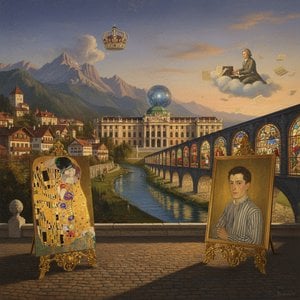
A Pioneer of Modernity: The Life and Vision of Otto Koloman Wagner
Otto Koloman Wagner, born in Vienna in 1841, stands as a pivotal figure bridging the gap between 19th-century historicism and the dawn of modern architecture. His journey wasn’t one of immediate revolution, but rather a gradual evolution—a thoughtful dismantling of established norms coupled with an unwavering commitment to functionality and honest expression. Initially steeped in classical training at the Vienna Polytechnic Institute and later refined at the Royal Academy of Architecture in Berlin, Wagner's early work reflected the prevailing academic styles. However, even within these traditional frameworks, seeds of innovation were sown. His studies under August Sicardsburg and Eduard von der Nüll instilled a crucial principle: architecture must possess a “rational expression” suited to its modern purpose—a concept that would become central to his life’s work. These formative years weren't merely about mastering technique; they were about questioning the very foundations of architectural thought, setting the stage for Wagner’s eventual break from convention. He began building a reputation through speculative ventures, designing apartment houses that subtly blended classical elements with emerging modernist ideas, financing these projects himself and demonstrating an entrepreneurial spirit alongside his artistic vision. Wagner's early career was marked by a fascination with classical forms—a legacy of his training at the Academy in Berlin—but he quickly recognized the limitations of replicating past glories without adapting them to contemporary needs. He embraced the burgeoning Vienna Secession movement, recognizing its imperative for artistic liberation and rejecting the stylistic constraints imposed by conservative forces. This alliance propelled him toward groundbreaking innovations that would redefine Viennese architecture and establish him as a champion of functionalism. His meticulous attention to detail—particularly in his designs for urban spaces like Karlsplatz Pavillion—demonstrated an unwavering belief in the transformative power of thoughtful design. Wagner’s stylistic evolution mirrored broader societal shifts, reflecting a growing desire for clarity and simplicity amidst the ornate excesses of the Belle Époque.The Vienna Secession and a Blossoming Style
A turning point arrived in 1893 with Wagner’s compelling entry into the Vienna city-planning competition. Though not ultimately victorious in the overall plan, his proposals—particularly those concerning an integrated urban rail network—garnered significant attention and led to his appointment as chief architect of the municipal railway system in 1894. This marked a decisive shift towards urban planning and a more pragmatic approach to design. Simultaneously, Wagner became deeply involved with the burgeoning Vienna Secession movement, founded in 1897 by Josef Maria Olbrich and Josef Hoffmann—two of his pupils—a group dedicated to challenging the conservative artistic establishment. Wagner’s style during this period blossomed into a distinctive blend of Art Nouveau flourishes and functional clarity. The Vienna Metro stations he designed—often adorned with decorative schemes by Koloman Moser—are prime examples of this synthesis. These weren't merely transportation hubs; they were carefully considered works of art, intended to elevate the everyday experience of city dwellers. Wagner’s meticulous attention to detail—particularly in his designs for urban spaces like Karlsplatz Pavillion—demonstrated an unwavering belief in the transformative power of thoughtful design. His stylistic evolution mirrored broader societal shifts, reflecting a growing desire for clarity and simplicity amidst the ornate excesses of the Belle Époque. Wagner's architectural philosophy centered on the idea that buildings should serve their purpose without sacrificing beauty or artistic expression. He championed geometric forms—particularly those derived from mathematical ratios—as instruments of rational design, rejecting superfluous ornamentation in favor of structural honesty. This approach resonated deeply with the principles of Modernism and foreshadowed the radical transformations that would reshape European architecture in the decades following his death. His unwavering conviction in functionality—coupled with a profound appreciation for craftsmanship—established him as one of the most influential architects of his time.Landmark Creations and Architectural Innovations
Wagner’s legacy is etched into the urban landscape of Vienna through a series of remarkable buildings that showcase his evolving style and innovative thinking. The Majolica House (1900–1904), designed in collaboration with Josef Olbrich, exemplifies his masterful fusion of Art Nouveau aesthetics and structural precision—a testament to his ability to elevate everyday spaces into works of art. The Kirche am Steinhof (Church of St. Leopold), completed between 1897 and 1902, stands as a beacon of Viennese architectural innovation, utilizing steel frames and innovative construction techniques to create a serene sanctuary that embodies Wagner’s commitment to both beauty and practicality. His Karlsplatz Pavillion—a public toilet facility—became an unexpected symbol of his pioneering spirit and demonstrated his conviction that even seemingly mundane structures could contribute to the betterment of society. The Austrian Postal Savings Bank building (1894–1905) represents a pivotal moment in Wagner’s stylistic trajectory, marking a decisive move away from ornate decoration toward a more restrained aesthetic—a reflection of his evolving architectural philosophy. Wagner's influence extended far beyond Vienna, inspiring architects across Europe and shaping the course of Modernist design. He remains a towering figure whose work continues to inspire architects and designers seeking to create buildings that are both beautiful and functional. His unwavering conviction in functionality—coupled with a profound appreciation for craftsmanship—established him as one of the most influential architects of his time. His contributions to the Vienna Secession were instrumental in fostering an environment of artistic freedom and innovation, paving the way for a new aesthetic that challenged conventional norms. Otto Koloman Wagner’s legacy continues to be celebrated not just for his individual achievements, but for his pioneering role in bridging the gap between the past and the future—a true visionary who helped shape the modern world we inhabit today.Spørsmål og svar
Hvor er Otto Koloman Wagner sine kunstverk organisert etter farge?
Otto Koloman Wagner sine verk kan utforskes etter farge på kunstnerens Spektralindeks-side.
Kan jeg besøke et virtuelt museum med verkene til Otto Koloman Wagner?
Otto Koloman Wagner sine kunstverk kan ses i et 3D-galleri på artistens side 3D-museum.
Kan jeg bla gjennom Otto Koloman Wagner sine verk etter medium?
Otto Koloman Wagner sine verk kan bla gjennom etter medium på Otto Koloman Wagner sin Alle medier-side.
Kan jeg bla gjennom Otto Koloman Wagner sine verk etter fargepalett?
Siden Etter fargepalett grupperer Otto Koloman Wagner sine kunstverk etter deres fargepaletter.
Hvor kommer Otto Koloman Wagner fra?
Otto Koloman Wagner ble født i Østerrike.
Hvordan finner jeg verk av Otto Koloman Wagner innenfor et spesifikt tema?
Siden Etter nøkkelord for Otto Koloman Wagner grupperer kunstnerens verk etter deres nøkkelord.
Hvor populære er kunstverkene til Otto Koloman Wagner?
En Statistikk-side finnes for Otto Koloman Wagner, som presenterer statistikk om kunstnerens verk på denne nettsiden.
Hvilken by og hvilket land er Otto Koloman Wagner født i?
Otto Koloman Wagner ble født i Vienna i Østerrike.