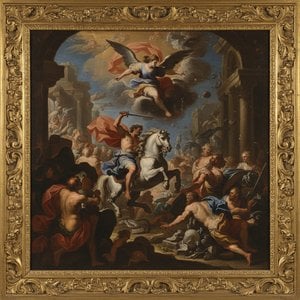
Johann Michael Rottmayr (1654 - 1730): Austrian Baroque Master
Johann Michael Rottmayr stands as a cornerstone of Austrian Baroque painting, marking the decisive transition from Renaissance grandeur to the opulent dynamism of the Rococo era. Born in Lauf an der Pegnitz, Bavaria, around 1654 (sources vary slightly between 1654 and 1656), Rottmayr’s artistic journey began within a family steeped in creative tradition—a fertile environment nurturing his innate talent for visual expression. His formative education commenced under Johann Carl Loth in Venice – an immersion into the stylistic brilliance of Titian, Veronese, and Tintoretto that instilled within him a profound appreciation for coloristic richness, dramatic composition, and masterful manipulation of light and shadow. This Venetian influence would permeate his entire oeuvre, shaping his artistic vision for decades to come.
Early Training & Venetian Influence
Loth’s tutelage wasn't merely about mastering technique; it was an intellectual encounter with the humanist ideals of the Renaissance, fostering a deep understanding of classical art history and inspiring Rottmayr to explore innovative approaches to representation. Just as Hans Adam Weissenkircher brought Italian artistic currents northward—establishing a shared aesthetic dialogue that enriched Bavaria’s cultural landscape—Rottmayr absorbed these influences, propelling him toward a distinctive style characterized by both grandeur and subtle nuance. He diligently studied the techniques of Venetian masters, meticulously replicating their use of chiaroscuro and color palettes to achieve breathtaking realism. This dedication to observation and emulation would prove invaluable in his subsequent artistic endeavors.
Salzburg & Collaboration with Fischer
Rottmayr’s burgeoning reputation swiftly garnered recognition, securing him a prestigious position as the general painter to Prince-Bishop Johann Ernst Graf Thun of Salzburg in 1689 – an endorsement that provided consistent commissions and firmly establishing his stature within Salzburg’s aristocratic circles. Under Thun’s patronage, Rottmayr flourished, producing both secular and religious works that showcased his growing mastery. Perhaps his most enduring partnership was with Johann Bernhard Fischer von Erlach—a collaboration that transcended mere artistic endeavor; it represented a shared commitment to architectural grandeur and visual harmony. Together they embarked on ambitious projects transforming Salzburg's cityscape – notably Schloss Frain an der Thaya (now Vranov nad Dyjí) where Rottmayr’s skill in illusionistic ceiling painting created a truly immersive experience, seamlessly integrating architecture and art into a unified aesthetic statement.
The Melk Abbey Dome & Artistic Innovation
Rottmayr's crowning achievement remains the monumental fresco adorning the central dome of Melk Abbey – a breathtaking testament to his artistic prowess and technical virtuosity. Completed with unparalleled dedication, this masterpiece depicts a visionary depiction of heaven—a swirling vortex of luminous figures bathed in ethereal light that defies conventional perspective and transports viewers into a realm of divine beauty. The sheer scale of the work combined with Rottmayr’s masterful command of illusionistic techniques solidified his reputation as one of Austria's foremost Baroque painters. Beyond Melk Abbey, Rottmayr continued to embellish churches and palaces across Austria and Germany—leaving an indelible mark on the artistic heritage of Central Europe. His frescoes for Karlskirche in Vienna exemplify his unwavering commitment to dramatic composition and vibrant color palettes—capturing the spirit of Salzburg’s baroque era.
Legacy & Influence
Johann Michael Rottmayr's contribution extends far beyond individual masterpieces; he served as a pivotal conduit between Renaissance traditions and Baroque innovation, shaping the artistic landscape of Austria for generations to come. His paintings embody a dynamic interplay of light and shadow—a hallmark of Baroque aesthetics—yet they also reveal a burgeoning sensitivity to form and detail foreshadowing the elegance and refinement of the Rococo style. Rottmayr’s legacy is not merely one of visual splendor; it's a testament to his ability to synthesize diverse influences, push artistic boundaries, and create works that continue to inspire awe and wonder centuries later—a true embodiment of the enduring power of art. He died peacefully in Vienna on October 25th, 1730.