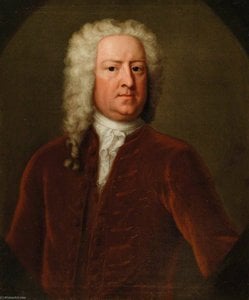
A Life Bridging Worlds: The Artistic Journey of Michael Dahl
Michael Dahl, a name synonymous with the elegance and refinement of 18th-century portraiture, was a Swedish artist whose presence indelibly shaped the English art scene. Born in Stockholm around 1659 – sources subtly vary between 1658 and 1659 – his trajectory wasn’t confined by national borders but rather defined by an ambitious pursuit of artistic mastery that propelled him across Europe, ultimately establishing him as a leading portraitist in England. His story is one woven with threads of familial sacrifice, rigorous training, a pivotal religious conversion born of opportunity, and the astute navigation of diverse cultural landscapes. The unwavering dedication of his mother, Catarina Dahl, to nurturing his talent laid the foundation for a career that would see him immortalize royalty, nobility, and leave behind a legacy of exquisite paintings celebrated for their aristocratic grace.From Swedish Foundations to Italian Influences
Dahl’s artistic education commenced in Sweden under Martin Hannibal in 1674, a figure brought from Italy by David Klöcker Ehrenstrahl with the specific purpose of establishing a portrait academy. This initial training provided him with fundamental skills – a grounding in technique and composition – before he transitioned to study directly under Ehrenstrahl himself. This move signified Dahl’s burgeoning promise as an artist, indicating that his talent was recognized and nurtured by one of Sweden's most esteemed painters. However, Dahl’s ambitions extended far beyond the confines of Stockholm. In 1682, he embarked on a remarkable educational odyssey across Europe, armed with a passport granting him freedom to travel and fueled by an unquenchable thirst for artistic knowledge. His arrival in London proved to be a pivotal moment – a calculated step towards realizing his aspirations. He found himself under the tutelage of Robert White, a skilled engraver and painter who was already well-established within the English art world, assisting him with engraving projects, including a portrait of King Charles XI of Sweden. This experience wasn’t merely supplementary; it provided invaluable practical skills and an essential introduction to the dynamics of the English art market. Yet, his encounter with Godfrey Kneller proved to be truly transformative. Kneller imparted not only technical expertise but also a crucial understanding of how to cater to public demand – a pragmatic approach that contrasted sharply with Ehrenstrahl’s more court-focused sensibilities. Dahl's travels continued to Paris and then Rome, where he absorbed the vibrant atmosphere and artistic innovations of the Baroque period.Rome, Conversion, and Patronage
The exiled Queen Christina of Sweden played a profoundly influential role in Dahl’s career during his time in Rome. Recognizing the strategic advantage of access to powerful circles and papal patronage, Dahl underwent a significant transformation – converting to Roman Catholicism at her behest. This decision opened doors that would have otherwise remained firmly closed, allowing him to paint portraits of the Queen herself and present his work before Pope Innocent XI, who bestowed upon him a gold medal – a tangible recognition of his burgeoning talent and artistic merit. The conversion, while perhaps strategically motivated, underscores Dahl’s remarkable adaptability and willingness to navigate complex social and religious landscapes in pursuit of his artistic goals. It was during this period that he honed his skills further, absorbing the Baroque aesthetic that would become so characteristic of his mature work – a style marked by dramatic lighting, rich colors, and an emphasis on theatricality. The patronage of Queen Christina provided him with not only financial support but also invaluable connections within the Roman art world, solidifying his position as a rising star.A Master of English Portraiture
Upon returning to England, Michael Dahl swiftly established himself as one of the most sought-after portraitists of his time. His style was characterized by an elegant and refined sensibility – capturing not merely the likeness but also the status, personality, and inner life of his aristocratic sitters. His portraits are distinguished by a masterful command of color, meticulous attention to detail in rendering textures (from velvet robes to intricate lace), and an overall sense of grandeur that perfectly reflected the wealth and power of his subjects. He painted numerous prominent figures, including Queen Anne, Prince George of Denmark, and a constellation of members from the English nobility – individuals who sought him out for his ability to capture their essence with remarkable accuracy and sophistication. Notable works include striking portraits of Sir William Carew, John Churchill (1st Duke of Marlborough), and Sir Robert Walpole – each painting revealing a unique facet of the sitter’s character and bearing. Perhaps one of his most impressive achievements is the triple portrait of the 2nd Earl of Burlington, the 1st Duke of Kingston upon Hull, and the 3rd Baron Berkeley of Stratton – a masterful display of his skill in group portraiture, showcasing his ability to balance individual characterization with compositional harmony and create a sense of shared identity among the subjects.Legacy and Historical Significance
Michael Dahl’s artistic style represents a compelling synthesis of Swedish, Italian, and English influences. He absorbed the technical foundations from Hannibal and Ehrenstrahl, learned market savvy from Kneller, and benefited immensely from the patronage system he encountered in Rome. His work embodies the Baroque aesthetic prevalent during his time but infused with a uniquely refined sensibility – a testament to his artistic intelligence and adaptability. He profoundly influenced subsequent generations of portrait painters with his elegant style and technical proficiency, leaving an enduring mark on English portraiture. Beyond his artistic contributions, Michael Dahl’s success as a Swedish artist flourishing primarily in England highlights the interconnectedness of European art during the Baroque period. His story is one of ambition, resilience, and cultural exchange – a testament to the power of talent, determination, and the willingness to embrace new opportunities. His portraits offer invaluable insights into the lives and appearances of the English aristocracy during the early 18th century, serving as both historical documents and enduring works of art that continue to captivate viewers today.Spørsmål og svar
Hvor kan jeg se alle kunstverk av Mikael Dahl?
Utforsk alle verk av Mikael Dahl på denne nettsiden via kunstnerens Alle kunstverk-side.
Hvilken by og hvilket land er Mikael Dahl født i?
Mikael Dahl ble født i Stockholm i Sverige.
Hvor mange kunstverk av Mikael Dahl er tilgjengelige å bla gjennom?
Du kan bla gjennom 180 kunstverk verk av Mikael Dahl på siden Alle kunstverk.