A Brushstroke of the Exotic: The Life and Art of Marmaduke Cradock
Marmadoke Cradock, a name perhaps less instantly recognizable than his contemporaries yet possessing an undeniable charm and distinctive style, occupies a fascinating niche in 18th-century British art. Born into a world increasingly captivated by natural history and the wonders of far-flung lands, Cradock dedicated his artistic life to depicting birds and animals with a vivacity and compositional flair that set him apart. While biographical details remain somewhat sparse – a common fate for artists operating outside the established portraiture circles – we can piece together a picture of a man deeply immersed in the burgeoning scientific curiosity of his time, translating observation into dynamic and often theatrical paintings. He wasn’t merely recording fauna; he was crafting narratives, imbuing his subjects with personality and placing them within meticulously arranged settings that hinted at exotic locales and the thrill of discovery.Influences and Early Development
Cradock's artistic lineage is intriguing, demonstrating a clear debt to both Dutch masters and contemporary continental artists. The influence of Jan Weenix and other Dutch still life painters is readily apparent in his early works – the careful rendering of plumage, the attention to texture, and the use of dramatic lighting all echo the traditions of Northern European naturalism. However, Cradock wasn’t simply copying; he infused this foundation with a distinctly British sensibility. Crucially, the work of Peter Hondecoeter, another Dutch master specializing in bird paintings, proved particularly formative. But it was perhaps his engagement with the artistic circles surrounding George Edwards, the renowned ornithologist and engraver, that truly shaped his career trajectory. Edwards’s meticulous illustrations, based on direct observation of live birds, provided Cradock with a wealth of anatomical knowledge and inspired him to strive for accuracy in his depictions. The influence of François Nicolas Martinet is also visible in the artist's compositions, particularly in the arrangement of animals within elaborate architectural settings. This blend of scientific precision and artistic license would become Cradock’s hallmark.A Career Defined by Dynamic Compositions
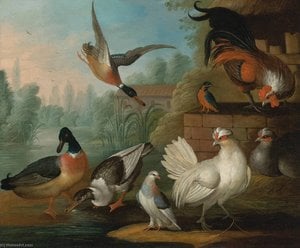
Cradock carved out a successful career specializing in paintings of birds, game, and other animals, often arranged in lively groups against lush backgrounds. Unlike many of his contemporaries who focused on the formal portraiture of individual specimens, Cradock favored dynamic compositions teeming with life. His canvases are rarely static; birds take flight, monkeys playfully interact, and dogs eagerly pursue their quarry. This sense of movement is achieved through careful attention to posture, gesture, and the interplay of light and shadow. He frequently depicted exotic species – parrots, macaws, cockatoos – reflecting the growing interest in global exploration and trade. These weren’t simply depictions of animals; they were statements about wealth, status, and a fascination with the unknown. Cradock's paintings often feature elaborate architectural elements—ruined temples, classical columns, and exotic foliage—creating a sense of theatricality and transporting the viewer to distant lands. He was adept at creating a visual narrative within each composition, suggesting stories of hunting expeditions, colonial encounters, or simply the beauty of the natural world.Technique and Style
Cradock’s technique was characterized by a masterful use of oil paint, allowing him to achieve remarkable detail and luminosity. He employed a layered approach, building up color and texture through subtle glazes and scumbling techniques. His brushwork is often loose and expressive, particularly in the rendering of foliage and backgrounds, creating a sense of depth and atmosphere. He possessed an exceptional ability to capture the iridescence of bird plumage, using a delicate palette of colors to convey the shimmering quality of feathers. His compositions are notable for their careful balance of light and shadow, which serves to highlight key elements and create a dramatic effect. While he clearly prioritized accuracy in his depictions of anatomy, Cradock wasn’t afraid to embellish or idealize his subjects, adding a touch of artistic flair to his work. He frequently used warm, earthy tones—ochres, browns, and reds—to create a sense of richness and opulence.Historical Significance and Legacy
Marmadoke Cradock’s historical significance lies in his ability to bridge the gap between scientific illustration and artistic expression. He wasn't merely documenting animals; he was creating visually compelling narratives that reflected the cultural values of his time. His paintings offer a fascinating glimpse into the 18th-century fascination with natural history, global exploration, and colonial encounters. While overshadowed by some of his more famous contemporaries, Cradock’s work has experienced a resurgence in recent years, as scholars and collectors have come to appreciate his unique style and compositional flair. His influence can be seen in the work of later animal painters, who adopted his dynamic compositions and attention to detail. Today, his paintings are highly sought after by museums and private collectors alike, serving as a testament to his enduring artistic legacy. He represents a captivating intersection of art, science, and the spirit of adventure—a brushstroke of the exotic in an age of discovery.- Major Collections: Numerous public and private collections worldwide.
- Key Themes: Exotic birds, animal still life, dynamic compositions, theatrical settings, natural history illustration.
- Notable Characteristics: Masterful use of oil paint, attention to detail, dramatic lighting, sense of movement and narrative.