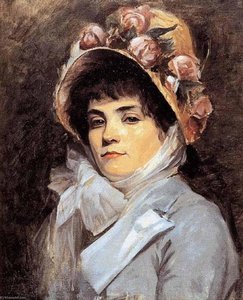
A Life Cut Short: The Passion and Promise of Marie Bashkirtseff
Born Maria Konstantinovna Bashkirtseva in 1858 amidst the vast landscapes of Gavronsk, Ukraine, Marie Bashkirtseff’s life was a compelling blend of aristocratic privilege and fiercely independent spirit. Her family, landowners with deep roots in Russian society, provided her with an upbringing steeped in culture – her mother, Elena Baschkirtzeff, a gifted pianist, and her father, Nikolai Baschkirtsev, a military engineer, ensured she received a broad education. This included fluency in multiple languages and exposure to diverse cultures as the family moved between Russia, Switzerland, and France due to her father’s assignments. However, this seemingly idyllic existence was shadowed by societal expectations that young women of her station would conform to traditional roles – expectations Bashkirtseff would ultimately challenge with both brushstroke and pen. From a tender age, she demonstrated an aptitude for art, a passion nurtured through private tutoring and later, formal training in Paris, the epicenter of artistic innovation during the late 19th century. This early exposure laid the foundation for a career tragically curtailed by illness but remarkably impactful nonetheless.Parisian Awakening: Realism, Feminism, and Artistic Voice
The year 1877 marked a pivotal moment in Bashkirtseff’s artistic journey when she enrolled at the Académie Julian in Paris. This progressive institution, unusually for the time, admitted women, providing her with access to rigorous training and a community of fellow artists. It was here that she fully immersed herself in the prevailing artistic currents, particularly those of Realism and Naturalism championed by figures like Jules Bastien-Lepage. While Bastien-Lepage focused on rural life, Bashkirtseff turned her gaze towards the bustling urban landscape of Paris and its inhabitants. She sought to capture not merely appearances but the very essence of contemporary existence, portraying everyday people with a psychological depth that was remarkably forward-thinking for her era. Her paintings frequently featured portraits, genre scenes, and, significantly, self-portraits – intimate explorations of identity and emotion. She employed a realistic style characterized by meticulous detail and dramatic lighting, occasionally incorporating impressionistic elements to convey the fleeting effects of light and atmosphere. But Bashkirtseff’s artistic ambition extended beyond mere representation; she aimed to depict women in unconventional roles, reflecting her own burgeoning independence and challenging societal norms. This commitment was mirrored in her active engagement with feminist thought. Under the pseudonym “Pauline Orrel,” she contributed articles to Hubertine Auclert's feminist newspaper, *La Citoyenne*, passionately advocating for gender equality and questioning traditional constraints placed upon women.The Journal: A Window into a Modern Soul
Perhaps Bashkirtseff’s most enduring legacy is not her paintings but her meticulously kept journal, begun at the age of thirteen and continued until her death. This extensive diary offers an extraordinarily intimate account of her life, thoughts, ambitions, and struggles – a strikingly modern work of psychological self-exploration that predates many similar introspective writings. Within its pages, she grapples with artistic aspirations, romantic disappointments, societal pressures, and the complexities of female identity in 19th-century Paris. The journal reveals a woman fiercely determined to forge her own path, unafraid to express her vulnerabilities and challenge conventional expectations. Her famous quote, “Let us love dogs, let us love only dogs! Men and cats are unworthy creatures,” encapsulates her disillusionment with romantic relationships and her preference for the unconditional affection of animals – a sentiment that speaks volumes about her independent spirit and rejection of societal norms. The journal is not simply a personal record; it’s a profound meditation on art, life, and the search for meaning in a rapidly changing world.Legacy and Remembrance: A Lasting Impression
Marie Bashkirtseff's life was tragically cut short by tuberculosis in 1884 at the young age of twenty-five. However, her posthumous recognition cemented her place as a significant figure in both art and literature. Her journal, published in 1887, achieved immediate success, captivating readers with its honesty, psychological depth, and unconventional perspective. Translated into English two years later as *Marie Bashkirtseff: The Journal of a Young Artist*, it garnered praise from prominent intellectuals like William Gladstone and George Bernard Shaw. The journal’s influence resonated through subsequent generations of writers, inspiring figures such as Mary MacLane, Pierre Louÿs, Katherine Mansfield, and Anaïs Nin. Her life story has also been adapted into plays and films, most notably a segment in *The Affairs of Maupassant* (1938). But perhaps the most unique testament to her enduring legacy is found at Cimetière de Passy in Paris, where her grave is marked by a full-sized replica of her artist’s studio – declared a historic monument by the French government. This extraordinary tribute stands as a powerful symbol of her artistic dedication and lasting contribution to cultural history. Marie Bashkirtseff remains an important figure, not only as a pioneering female artist who challenged societal norms but also as a visionary whose work continues to resonate with audiences today, offering valuable insights into the social and cultural landscape of 19th-century Paris and the universal human experience.Spørsmål og svar
I hvilken historisk periode arbeidet Marie Bashkirtseva?
Marie Bashkirtseva var virksom i perioden 19th Century. Denne perioden plasserer kunstnerens virke i en historisk kontekst.
Hvor kommer Marie Bashkirtseva fra?
Marie Bashkirtseva ble født i Ukraine.
Finnes det en oversikt over alle motivene Marie Bashkirtseva malte?
Siden Motivatlas kartlegger Marie Bashkirtseva sine kunstverk etter motiv.