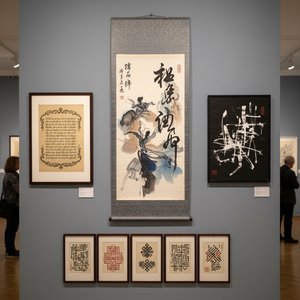
A Life Immersed in Tradition: The World of Li Yanshan
Li Yanshan (1898-1961), a name synonymous with the flourishing of *guohua* landscape painting in 20th-century China, was more than just an artist; he was a cultural custodian, a dedicated educator, and a discerning connoisseur. Born Li Yaochen in Xinhui County, Guangdong province, into a family steeped in scholarly tradition, his path was seemingly preordained for a life of letters. From a young age, he absorbed the rich tapestry of classical Chinese literature, laying a foundation that would profoundly influence his artistic vision. This early immersion wasn’t merely academic; it instilled within him a deep reverence for China's cultural heritage – a reverence that became the cornerstone of his art. His formal artistic training began in Guangzhou under the tutelage of Pan He, a celebrated *guohua* painter who recognized and nurtured Li’s burgeoning talent. This mentorship proved pivotal, providing Li with not only technical skills but also an understanding of the philosophical underpinnings of Chinese painting.Bridging Worlds: Education, Law, and Artistic Awakening
Li Yanshan's life took an unexpected turn when he enrolled in the Faculty of Law at Peking University in 1918. While seemingly a departure from his artistic inclinations, this period proved crucial in broadening his intellectual horizons. In Beijing, he actively sought out encounters with prominent painters and collectors, immersing himself in the world of Chinese art history and expanding his aesthetic sensibilities. Simultaneously, under the influence of Cai Yuanpei, then President of Peking University and an advocate for Western art, Li also began studying Western painting techniques under the renowned artist Xu Beihong. This exposure to diverse artistic approaches was not a dilution of his commitment to *guohua*, but rather an enrichment – a broadening of perspective that would later inform his unique style. Upon graduating, he entered civil service in Guangdong, holding various legal positions while continuing to paint and refine his skills. He served as a county’s education department section chief, then moved into roles in Shantou and Guangzhou, eventually becoming a principal judge of the municipal court. However, it was his involvement with the Chinese Painting Research Society (CPRS) in 1925 that truly cemented his destiny as an artist.The CPRS and a Commitment to Tradition
Founded by his mentor Pan He, the CPRS represented a conscious effort to reaffirm the importance of traditional Chinese cultural values and painting techniques amidst a period of rapid modernization and Western influence. Li Yanshan quickly became an active member, rising through the ranks to become a standing committee member in 1928. The Society’s core belief – that a deep understanding of tradition was essential for the future development of Chinese painting – resonated deeply with Li's own convictions. The CPRS provided a platform for artists to exhibit their work, publish their ideas, and engage in critical dialogue about the direction of Chinese art. It became the largest art body in Southern China, fostering a vibrant community of like-minded individuals dedicated to preserving and promoting *guohua*. This period marked a turning point in Li’s life; he increasingly devoted himself to painting, recognizing that his true calling lay not in law or administration, but in the realm of artistic expression. In 1932, he accepted the position of Headmaster of the Guangzhou Municipal College of Art, further solidifying his commitment to art education and shaping a new generation of Chinese painters.Wartime Resilience and Hong Kong Sanctuary
The outbreak of the Second Sino-Japanese War in 1937 brought immense hardship to China, disrupting lives and challenging artistic endeavors. Li Yanshan, like many others, was forced to seek refuge, moving between various cities including Hong Kong and Macau. Despite the turmoil, he persevered with his painting, finding solace and purpose in his art. He received patronage from wealthy admirers who recognized his talent and supported his work during these difficult times. After the war’s end in 1945, Li briefly returned to his hometown of Xinhui, creating a poignant scroll titled “A Land Untarnished” as a commemoration of peace. However, he soon relocated back to Guangzhou, where he re-established himself as a leading *guohua* painter through exhibitions and collaborations. In 1948, Li made the fateful decision to travel to Hong Kong, initially for a short visit, but it ultimately became his permanent home. As mainland China transitioned under Communist rule in 1949, many artists followed suit, seeking refuge in Hong Kong. Li joined forces with fellow masters like Chang Dai-chien and Gao Jian-fu, organizing joint exhibitions that showcased the richness and diversity of Chinese painting. He held a solo exhibition in 1951, his last before his passing in 1961. In his final years, Li embraced a more secluded existence, dedicating himself to exploring the essence of *guohua* with unwavering focus. His studio became a sanctuary where he painted and contemplated, leaving behind a legacy that continues to inspire artists and art lovers today. He was known for his demanding standards when taking on students, ensuring only those truly dedicated would learn from him.Spørsmål og svar
Kan jeg utforske Li Yanshan sine verk etter fargespekter?
Li Yanshan sine verk kan utforskes etter farge på kunstnerens Spektralindeks-side.
Finnes det en virtuell 3D-omvisning av Li Yanshan sine verk?
Et virtuelt besøk er mulig: siden 3D-museum til Li Yanshan presenterer kunstnerens verk i et tredimensjonalt galleri.
Hvor mange kunstverk av Li Yanshan er tilgjengelige for gjennomgang?
Du kan bla gjennom 4 kunstverk verk av Li Yanshan på siden Alle kunstverk.