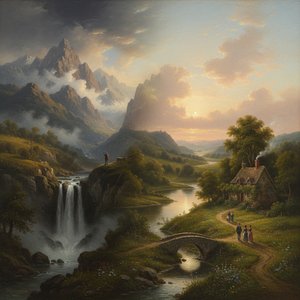
Lazzaro Pasini - A Tuscan Landscape Painter
Lazzaro Pasini (1861–1949) stands as a prominent figure in Italian landscape painting, particularly within the Macchiaioli movement—a group of artists who revolutionized artistic expression by prioritizing direct observation and capturing the immediacy of nature. Born in Reggio Emilia, Italy, Pasini’s formative years were steeped in the traditions of Bolognese art, where he honed his skills under the tutelage of Romualdo Belloli, a respected engraver who instilled in him a meticulous attention to detail and an appreciation for tonal harmonies. This early training would prove invaluable as he embarked on a journey toward artistic innovation.
- Early Influences: Pasini’s artistic sensibilities were profoundly shaped by the Impressionist movement, spearheaded by Claude Monet and Pierre-Auguste Renoir. These artists championed capturing fleeting moments of light and color—a concept that resonated deeply with Pasini's desire to transcend academic conventions.
- Florence and Fattori’s Studio: Seeking further artistic development, Pasini relocated to Florence in 1884 where he enrolled at the Academy and studied under Giovanni Fattori. Fattori’s studio served as a crucible for experimentation, encouraging Pasini to embrace the Macchiaioli style—characterized by bold brushstrokes and unrestrained color palettes intended to convey emotion rather than precise representation.
- The Tuscan Landscape: Pasini's oeuvre is overwhelmingly devoted to landscapes of Tuscany. He meticulously documented the region’s diverse terrains—rolling hills, cypress-studded slopes, and sunlit valleys—employing a technique that prioritized atmospheric perspective and tonal modulation. His canvases are imbued with a palpable sense of tranquility and beauty.
The Macchiaioli Style: Breaking Boundaries
Pasini’s commitment to the Macchiaioli aesthetic represents a decisive departure from prevailing artistic norms. Rejecting the meticulous realism favored by academic painters, Macchiaioli artists prioritized capturing the essence of nature—its moods and sensations—through expressive brushwork and vibrant color harmonies. This stylistic choice was driven by a conviction that art should serve as a conduit for emotional experience rather than merely an objective depiction of reality.
- Bold Strokes and Color Harmony: The Macchiaioli technique involved applying paint in thick, irregular strokes—often juxtaposed with areas of pure color—to create visual effects that conveyed dynamism and immediacy. Pasini skillfully utilized tonal modulation to simulate the diffusion of light across surfaces, achieving a luminous quality that captured the spirit of Tuscan landscapes.
- Influence of Impressionism: Like Fattori and other Macchiaioli contemporaries, Pasini drew inspiration from Impressionist painters who championed capturing fleeting moments of light and color. He adopted Monet’s compositional strategies—such as placing figures in relation to expansive vistas—to heighten the impact of his paintings.
- Notable Achievements: Pasini's artistic prowess was recognized by the Ministry of Education, which awarded him a gold medal for his landscape painting “Twelve Studies of Vesuvius” in 1918. This accolade underscored the significance of his contribution to Italian art and cemented his reputation as one of Tuscany’s foremost landscape painters.
Museum Collections and Legacy
Pasini's artworks are housed in prestigious museums across Italy, including the Pinacoteca di Vicenza and Museo del Novecento in Milan. These institutions offer visitors a chance to appreciate the artist’s mastery of tonal harmony and his ability to convey the sublime beauty of Tuscan landscapes. His paintings continue to inspire admiration for their expressive power and technical precision—a testament to Pasini's enduring legacy as a pivotal figure in Italian landscape painting.
Further Exploration
The Museo del Novecento showcases a remarkable collection of artworks from the early 20th century, including masterpieces by artists such as Thomas Moran, William James Glackens and Jean-François Raffaelli. Visiting this museum provides invaluable insight into Pasini’s artistic context and influences. Explore online resources for detailed information about Lazzaro Pasini's life and work: https://WahooArt.com/@/lazzaro-pasini https://WahooArt.com/art.nsf/o/a@d3afpd https://WahooArt.com/art.nsf/art_en?open&query=lazzaro+pasini,lazzaro,pasini