A Chronicler of Viennese Society: The Life and Art of Josef Kriehuber
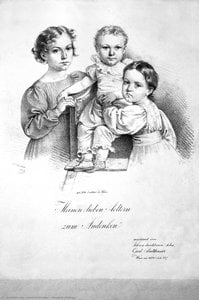
Born in Vienna on December 14th, 1800, Josef Kriehuber occupies a unique position within Austrian art history. He wasn’t striving for grand historical narratives or mythological allegories; instead, his artistic vision focused intently on the intimate details of everyday life, making him an unparalleled chronicler of 19th-century Viennese society through the burgeoning medium of lithography. Kriehuber's journey began with formal training at the Vienna Academy under Hubert Maurer, but it was his embrace of lithography that truly defined his career and legacy. This innovative technique allowed for the relatively rapid and affordable reproduction of images, democratizing portraiture and making it accessible to a wider audience than ever before – an audience Kriehuber served with unwavering dedication. He wasn’t simply reproducing likenesses; he was crafting visual records of status, personality, and the very spirit of an era. His work stands as a remarkable testament to his ability to capture not just appearances but also the subtle nuances of human character.The Biedermeier Portraitist: A Window into an Era
Kriehuber’s artistic development flourished within the context of the Biedermeier period (roughly 1815-1848). This era, born from the aftermath of Napoleonic upheaval, fostered a focus on domesticity, simplicity, and the everyday. These values resonated deeply with Kriehuber’s sensibilities. He sought to depict the world as he saw it – not through idealized romanticism or grand historical pronouncements, but through the quiet realities of daily life in Vienna. While he initially explored landscape lithography, it was portraiture where his talent truly shone. He became extraordinarily prolific, creating over 3000 lithographs throughout his career – an astonishing number that speaks to both his skill and the immense demand for his work. His clientele spanned the spectrum of Viennese society: nobility, government officials, prominent personalities, and those simply seeking a lasting image of themselves or their loved ones. Kriehuber’s portraits weren't idealized fantasies; they were remarkably accurate representations, imbued with a sense of character and social standing. He possessed an uncanny ability to capture not just physical likeness but also the inner life of his subjects, making each portrait a unique psychological study. His meticulous attention to detail, combined with a subtle understanding of human expression, allowed him to create portraits that felt both intimate and revealing.Beyond Likeness: Documenting Vienna’s Cultural Landscape
While celebrated for his portraits, Kriehuber's artistic vision extended beyond individual representation. He recognized the importance of documenting the urban landscape itself, particularly the vibrant atmosphere of Vienna’s Prater park. His lithographs depicting scenes from the Prater offer invaluable insights into 19th-century Viennese life and culture. These weren’t simply picturesque views; they were snapshots of a society at leisure, revealing details about fashion, social interactions, and the recreational habits of the time. He captured the energy and excitement of the Prater, showcasing its diverse attractions and the people who flocked to enjoy them. This dedication to capturing the essence of Vienna cemented his place as an important observer of Austrian society. His work provides a vivid window into a world that is often overlooked in traditional historical accounts.Technique and Style: The Master of Lithography
Kriehuber’s mastery of lithography was central to his success. He wasn't merely a portraitist; he was a skilled technician who understood the unique possibilities of this printing process. Lithography allowed for rapid reproduction, making portraits affordable for a wider audience than traditional painting. More importantly, it enabled Kriehuber to achieve remarkable detail and tonal range – qualities that were essential to his ability to capture the nuances of human expression. His portraits are characterized by meticulous draftsmanship, precise lines, and a subtle use of shading. He wasn’t interested in bold brushstrokes or dramatic contrasts; instead, he favored a more restrained approach, focusing on capturing the delicate details of clothing, hair, and facial features. This understated style, combined with his technical skill, made his portraits highly sought after by those seeking a flattering yet truthful representation of themselves. The process itself demanded patience and precision, reflecting Kriehuber’s meticulous nature as an artist.Legacy and Recognition: A Lasting Impression
Kriehuber’s influence extended beyond his prolific output. He served as a teacher at the Theresianum Academy in Vienna, nurturing future generations of artists and passing on his technical expertise. In 1860, he received significant recognition with the Franz Joseph Order, acknowledging his contributions to Austrian art. However, the rise of photography towards the end of his life presented a challenge to his profession. As photographic portraiture became more accessible and affordable, demand for lithographic portraits declined, leading to financial hardship in his later years. Despite this, Kriehuber continued to work until his death on May 30th, 1876, leaving behind an extraordinary body of work that continues to captivate and inform us today. His legacy lies not only in the sheer number of portraits he created but also in their historical significance as a visual record of 19th-century Central European society. Collections of his works are held at the Albertina museum and the Austrian National Library, ensuring his art will continue to be appreciated for generations to come. His work remains a testament to the power of observation and the enduring appeal of capturing the human spirit.Spørsmål og svar
Hvilke farger brukte Josef Kriehuber oftest?
Palettens genom til Josef Kriehuber er en side som presenterer fargeprofilen til kunstnerens samlede verker.
Kan jeg utforske verkene til Josef Kriehuber etter tema?
Motivatlas til Josef Kriehuber er en side som kartlegger kunstnerens verk etter motiv.
Hvor mange kunstverk av Josef Kriehuber er tilgjengelige for gjennomgang?
Du kan bla gjennom 130 kunstverk verk av Josef Kriehuber på siden Alle kunstverk.