John Seymour Lucas (1849–1923): Victorian Painter of History and Detail
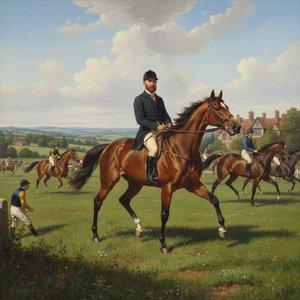
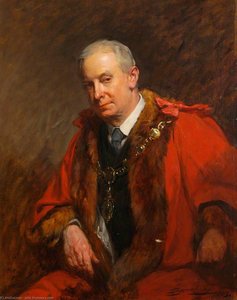
John Seymour Lucas, born in London on December 21st, 1849, stands as a singular figure within the annals of Victorian art – an artist who didn’t merely depict historical scenes but painstakingly reconstructed moments from Britain's often turbulent past. He wasn’t driven by revolutionary fervor or avant-garde experimentation; rather, he possessed an unwavering dedication to capturing truthfulness and nuance, achieving renown as both a portrait painter and a celebrated costume designer. His artistic journey began unexpectedly: an apprenticeship in woodcarving preceded his embrace of the canvas, instilling within him a foundational understanding of three-dimensional form that profoundly shaped his remarkable realism. This early training fostered a deep appreciation for texture, detail, and materiality—elements that permeate his historical compositions with palpable vibrancy. Formal education at St. Martin’s Lane Art School and subsequently the Royal Academy Schools provided a robust technical base, yet it was travel across Europe – particularly to Holland and Spain – that truly ignited his artistic vision.
Influences Shaping His Artistic Eye
Lucas's artistic sensibilities were profoundly molded by the masters of Dutch and Spanish painting. He wasn’t merely imitating their stylistic conventions; he absorbed their mastery of light, shadow, and psychological depth—techniques central to portraiture and historical narratives alike. Diego Velázquez, in particular, served as an enduring inspiration, fueling Lucas’s commitment to portraying not just *what* transpired but *how* it felt – the tension, the drama, the human cost inherent in pivotal historical episodes. This influence manifested itself most notably in his meticulous attention to detail, especially when rendering fabrics, armor, and architectural settings—elements meticulously recreated to convey an authentic sense of place and time. Lucas eschewed grand allegories or idealized representations; instead, he sought to capture reality with uncompromising accuracy, mirroring Velázquez’s approach to portraying human subjects within their environments. The legacy of Van Dyck also resonated deeply within him, informing his understanding of portraiture and contributing to the dignified composure characteristic of many of his portraits.
A Painter Dedicated to Realism: Technique and Style
Lucas's artistic technique was characterized by an unwavering commitment to realism—a pursuit that demanded painstaking observation and meticulous execution. He employed a layered approach to painting, building up surfaces with multiple glazes to achieve subtle tonal variations and capturing the nuances of light and shadow with exceptional precision. This dedication to detail extended beyond mere visual representation; Lucas sought to convey not only *what* was seen but also *how* it felt—the atmosphere of a scene, the emotions conveyed by its participants. His canvases pulsated with palpable texture, reflecting his formative experience as a woodcarver and demonstrating his profound understanding of material properties. He skillfully utilized brushstrokes to create expressive marks that communicated both visual information and emotional resonance—a hallmark of Victorian painting at its finest. Lucas’s meticulous rendering of fabrics, armor, and architectural elements exemplifies this stylistic ethos, mirroring Velázquez's masterful handling of these subjects.
Notable Achievements: Historical Narratives and Costume Design
Lucas achieved considerable acclaim during his lifetime, culminating in his election as a Royal Academician in 1886—a prestigious honor recognizing his artistic merit and scholarly pursuits—and establishing him as a sought-after portraitist and costume designer. His paintings stand as powerful testimonies to Victorian historical consciousness—scenes meticulously researched and rendered with breathtaking realism that illuminate key moments in British history. Among his most celebrated works is *Rebel Hunting after Culloden* (1884), which captures the aftermath of the Jacobite uprising with arresting immediacy, portraying the confrontation between British soldiers and local blacksmiths with remarkable psychological depth. The painting’s composition—the stark contrast between muscular figures and smoky forge—effectively conveys the tension and anxiety of the period. Similarly, *The Flight of the Five Members* (Houses of Parliament), commissioned in 1884, exemplifies Lucas's ability to tackle large-scale projects with impressive technical skill and artistic vision. He skillfully captured the grandeur of the parliamentary building and conveyed a sense of solemn occasion—a testament to his mastery of architectural representation. Beyond painting, Lucas distinguished himself as a costume designer for theatrical productions, demonstrating an equally discerning eye for historical accuracy and stylistic elegance. His designs for “The Duke of Normandy” – commissioned for Prince Alfred’s ball in 1897 – showcased his unparalleled talent for recreating authentic period attire—a feat that cemented his reputation as one of Britain's foremost artists of the Victorian era.
Legacy: A Voice of Authenticity Amidst Artistic Change
John Seymour Lucas died peacefully on May 8th, 1923, leaving behind a legacy as an artist who championed realism and unwavering fidelity to historical detail—a stance that contrasted sharply with the burgeoning trends of Impressionism and Symbolism dominating the artistic landscape of his time. Despite these stylistic shifts, Lucas’s paintings continue to resonate with audiences today, offering invaluable insights into Victorian perceptions of history and embodying the enduring values of meticulous observation and skillful craftsmanship. His contribution to British art is undeniable—a testament to his dedication to preserving the past while simultaneously elevating it to new heights of artistic expression.