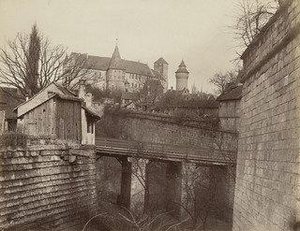
Johann Hahn: A Nuremberg Painter of Walls and Rivers
Johann Hahn (1840-1900) wasn’t a name that echoed through the grand halls of the art world during his lifetime, yet today he stands as a quietly significant figure in 19th-century German landscape painting. Born in Nuremberg, Hahn dedicated his artistic life to capturing the essence of his city – not its opulent palaces or bustling marketplaces, but the sturdy, enduring walls that defined its identity and the meandering rivers that pulsed through its heart. His work offers a unique perspective on urban life, blending meticulous detail with an underlying romantic sensibility, revealing a deep connection to both the tangible and the intangible aspects of Nuremberg’s character.
Hahn's early life was marked by a modest upbringing within a family deeply rooted in the city’s artisan traditions. While specific details about his formal artistic training remain somewhat elusive – he wasn’t formally enrolled at a prestigious academy – it’s believed he honed his skills through observation and apprenticeship, likely working alongside other craftsmen and artists in Nuremberg. This hands-on approach instilled in him an acute awareness of materials and techniques, which is evident in the remarkable precision with which he rendered textures, light, and shadow in his paintings.
His artistic focus quickly settled on the city walls and riverbanks. These weren’t subjects typically favored by landscape painters of the era, who often sought dramatic mountain vistas or idyllic countryside scenes. Hahn, however, found beauty and significance in the everyday – the weathered stones of the fortifications, the reflections shimmering on the water's surface, the subtle shifts in light as they played across the urban landscape. He meticulously documented these details, creating a series of paintings that offer an intimate portrait of Nuremberg’s physical environment. His most celebrated works include “Splittler Gate, Nuremberg,” a captivating depiction of one of the city’s iconic gateways, and numerous studies of the walls themselves, showcasing their intricate construction and the way they interacted with the surrounding landscape.
The Splittler Gate and Beyond: A Study in Urban Detail
“Splittler Gate, Nuremberg” is arguably Hahn's most famous painting. It’s a remarkably detailed rendering of this historic gate, capturing not just its physical form but also the atmosphere of the surrounding street scene. The composition is carefully balanced, drawing the eye to the imposing structure while simultaneously revealing the life and activity that unfolded within its shadow. Hahn masterfully employed techniques of atmospheric perspective – using subtle variations in color and tone to create a sense of depth and distance – effectively conveying the scale and grandeur of the gate.
Beyond the Splittler Gate, Hahn produced a vast body of work focused on Nuremberg’s fortifications. These paintings aren't simply topographical records; they are imbued with a quiet dignity and a sense of reverence for the city’s history. He depicted the walls not as symbols of defense but as enduring monuments to human endeavor, reflecting on their role in shaping the city’s identity and its relationship to the outside world. His meticulous attention to detail – from the individual stones of the wall to the reflections in the river below – reveals a deep appreciation for the beauty of the ordinary.
Technique and Influences
Hahn's artistic style is characterized by a remarkable level of realism combined with a subtle romanticism. He was a keen observer of light and shadow, skillfully capturing their effects on the city’s surfaces. His use of color is restrained but effective, creating a sense of harmony and balance in his compositions. While he wasn’t directly influenced by any single artistic movement, his work shares certain affinities with German Romanticism – particularly its emphasis on emotion, nature, and the sublime. The focus on urban landscapes, rather than grand vistas, also distinguishes him from many of his contemporaries.
It's important to note that Hahn’s work was largely produced during a period of significant social and economic change in Germany. The rise of industrialization threatened traditional crafts and ways of life, and Nuremberg, like many other German cities, was grappling with the challenges of modernization. Hahn’s paintings can be seen as a quiet resistance to these changes – a celebration of the city's enduring character and its connection to the past.
Legacy and Rediscovery
During his lifetime, Johann Hahn remained largely unknown outside of Nuremberg. His work was primarily appreciated by local residents who recognized the value of his detailed depictions of their city. However, in recent decades, there has been a growing interest in his paintings – fueled by scholarly research and exhibitions that have brought his work to a wider audience.
Today, Hahn is increasingly recognized as a significant figure in 19th-century German landscape painting. His meticulous attention to detail, combined with his unique perspective on urban life, offers a valuable contribution to our understanding of the period. The Philip Hahn Collection in New York City houses a substantial number of his works, providing an invaluable resource for scholars and art enthusiasts alike. His paintings continue to resonate with viewers today, reminding us of the beauty that can be found in the most unexpected places – even within the walls and rivers of a seemingly ordinary city.