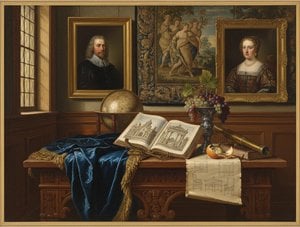
Johan de la Rocquette: A Dutch Portraitist of Refined Elegance
Johan de la Rocquette (1640 – 1694) represents a cornerstone of seventeenth-century Dutch art, specifically within the genre of portraiture. Born in Utrecht, Netherlands, his life unfolded during an era defined by intellectual curiosity and humanist ideals—forces that subtly permeated his artistic vision. Biographical details remain somewhat elusive compared to luminaries like Rembrandt or Vermeer, yet extant records portray him as a dedicated craftsman committed to portraying individuals with meticulous precision and understated grace. His art speaks volumes about the values of his time – observation, restraint, and an unwavering respect for human dignity.
Early Life & Training: The Influence of Gerrit Dou
Precise documentation concerning Rocquette’s formative years is regrettably sparse. However, he received invaluable artistic training under Gerrit Dou, a Leiden artist celebrated for his masterful manipulation of chiaroscuro—the dramatic interplay between light and shadow—a technique that would become inextricably linked to Rocquette's distinctive style. This mentorship instilled within him a profound understanding of anatomical accuracy and compositional balance; Dou’s influence extended far beyond mere technical skill, shaping Rocquette’s artistic sensibility as a whole. The Leiden School’s commitment to naturalism profoundly impacted his approach to portraying the human form.
Style & Technique: A Palette of Serenity
Rocquette's oeuvre distinguishes itself through a deliberately restrained palette—favoring muted tones and subtle gradations that cultivate an atmosphere of contemplative calm. Unlike the opulent grandeur championed by many Baroque artists, his canvases convey a palpable sense of quiet dignity and psychological depth. He skillfully harnessed chiaroscuro—inherited directly from Dou—to sculpt forms with light, emphasizing texture and conveying nuanced emotions through facial expressions and posture. Rocquette’s meticulous attention to detail ensured that every brushstroke conveyed not just likeness but also character – an ambition characteristic of the Leiden School's artistic ethos.
Notable Works: Exemplars of Leiden Portraiture
Rocquette’s legacy rests principally upon a select group of portraits that exemplify his stylistic prowess and solidify his place within Leiden portraiture history. “Portrait of Philippus Baldaeus and Gerrit Mossopotam,” completed in 1668, stands as an outstanding illustration of Rocquette's dedication to detail and masterful rendering of drapery—a hallmark of the period’s artistic conventions. The painting captures Baldaeus’s dignified countenance and Mossopotam’s contemplative gaze, bathed in soft light that illuminates their features with remarkable subtlety. This artwork exemplifies Rocquette’s ability to distill complex psychological states into visual form, reflecting the humanist values prevalent during his lifetime.
Influence & Legacy: Embracing Naturalism
Rocquette's artistic endeavors align closely with the Leiden School’s overarching aesthetic principles—a movement devoted to capturing reality with unflinching honesty and psychological insight. He contributed to a broader tradition of Dutch portraiture that prioritized portraying inner character alongside external appearance, mirroring the intellectual currents of his era. Though perhaps overshadowed by more celebrated contemporaries, Rocquette's paintings endure today due to their understated elegance and profound sensitivity to human emotion—a testament to his enduring artistic contribution.
Further Research: Ongoing scholarly investigations strive to illuminate Rocquette’s life and artistic output, bolstering our understanding of this significant figure within the Dutch Golden Age – a quest that promises to enrich our appreciation for his singular vision and lasting legacy.