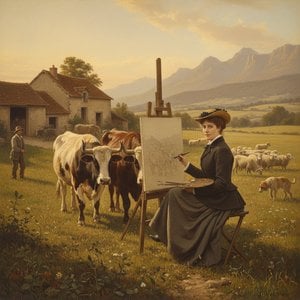
Jean-François Raffaëlli: Bridging Realism and Impressionism
Jean-François Raffaëlli (1850–1924) stands as a singular figure in the annals of French art, embodying a fascinating convergence between Realist principles and the burgeoning spirit of Impressionism. Born in Paris on April 20, 1850, to Tuscan parents—a lineage that would subtly shape his artistic sensibility—Raffaëlli embarked upon an artistic journey marked by both disciplined training and profound empathy for the everyday lives of ordinary people. His legacy resides not merely in his paintings but in his pioneering contribution to a stylistic dialogue that continues to resonate with artists today.
Early Life and Artistic Aspirations
Before dedicating himself wholly to painting, Raffaëlli explored diverse interests—music and theatre—demonstrating an early inclination towards creative expression beyond the visual arts. However, it was his innate aptitude for observation and representation that ultimately steered him toward a career in art. Following formative studies at the École des Beaux-Arts under Jean-Léon Gérôme, Raffaëlli’s initial encounter with Academic painting proved somewhat disillusioning; Gérôme's rigid formalism clashed with Raffaëlli’s burgeoning desire to capture the dynamism of modern life. Recognizing this divergence, he swiftly abandoned the École’s constraints and embarked upon a transformative European tour—a journey that would profoundly influence his artistic vision.
- This excursion exposed him to diverse cultural landscapes and artistic traditions, fostering an understanding of both classical grandeur and burgeoning urban realities.
- Crucially, it ignited his conviction that the most compelling subject matter lay not in idealized depictions but in honest portrayals of human experience—a stance that would define his subsequent artistic endeavors.
Artistic Style and Influences: The Birth of “Caractérisme”
Raffaëlli’s artistic style, dubbed “caractérisme,” represents a pivotal innovation within the Realist movement. Rejecting the conventions of Academic art—characterized by meticulous detail and idealized forms—he championed a method rooted in astute observation and psychological insight. Influenced by writers like Émile Zola and philosophers such as Hippolyte-Adolphe Taine, Raffaëlli sought to capture not merely appearances but the essence of human character within its social context. This approach distinguished him from many of his contemporaries who adhered to more conventional stylistic norms.
- His palette—often muted earth tones—served as a deliberate counterpoint to the vibrant hues favored by Impressionists, prioritizing tonal subtlety and conveying mood rather than visual spectacle.
- Furthermore, Raffaëlli’s technique—characterized by precise hatching and linear contours—reflected his unwavering commitment to realism, meticulously rendering textures and forms with remarkable accuracy.
Major Works and Recognition: Capturing Parisian Life
Raffaëlli's artistic output spanned a wide range of genres and subjects, yet several paintings stand out as particularly emblematic of his distinctive vision. Among these are *Les Déclassés* (1881), arguably his most celebrated masterpiece—a stark depiction of social alienation that garnered critical acclaim and cemented Raffaëlli’s reputation as a champion of marginalized voices. The painting's unsettling realism and psychological depth captivated audiences and established Raffaëlli as a pioneer in portraying the complexities of urban life.
- Other notable works include *At the Caster’s* (1886), offering an intimate glimpse into the daily routines of Parisian artisans, and *The Little Donkeys* (1906)—a poignant portrayal of rural poverty that underscored Raffaëlli's unwavering empathy for humanity.
- His artistic achievements were recognized by prominent figures within the art world—including Degas and Huysmans—who championed his stylistic innovation and validated his commitment to portraying the human condition with unflinching honesty.
Raffaëlli’s enduring legacy lies in his ability to synthesize Realist principles with Impressionistic techniques, forging a unique artistic voice that continues to inspire artists today.