The Spirit of a Glasgow Boy
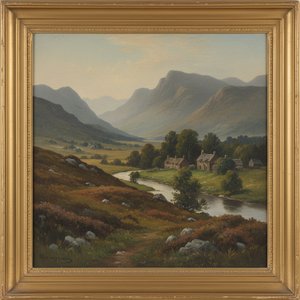
James Elder Christie emerged from the rugged landscapes of Stirling, Scotland, into a world caught between the soot of industrial progress and the lingering whispers of Romanticism. As a vital member of the celebrated Glasgow Boys collective, his life and work served as a bridge between these two eras. His formative years at the Paisley Art School provided him with a rigorous foundation in classical tradition, yet it was his ability to infuse this training with the burgeoning spirit of Symbolism that truly defined his legacy. Alongside contemporaries like John Atkinson Grimshaw and Angus McLaren, Christie sought to move beyond mere imitation, striving instead to capture the psychological and atmospheric essence of the Scottish experience through a lens of meticulous realism.A Tapestry of Light and Legend
The brilliance of Christie’s oeuvre lies in his masterful command of chiaroscuro and his ability to weave narrative into the very fabric of his compositions. He possessed a rare talent for transforming the mundane into the magical, a skill most evident in his genre paintings inspired by the poetic soul of Robert Burns. In works such as “Tam o’ Shanter,” Christie employs dramatic shifts between light and shadow to evoke the haunting, supernatural energy of the legendary ballad. This same vibrancy pulses through “Halloween Frolics,” where a festive gathering in the woods is brought to life through striking reds, yellows, and deep forest greens. Through his expressive brushwork, the artist does not merely depict a scene; he invites the viewer into a moment of pure, unadulterated revelry, where lanterns and balloons dance against the encroaching night.The Intimacy of the Human Portrait
Beyond the grand narratives and festive scenes, Christie was a profound observer of the human condition, particularly through his sensitive portraiture. He held a special affinity for capturing the innocence of childhood and the quiet dignity of his subjects. In “G. Whiting,” painted in 1888, one finds an exquisite example of his ability to convey character through rich, muted tones and a sense of deep intimacy. His portraits are never static; they are studies in psychological depth, whether portraying the nuanced family dynamics of “Vanity Fair” or the contemplative stillness of a single figure. By blending meticulous realism with an allegorical touch, Christie ensured that his subjects remained timeless, standing as enduring symbols of the Victorian era's complex and shifting emotional landscape.Spørsmål og svar
Hvor er James Elder Christie sine kunstverk gruppert etter teknikk?
James Elder Christie sine verk kan bla gjennom etter medium på James Elder Christie sin Alle medier-side.
Kan jeg utforske James Elder Christie sine verk etter fargespekter?
James Elder Christie sine verk kan utforskes etter farge på kunstnerens Spektralindeks-side.
Hvor populære er kunstverkene til James Elder Christie?
Siden Statistikk for James Elder Christie presenterer statistikk beregnet ut fra kunstverkene til kunstneren som er oppført på denne nettsiden.