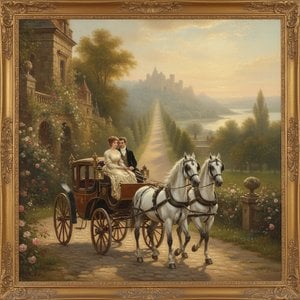
James Alfred Aitken (1846–1897): Echoes of Romanticism and the Bold Strokes of Glasgow
James Alfred Aitken emerged as a significant figure in Scottish landscape painting during the latter half of the 19th century, inheriting the legacy of Romantic idealism while forging his own distinctive artistic voice within the burgeoning Glasgow School. Born in Edinburgh in 1846, Aitken’s early exposure to art instilled a lifelong passion for capturing the sublime beauty of Scotland's highlands and coastal regions—a fascination that would define his entire artistic career.
Early Training & Influences: Aitken began his artistic education at Glasgow School of Art under Horatio McCulloch, arguably Scotland’s most influential landscape painter of the time. McCulloch championed a Romantic aesthetic prioritizing emotional intensity and expressive brushwork; this profound influence shaped Aitken's approach to composition and color palettes from the outset. McCulloch recognized Aitken’s talent for conveying atmosphere and emotion—a skill that would become central to Aitken’s artistic style.
Dublin Years & Artistic Exploration: Following his marriage to Anne Miller in 1872, Aitken relocated to Dublin where he pursued further studies at the Royal Hibernian Academy alongside Henry MacManus. This period proved crucial for Aitken's artistic development, fostering experimentation with color theory and compositional techniques—preparing him for his eventual return to Glasgow and cementing his commitment to the Glasgow School’s distinctive visual language. He actively sought inspiration from diverse sources, broadening his artistic horizons beyond purely Scottish landscapes.
Glasgow & The Glasgow School: Aitken established himself as a respected artist in Glasgow, becoming a founding member of the Glasgow “Pen and Pencil Club” and exhibiting prolifically at both the Royal Academy and Glasgow Institute of Fine Arts. Embracing McCulloch’s bold color palettes and loose brushstrokes—a hallmark of the Glasgow School—Aitken produced paintings that resonated deeply with viewers, conveying palpable emotion and capturing the grandeur of Scotland's wilderness. His work stood as a testament to the movement’s ambition to elevate landscape painting beyond mere representation, striving instead for psychological insight and aesthetic delight.
Notable Works & Artistic Style: Aitken’s artistic style is characterized by a remarkable blend of Romantic grandeur and Impressionistic vibrancy—a synthesis that distinguishes him from many of his contemporaries. His canvases depict iconic Scottish landscapes with meticulous detail, yet infused with an expressive dynamism reminiscent of Frederic Edwin Church's *Niagara Falls*. Notably, he created a scaled-down homage to Church’s monumental masterpiece, demonstrating both technical mastery and artistic sensitivity. Aitken’s paintings are celebrated for their luminous color palettes and masterful brushwork—techniques that capture the essence of Scottish light and atmosphere with breathtaking accuracy.
Legacy & Recognition: Aitken's contribution to Scottish art is commemorated by the National Gallery of Ireland, where his painting *Niagara Falls* resides as a poignant reminder of his artistic vision and enduring influence on subsequent generations of landscape painters—a testament to his unwavering dedication to capturing the sublime beauty of Scotland’s natural world. His legacy continues to inspire admiration for its emotive power and technical brilliance, securing Aitken's place among Scotland’s most revered artists.