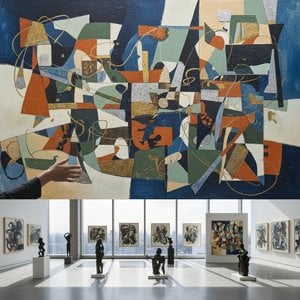
Graciela Hasper: A Bold Exploration of Geometric Abstraction
Graciela Hasper, born in Buenos Aires, Argentina, in 1966, stands as a prominent figure in contemporary Argentine painting. Her artistic journey began with formal studies at Diana Eisenberg’s workshop from 1988 to 1991 and continued with participation in Guillermo Kuitca’s prestigious residency program for young Argentinian artists in the same year. Hasper's distinctive style emerged from a fascination with geometric abstraction, drawing inspiration from both early twentieth-century European Modernism –particularly Mondrian and Malevich– and the burgeoning movement of abstraction within Argentina during the turbulent years following the military dictatorship. This lineage profoundly shaped her artistic vision, propelling her to create compositions characterized by meticulous color palettes, dynamic orthogonal lines, and precise contours.
- Early Influences: Hasper’s formative years were marked by exposure to influential artists like Diana Eisenberg, who instilled in her a deep appreciation for conceptual art and experimental techniques.
- Kuitca Residency Program: The Kuitca residency program provided invaluable opportunities for Hasper to engage with fellow artists and explore innovative approaches to artistic expression.
- The Rojas Group: Her involvement in the Rojas Group solidified her position within Argentina’s vibrant art scene, fostering collaboration and shaping her aesthetic sensibilities.
Hasper's breakthrough came with her debut exhibition at the Rojas Gallery in Buenos Aires in 1992, coinciding with a period of significant sociopolitical transformation in Argentina. Notably, she was one of the sole female members of the Rojas Group—a collective recognized for its pioneering exploration of abstraction and its commitment to challenging conventional artistic norms. The group’s ethos championed experimentation and dialogue, mirroring Hasper's own dedication to pushing boundaries within her creative practice.
- Crimen y Ornamento Exhibition: Her participation in *Crimen y Ornamento* (Crime and Ornament), curated by Jorge Gumier Maier, Nicolás Guiagnini, and Pablo Siquier, cemented her reputation as a leading voice in Argentine abstraction.
- Recognition of Female Artists: Hasper’s inclusion in this landmark exhibition underscored the importance of acknowledging female artists' contributions to artistic discourse and innovation.
Throughout her career, Hasper has consistently pursued ambitious projects that explore spatial relationships and engage viewers on a visceral level. Her installations—particularly *Intemperie* (Weather)—represent a significant departure from traditional painting, transforming architectural spaces into immersive environments where color and light converge to create captivating sensory experiences. This commitment to site-specific art reflects Hasper’s belief in the transformative power of artistic intervention and her desire to expand the possibilities of visual expression.
- Fulbright Scholarship: Hasper's Fulbright scholarship enabled her to reside at Apex Art in New York, fostering connections with international artists and broadening her artistic horizons.
- Chinati Foundation Residency: Her subsequent residency at the Chinati Foundation in Marfa, Texas, provided further impetus for experimentation and reflection on art history’s legacy.
Hasper's work has garnered critical acclaim and secured its place within prominent collections worldwide—including Banco Ciudad de Buenos Aires, Deutsche Bank, Faena Collection, Museo Arte Latinoamericano de Buenos Aires, Museo Castagnino de Rosario, Museo Nacional de Bellas Artes, The Museum of Fine Arts, Houston, Philadelphia Museum of Art, and Telefonica Argentina. Her enduring influence extends beyond the realm of art history, serving as an inspiration for younger generations of artists striving to forge new paths in abstraction and visual storytelling. Graciela Hasper continues to be recognized as one of Argentina’s most important contemporary painters, cementing her legacy as a visionary artist who champions bold experimentation and profound engagement with the complexities of human experience.