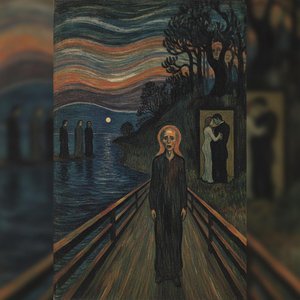
A Life Bathed in Blue: The Enigmatic World of Eugène Jansson
Eugène Fredrik Jansson, born in Stockholm in 1862, was a Swedish painter whose work occupies a unique and haunting space within the landscape of late 19th and early 20th-century art. He wasn’t merely documenting his surroundings; he was translating an internal emotional state onto canvas, one steeped in melancholy, longing, and a profound sensitivity to light and atmosphere. Jansson's life, marked by chronic illness and a quiet introspection, profoundly shaped his artistic vision, leading him to become known as “Blåmålaren” – the Blue Painter – for his evocative nocturnal scenes of Stockholm. His story is not one of flamboyant social circles or dramatic breakthroughs, but rather a slow, deliberate exploration of color, form, and the human condition, culminating in a body of work that continues to resonate with its quiet power.Early Years and Artistic Formation
Jansson’s upbringing was relatively modest, his parents striving for cultural enrichment despite their position between the working class and lower middle class. This instilled in him an early appreciation for both art and music – he received piano lessons as a child. However, at fourteen, scarlet fever struck, leaving him with lasting health problems: impaired eyesight, hearing difficulties, and chronic kidney issues. These physical limitations undoubtedly contributed to his withdrawal from the bustling world and fostered a more internal focus. He initially studied at the Tekniska Skolan (now Konstfack) under Edvard Perséus, a portrait painter who provided foundational training. While accepted into the Royal Swedish Academy of Arts’ antique school in 1881, financial constraints prevented him from joining his peers in Paris, then the epicenter of artistic innovation. This meant Stockholm itself became his primary subject matter, and he remained largely within its confines for much of his career. His early works reflect this – assisting Perséus with portraits and experimenting with still lifes before discovering his signature style.The Nocturnes: Painting the Soul of a City
It was in the 1890s that Jansson truly found his voice, embarking on a series of night scenes that would define his reputation. These weren’t simply depictions of Stockholm at night; they were explorations of mood and emotion rendered through an almost monochromatic palette dominated by shades of blue. He painted views over Riddarfjärden bay, as seen from his home on Södermalm, and streetscapes imbued with a sense of stillness and solitude. The brushstrokes are visible, expressive, contributing to the overall feeling of atmospheric haze and dreamlike quality. These paintings weren’t about precise representation; they were about capturing the *feeling* of being in Stockholm at night – the quiet hum of the city, the play of light on water, the sense of isolation amidst urban life. The influence of Impressionism is present, but Jansson pushed beyond its focus on fleeting moments of light to create something more deeply psychological. He wasn’t merely observing; he was internalizing and re-presenting his emotional response to the city around him.A Shift in Focus: The Male Nudes
Around 1904, Jansson's artistic focus underwent a significant transformation. While continuing to paint nocturnes, he began to create a series of male nudes, often depicted in intimate settings or with symbolic objects. These paintings are remarkable for their frankness and sensitivity, challenging the conventions of the time. They weren’t overtly erotic but rather explorations of beauty, vulnerability, and the human form. The exact reasons behind this shift remain debated, but it's likely a combination of personal exploration and a growing interest in symbolism and psychological themes. These nudes were often painted in private, away from public scrutiny, reflecting a deeply personal artistic endeavor. They are characterized by soft lighting, delicate modeling, and an overall sense of quiet contemplation.Legacy and Historical Significance
Eugène Jansson died in 1915, leaving behind a relatively small but profoundly impactful body of work. He didn’t achieve widespread recognition during his lifetime, remaining somewhat outside the mainstream art world. However, his paintings have gained increasing appreciation in recent decades, recognized for their unique aesthetic and psychological depth.- He is now considered a precursor to Expressionism
- His work anticipates the Symbolist movement’s exploration of inner states.
- Jansson's sensitive portrayal of male figures challenged societal norms.
Spørsmål og svar
I hvilken historisk periode arbeidet Eugene Jansson?
Eugene Jansson var virksom i perioden 19th Century. Denne perioden plasserer kunstnerens virke i en historisk kontekst.
Hvilken by og hvilket land er Eugene Jansson født i?
Eugene Jansson ble født i Jakob and Johannes parish i Sweden.
Kan jeg bla gjennom Eugene Jansson sine verk etter medium?
Eugene Jansson sine verk kan utforskes etter medium på Eugene Jansson sin Alle medier-side.