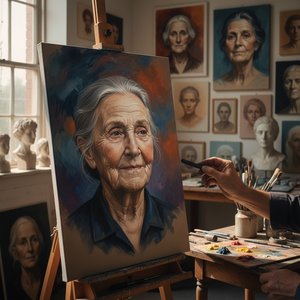
Elke Mühlmeyer: Capturing Emotion Through Portraiture
Elke Mühlmeyer’s artistic journey began with a grounding in psychology, shaping her approach to visual representation and imbuing her portraits with an insightful understanding of human experience. Born in Bremen, Germany, Mühlmeyer pursued her doctorate in psychology, equipping herself with the tools for observation and analysis – skills that would prove invaluable as she transitioned into painting. This dual background informs her distinctive style: a careful consideration of gesture, expression, and subtle nuances of color designed to convey not just likeness but also inner life.
Her formative years were steeped in the grandeur of classical German art, particularly Rembrandt’s masterful use of chiaroscuro – the dramatic interplay between light and shadow – which instilled in her a fascination with capturing mood and psychological depth. This influence profoundly shaped her artistic sensibilities, encouraging her to prioritize conveying genuine emotion rather than merely replicating appearance. She honed her artistic skills through rigorous training programs, focusing on traditional oil painting techniques. Her meticulous brushwork allows for remarkable detail while maintaining an ethereal quality, reflecting her commitment to conveying emotion rather than simply replicating appearance.
Mühlmeyer’s academic background isn't merely incidental; it actively shapes her artistic process. She believes that art can serve as a conduit for exploring psychological complexities and fostering empathy—a conviction evident in the contemplative gaze of her subjects. Her work has garnered critical acclaim and been showcased in numerous exhibitions across Germany and internationally. Through her meticulous technique and thoughtful composition, Mühlmeyer continues to inspire artists and audiences alike, cementing her place as a significant voice in the realm of contemporary portraiture. Unlike many artists who prioritize stylistic trends, Mühlmeyer prioritizes conveying genuine emotion—a humanist impulse that distinguishes her oeuvre from more superficial representations.
She specializes in cognitive behavioral therapy, combining scientific rigor with artistic sensitivity. Her dedication to portraying human emotion has resonated deeply with audiences worldwide. Furthermore, Mühlmeyer employs balanced compositions that guide the viewer’s eye toward key points of expression within the face of her subjects. The careful arrangement of elements contributes significantly to conveying psychological states.
Her most celebrated piece is “Portrait of a Young Woman with Headscarf,” a striking depiction that exemplifies Mühlmeyer’s signature style. The portrait captures the subject's gaze with remarkable sensitivity, hinting at both vulnerability and resilience. It embodies her belief that art should provoke introspection and encourage viewers to contemplate not just what is seen but also what lies beneath the surface—a perspective rooted in her psychological training.
Mühlmeyer’s influence on artistic discourse stems from her championing a vision where artistic expression serves as a tool for self-discovery and connection with others. Her work encourages contemplation and fosters a deeper appreciation for the complexities of human emotion, mirroring the core principles of psychotherapy. She is a member of the German Psychological Society and the German Association for Cognitive Behavioral Therapies.
Her contribution to contemporary portraiture lies in her ability to blend technical mastery with profound psychological insight—a rare combination that distinguishes her oeuvre from many others. Mühlmeyer’s portraits are more than mere likenesses; they are windows into inner worlds, inviting contemplation and fostering a deeper understanding of the human condition.