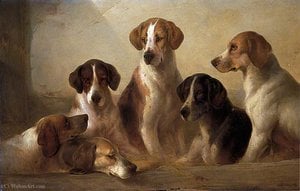
A Quiet Observer of Rural England: The Life and Art of Edward Robert Smythe
Edward Robert Smythe, a name perhaps less celebrated than his Victorian contemporaries, nevertheless occupies a significant niche in the pantheon of British landscape painters. Born in 1810, Smythe dedicated his life to capturing the idyllic beauty – and often, the harsh realities – of rural England during a period of immense social and agricultural change. His paintings offer a poignant glimpse into a world rapidly disappearing under the wheels of industrialization, a testament to the lives of those who tilled the land and formed the backbone of British society. While not formally trained in the grand academic tradition, Smythe’s keen eye for detail and his ability to evoke atmosphere quickly established him as a popular artist amongst collectors seeking authentic depictions of country life. His early years remain somewhat shrouded in mystery; however, it is known he came from a family with connections to the landed gentry, affording him access to rural estates and subjects that would dominate his oeuvre. This privileged position allowed him to observe and document scenes without the constraints often imposed upon artists reliant on commissions alone.
The Development of a Distinctive Style
Smythe’s artistic journey wasn't marked by dramatic stylistic shifts but rather a gradual refinement of his observational skills and painting technique. Initially, his works exhibited a clear influence from the Barbizon school, particularly in their emphasis on natural light and plein air painting – though Smythe rarely worked directly *en plein air*, preferring to sketch extensively outdoors before completing his canvases in the studio. He absorbed the Barbizonians’ commitment to realism but infused it with a distinctly English sensibility. His palette, while grounded in earthy tones, possessed a subtle luminosity that distinguished his work from the often darker hues of continental landscapes.
Technical Approach: Extensive sketching from nature followed by studio work; oil on canvas was his primary medium.
Over time, Smythe moved away from purely topographical representations, focusing instead on narrative scenes that highlighted the daily lives of agricultural workers. He wasn’t interested in romanticizing poverty or idealizing rural existence; rather, he presented a balanced view, acknowledging both the beauty and hardship inherent in country life. His compositions often feature carefully arranged figures engaged in everyday tasks – harvesting crops, tending livestock, or simply resting after a long day's work – creating scenes that feel simultaneously intimate and universal.
Subjects and Symbolism: A Portrait of Victorian Rural Life
The core subject matter of Smythe’s paintings revolved around the lives of peasants and laborers. He depicted them with dignity and respect, avoiding caricature or sentimentality. His canvases are populated by figures engaged in a variety of agricultural activities, offering a comprehensive portrait of rural life during the Victorian era. However, beneath the surface realism lies a subtle layer of symbolism.
The Harvest Moon, for example, isn’t merely a depiction of a bountiful yield; it also alludes to the cyclical nature of life and the importance of community in ensuring survival. Similarly, scenes featuring families gathered around a hearth often represent themes of domesticity, resilience, and the enduring power of tradition. Smythe's attention to detail – the worn clothing of his subjects, the tools they wielded, the architecture of their dwellings – served not only as an exercise in realism but also as a form of social commentary, subtly highlighting the challenges faced by those who lived off the land. He often included animals—horses, cattle, sheep—not just as elements of the landscape but as integral parts of the rural economy and way of life.
Legacy and Historical Significance
While Smythe never achieved the widespread fame of artists like Constable or Turner, his work remains highly valued by collectors and art historians for its authentic depiction of Victorian rural life. His paintings provide a valuable historical record of a period undergoing rapid transformation, offering insights into the social, economic, and cultural dynamics of 19th-century England. He stands as a quiet observer, meticulously documenting a world on the cusp of change.
Major Achievements: Smythe’s legacy lies in his ability to capture the essence of rural life with remarkable realism and sensitivity. His paintings are now held in numerous public and private collections across the United Kingdom and beyond, serving as enduring reminders of a bygone era. He successfully bridged the gap between topographical painting and narrative scene-making, creating works that are both visually appealing and historically informative. Although often overlooked, Edward Robert Smythe’s contribution to British art is significant, offering a poignant and compelling glimpse into the heart of Victorian England. His work continues to resonate with audiences today, reminding us of the enduring beauty – and fragility – of rural life.
Finnes det en virtuell 3D-omvisning av Edward Robert Smythe sine verk?
Edward Robert Smythe sine kunstverk kan oppleves i et 3D-galleri på artistens side Virtuelt 3D-galleri.
Finnes det en oversikt over alle motivene Edward Robert Smythe malte?
Utforsk Edward Robert Smythe sine verk etter motiv på kunstnerens Motivatlas-side.
Hvor mange kunstverk av Edward Robert Smythe er tilgjengelige å bla gjennom?
Du kan bla gjennom 21 kunstverk verk av Edward Robert Smythe på siden Alle kunstverk.
Hvor finner jeg Edward Robert Smythe sine kunstverk gruppert etter fargepalett?
For å finne verk av Edward Robert Smythe i en bestemt fargepalett, bruk kunstnerens Etter fargepalett-side.
Hvordan er Edward Robert Smythe sin karriere delt inn i perioder?
En kronologisk oversikt over Edward Robert Smythe sitt arbeid er tilgjengelig på kunstnerens Karriereløp-side, hvor verkene presenteres i rekkefølge etter når de ble skapt, kapittel for kapittel.
Hvor kan jeg finne statistikk om verkene til Edward Robert Smythe?
Siden Besøksstatistikk for Edward Robert Smythe presenterer statistikk beregnet ut fra kunstverkene til kunstneren som er oppført på denne nettsiden.
Hvor kan jeg se alle kunstverk av Edward Robert Smythe?
Utforsk alle verk av Edward Robert Smythe på denne nettsiden via kunstnerens Alle kunstverk-side.
Hvilke farger brukte Edward Robert Smythe oftest?
Edward Robert Smythe sin fargebruk i verkene oppført på denne nettsiden kan studeres på kunstnerens Fargepalettens sjel-side.