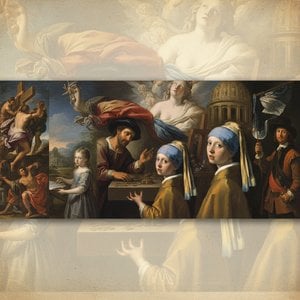
A Life Illuminated: The Artistic Journey of Edward Penny
Born in the picturesque Cheshire countryside in 1714, Edward Penny emerged as a significant figure in the evolving landscape of British art during the 18th century. His life story is one woven with threads of privilege, rigorous training, and dedicated service to the burgeoning artistic institutions of his time. The son of Robert Penny, surgeon—a profession that demanded both scientific precision and an understanding of human form—and connected to landed gentry, Penny benefited from opportunities for education and cultural exposure uncommon for many aspiring artists. This foundation allowed him to pursue his innate talent, leading him initially to London as an apprentice under the esteemed portraitist Thomas Hudson. Hudson’s tutelage instilled in Penny a mastery of foundational skills – drawing, composition, and painting techniques – that would serve as the bedrock of his artistic endeavors. He was sent to London and placed under the tuition of Thomas Hudson; later he went to Rome and studied under Marco Benefiale. This period proved transformative, exposing him to the grandeur of Renaissance art and profoundly influencing his aesthetic sensibilities.Early Training and Artistic Influences
Hudson’s influence extended far beyond mere technical instruction. He instilled in Penny a deep appreciation for classical ideals—particularly those embodied in Roman sculpture—which would permeate Penny's artistic vision throughout his career. Observing the meticulous detail and expressive dynamism of sculptures by Bernini and Michelangelo, Penny internalized principles of anatomical accuracy and dramatic staging that would become hallmarks of his style. Furthermore, Hudson’s insistence on portraying subjects with psychological depth encouraged Penny to delve beyond mere likeness, striving instead to capture the essence of character and emotion. These formative experiences shaped Penny's artistic sensibilities and established him firmly within the Baroque tradition—a movement characterized by opulent ornamentation, theatrical lighting, and a fervent embrace of emotional intensity.Rome and Renaissance Inspiration
Penny’s travels to Rome around 1748 represented a pivotal moment in his artistic development. He immersed himself in the vibrant cultural milieu of the city, absorbing the lessons of Marco Benefiale—a fellow artist who championed humanist ideals and celebrated the beauty of classical art. Benefiale's teachings reinforced Penny’s conviction that art should serve as a vehicle for moral contemplation and intellectual enrichment. The sheer scale and grandeur of Roman monuments—the Colosseum, the Pantheon—provided Penny with an unparalleled stimulus for imagination and compositional ambition. He meticulously studied the techniques employed by Renaissance masters like Raphael and Titian, absorbing their mastery of color harmony and perspective—skills that would inform his own artistic practice.London Career: Portraiture and Historical Narrative
Upon returning to England around 1748, Penny established himself as a professional painter, initially focusing on smaller portrait formats before gradually tackling more ambitious historical subjects. He quickly gained recognition for his skill in rendering likenesses, establishing a solid reputation within London's artistic circles. A discerning eye for capturing subtle nuances of expression and gesture—combined with an unwavering commitment to anatomical accuracy—distinguished Penny’s portraits from those produced by many of his contemporaries. His commissions spanned across social strata, reflecting the diverse interests of the British aristocracy and gentry. However, Penny’s ambition extended beyond mere portraiture; he sought to engage in broader artistic endeavors that explored themes of heroism, morality, and human experience.Notable Achievements and Artistic Legacy
Penny's most celebrated works include The Death of General Wolfe (1764)—a monumental depiction of the decisive British victory at Quebec—which garnered widespread acclaim and was widely disseminated through engravings by Richard Houston. This painting exemplifies Penny’s ability to portray dramatic historical events with both emotional intensity and technical skill, demonstrating his mastery of chiaroscuro—the skillful manipulation of light and shadow—to heighten visual drama. Equally compelling is A City Shower (1764), inspired by Jonathan Swift's satirical poem. Here, Penny demonstrates his keen observation of everyday life and urban landscapes, capturing the chaotic energy of a sudden downpour in London with remarkable detail. He skillfully employed atmospheric perspective—creating depth and realism through subtle gradations of color—to convey the mood and ambiance of the scene. Furthermore, Penny’s engagement with literary subjects—particularly Shakespeare—produced masterpieces like Imogen Discovered in the Cave (1770)—a dramatic illustration from *Cymbeline* that showcases his artistic virtuosity and intellectual curiosity. His legacy resides not only in his impressive oeuvre but also in his role as a founding member of the Royal Academy of Arts, where he championed formal training and national recognition for artists—establishing a cornerstone for British art history.Spørsmål og svar
Hvordan utviklet kunsten til Edward Penny seg over tid?
Kronologi til Edward Penny er en rullebar tidslinje som presenterer kunstnerens verk i kronologisk rekkefølge, gruppert i kapitler etter ulike perioder i karrieren.
I hvilken historisk periode arbeidet Edward Penny?
Edward Penny arbeidet i perioden Tidlig moderne tid. Perioden plasserer kunstnerens virke i historien.
Kan jeg bla gjennom Edward Penny sine verk etter stemning?
Stemningsrom til Edward Penny er en side som organiserer kunstnerens verk etter stemning.