The Luminous Legacy of Carlo Innocenzo Carlone
In the grand tapestry of the eighteenth century, few artists possessed the ability to dissolve the boundaries between heaven and earth as masterfully as Carlo Innocenzo Carlone. Born in 1686 in the serene village of Scaria, nestled within the Lombardy region of Italy, Carlone was destined for a life steeped in the visual arts. As the son of the renowned sculptor and architect Giovanni Battista Carlone, his early years were permeated by an understanding of form, structure, and the architectural grandeur that would later serve as the stage for his most breathtaking achievements. While his lineage suggested a path toward sculpture, Carlone found his true calling in the fluid, emotive world of painting, a choice that would eventually allow him to decorate the most prestigious halls of Europe with light and motion.
Carlone’s artistic journey was shaped by a profound synthesis of regional traditions. His formative training under masters such as Giulio Quaglio and Giovanni Battista Colomba provided him with a rigorous technical foundation, yet it was his time in Venice that truly ignited his creative spirit. Immersed in the Venetian school, he absorbed the essence of luminosity and chromatic brilliance. From this influence, he adopted a palette capable of capturing the shimmering quality of light and a sense of chiaroscuro that lent depth and drama to his figures. This Venetian flair, characterized by an emphasis on idealized beauty and sweeping, dynamic compositions, became the hallmark of his mature style, allowing him to breathe life into both religious allegories and mythological tales.
A Master of Architectural Illusion and Imperial Splendor
As his reputation grew, Carlone’s ambitions led him far beyond the borders of Italy, toward the burgeoning courts of Germany and Austria. He became a pivotal figure in the development of the Baroque aesthetic in Central Europe, recognized not merely as a painter of canvases, but as a visionary decorator of spaces. His arrival in regions such as Ludwigsburg and Vienna marked the beginning of an era where painting and architecture merged into a single, cohesive experience. Working alongside architects like Marcantonio Chiarini, Carlone mastered the art of quadratura—the technique of using perspective to create the illusion of infinite space on flat surfaces.
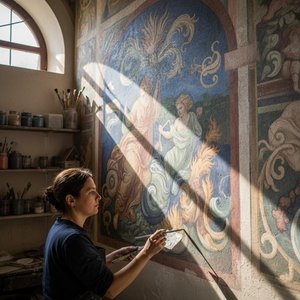
The zenith of his career is perhaps most vividly realized in the magnificent frescoes of the Belvedere Palace and Schönbrunn Palace in Vienna. In these sacred and imperial settings, Carlone’s work transformed ceilings into windows to the divine. His depictions of Apollo and Helios are not merely paintings; they are celestial events captured in pigment. Through a breathtaking interplay of light, color, and movement, he guided the viewer's gaze upward, creating a sense of awe that mirrored the power and prestige of the Habsburg court. His ability to integrate figures seamlessly into architectural frameworks ensured that his art was never an ornament added to a room, but rather the very soul of the architecture itself.
Artistic Significance and Enduring Influence
The historical significance of Carlo Innocenzo Carlone lies in his role as a bridge between the dramatic intensity of the Italian Baroque and the more refined, airy elegance of the late Baroque and early Rococo periods. His works, ranging from intimate pen and ink drawings to monumental altarpieces like San Carlo Borromeo Giving Last Communion to Victims of the Plague, demonstrate a versatility that commanded respect across different media. Even in his smaller-scale studies, such as those depicting The Marriage of Hercules and Hebe, one can observe the same rhythmic energy and emotional depth that defined his grandest frescoes.
Throughout his prolific career, which spanned several decades of European political and cultural shifts, Carlone remained a steadfast practitioner of beauty. His legacy is preserved not only in the permanent collections of institutions like the National Gallery of Art and the National Gallery of Victoria but also in the very stones of the palaces he adorned. He left behind an artistic blueprint for how color and light can be used to manipulate perception, ensuring that his name remains synonymous with the splendor of the age of emperors. His life, which concluded in his beloved Scaria in 1775, stands as a testament to the power of an artist to transcend geographical boundaries and create a universal language of wonder.