A Soldier’s Eye: The Life and Art of Cándido López
Cándido López, born in Buenos Aires in 1840, occupies a unique position within the landscape of Argentine art—a space forged not only by artistic talent but also by direct experience with one of South America's most brutal conflicts: the Paraguayan War. His life was a compelling blend of dedication to his craft and unwavering service to his nation, a duality that profoundly shaped his artistic vision. Initially drawn to the burgeoning field of photography, López apprenticed under Carlos Descalzo, honing an eye for composition and detail crucial to the daguerreotype process. This early training instilled in him a meticulous approach, prompting him to sketch as an aid—a practice that ultimately ignited his passion for painting. Between 1859 and 1863, he traversed the expansive landscapes of Buenos Aires province and Santa Fe, documenting the land through both photography and sketches, establishing a studio in Mercedes and gaining recognition with a commission to paint President Bartolomé Mitre’s portrait. These formative years were also marked by the influence of Italian muralist Ignacio Manzoni and painter Baldassare Verazzi, who guided him in color theory and perspective—foundations upon which his distinctive style would later blossom.
From Battlefield to Canvas: Witnessing War
The outbreak of the Paraguayan War in 1864 irrevocably altered López’s trajectory. Enlisting as a second lieutenant, he found himself immersed in the harsh realities of combat with the San Nicolás Infantry battalion. Yet, rather than abandoning his artistic pursuits, López ingeniously continued to create. Between battles, he sketched and painted scenes from military camps and landscapes, sending these works back to Buenos Aires where they quickly gained popularity, offering a glimpse into the war’s unfolding drama for those on the home front. He participated in pivotal engagements like Estero Bellaco and Boquerón, bearing witness to the conflict's intensity firsthand. Tragedy struck during the Battle of Curupayty when a grenade explosion shattered his right wrist, necessitating amputation above the elbow to prevent gangrene. This devastating injury might have silenced many artists, but López’s spirit remained unbroken. Returning to San Nicolás as an invalid, he remarkably began painting again—with his left hand.
A Unique Visual Language: Style and Innovation
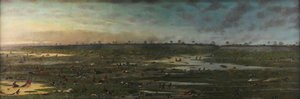
Following his recovery, López dedicated himself entirely to depicting the Paraguayan War, creating a body of work that stands apart for its distinctive characteristics. His paintings are immediately recognizable by their elongated horizontal format – often 40 x 120 cm or 48.5 x 152 cm – allowing him to represent multiple actions and expansive landscapes within a single canvas. This unconventional aspect, combined with his meticulous attention to detail, creates an immersive experience for the viewer. His style is frequently categorized as Naïve Art, demonstrating a directness and unpretentiousness in its approach to subject matter. Initially employing a triangular perspective close to the ground, he later shifted to elevated viewpoints that emphasized depth and showcased the vastness of the Argentine pampas. What truly sets López apart, however, is his remarkable neutrality. His war paintings avoid overt displays of emotion or suffering; instead, they present a detached, almost postcard-like view of the conflict, depicting soldiers as small figures within serene natural settings. This unusual perspective and detailed depiction of both military events and the surrounding environment define his artistic signature.
Legacy and Remembrance
In his later years, López moved between San Antonio de Areco, Merlo, and finally settled in Carmen de Areco, continuing to paint while facing financial hardship. Despite critical acclaim, consistent economic stability eluded him. A request for assistance to former President Mitre in 1885 resulted in a subsidy in exchange for a series of paintings documenting the war—a commission he diligently pursued between 1888 and 1902. He aimed to create ninety canvases but completed fifty-eight before his death in 1902, receiving a military burial with honors in La Recoleta Cemetery. Cándido López’s legacy rests on his singular perspective of the Paraguayan War—a fusion of artistic talent, military experience, and an unwavering commitment to documenting a pivotal moment in Argentine history. His paintings offer a valuable visual record of the conflict, characterized by their distinctive style, remarkable neutrality, and enduring power to transport viewers to a bygone era. His work remains a testament to the resilience of the human spirit and the transformative power of art.