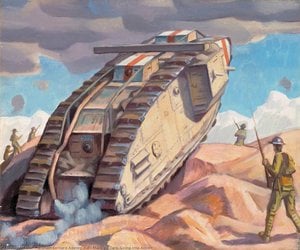
William Bernard Adeney: Pioneer of Tank Art and Landscape Impressionism
William Bernard Adeney (August 2, 1878 – April 4, 1966) stands as a pivotal figure in British art history, particularly recognized for his groundbreaking contributions to the depiction of military landscapes during World War I and his masterful exploration of tonal color palettes characteristic of Impressionism. Born in London, Adeney’s artistic journey began early, nurtured by a privileged upbringing that afforded him access to exceptional training—a formative experience at St. John's Wood School and subsequent studies at the Royal Academy Schools cemented his foundation as a painter. His fascination with capturing the immediacy of observation propelled him toward Paris and Central School for Art and Craft where he honed his skills in textile design alongside fellow artist Noel Gilford Adeney, marking the genesis of their enduring partnership both personally and professionally.
Adeney’s artistic sensibilities were profoundly shaped by Impressionist luminaries like Claude Monet and Pierre-Auguste Renoir, whose emphasis on capturing fleeting moments of light and color resonated deeply within him. This influence is palpable in his landscapes—particularly “Tunley Bottom”—where he eschews meticulous detail for a luminous tonal range that conveys atmosphere and emotion with remarkable sensitivity. He believed passionately in the importance of direct observation as the cornerstone of artistic creation, a conviction reflected throughout his oeuvre and documented in his autobiography "Flute," published by Brimstone Press. This poignant chronicle recounts Adeney's formative years, his artistic pursuits, and his profound connection with fellow musician Malcolm Arnold—a testament to the enduring bonds forged between artists and their creative collaborators.
Adeney’s artistic career gained international renown during World War I when he was commissioned by the British Tank Corps to document the deployment of armored vehicles. His iconic painting “The Experimental Depot for Tanks, Dollis Hill” exemplifies this period—a bold undertaking that fused technical precision with expressive brushwork. The canvas captures the scale and dynamism of the depot, conveying not merely visual information but also a palpable sense of industrial progress and military preparedness. He meticulously rendered the textures and colors of the armored vehicles, striving to convey both their functional purpose and their imposing presence. Adeney’s work during this time served as an inspiration for many other artists who sought to capture the spirit of the era.
Adeney's artistic output extended beyond wartim depictions; he cultivated a distinctive style rooted in tonal Impressionism—a technique characterized by subtle gradations of color that prioritize mood and feeling over accurate representation. This approach is evident in “Campers by a Stream,” where Adeney skillfully renders the tranquility of rural life through muted hues and textured brushstrokes, creating an immersive experience for the viewer. His meticulous attention to detail—particularly in capturing the interplay of light and shadow—demonstrates his unwavering commitment to artistic excellence. He was awarded the CBE (Commander of the Order of the British Empire) for his services to art education and public outreach.
Adeney’s influence extends beyond his own oeuvre—he served as Head of Textile Design at Central School for Art and Craft from 1903 onward, inspiring generations of students with his dedication to craftmanship and artistic exploration. His paintings reside in prominent museums across England and Wales, ensuring that his distinctive style continues to captivate audiences worldwide. He collaborated closely with fellow artist Noel Gilford Adeney on numerous projects, fostering a creative partnership that spanned decades and produced some of the most celebrated works of British art. Adeney’s legacy continues to inspire artists today, cementing his place as a true visionary of the 20th century.