A Life on the Waves: The Story of Arthur Cozens
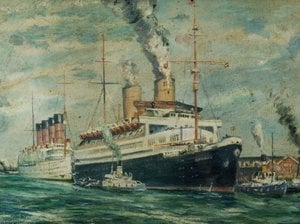
Arthur Cozens, born Herbert Hardy Cozens-Hardy in 1880, was a British artist whose life and work were inextricably linked to the sea. Though he adopted the simpler moniker ‘Arthur Cozens’ for his artistic pursuits, his full name hints at a family steeped in naval tradition – a heritage that profoundly shaped his career as a marine painter. While biographical details remain somewhat sparse, the essence of Cozens's artistry speaks volumes about a man captivated by ships, coastal life, and the ever-changing moods of the ocean. He wasn’t merely documenting vessels; he was capturing a feeling, an atmosphere, a romance tied to Britain’s maritime history. His paintings offer a window into a world where craftsmanship met adventure, and the power of nature held sway. Cozens's artistic journey unfolded against a backdrop of significant change – from the twilight of sail to the dawn of modern naval warfare, and his work reflects this evolution with remarkable sensitivity. He passed away in 1947, leaving behind a legacy of evocative marine scenes that continue to resonate with collectors and enthusiasts today.Early Influences & Artistic Development
The precise details of Cozens’s formal artistic training are not widely documented, but it is clear his early life provided the foundation for his lifelong fascination with ships and the sea. Growing up in a family connected to naval circles undoubtedly exposed him to maritime culture from a young age. This immersion fostered an acute observational skill – a keen eye for the intricacies of rigging, hull design, and the play of light on water. His initial works demonstrate a traditional approach, focusing on accurate representation and meticulous detail. However, Cozens quickly moved beyond mere technical proficiency, developing a distinctive style characterized by its atmospheric quality and subtle use of color. He wasn’t interested in grand historical battles or dramatic shipwrecks; instead, he focused on the everyday beauty of maritime life – yachts gliding across calm waters, ships at anchor in bustling harbors, coastal scenes bathed in soft light. This preference for quieter moments suggests a deep appreciation for the aesthetic qualities of the sea itself, rather than its more turbulent aspects. He absorbed influences from earlier marine masters like J.M.W. Turner and Frederick Taylor, but he forged his own path, creating works that were uniquely personal and evocative.A Painter of Peace & War
Cozens’s career spanned a period of significant upheaval, including both World Wars. While not overtly propagandistic, his art reflects the changing times. Before WWII, his paintings largely celebrated the leisure and elegance associated with yachting and coastal life – scenes of affluence and tranquility. However, as war clouds gathered, his subject matter shifted towards depictions of naval vessels engaged in wartime activities. He documented ships involved in convoy duty, harbor scenes teeming with activity, and the somber realities of a nation at war. These paintings are not glorifications of conflict; rather, they offer a poignant glimpse into the dedication and resilience of those who served at sea. His work during this period is characterized by a sense of realism tempered by an underlying empathy for the sailors and ships he portrayed. He became particularly known for his detailed depictions of Southampton’s harbor – a crucial embarkation point for troops and supplies, making him a significant chronicler of WWII naval operations in that region.Technique & Style: Capturing Light & Atmosphere
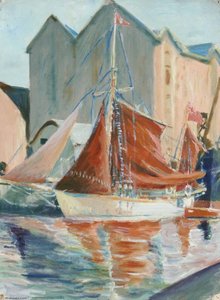
Arthur Cozens was primarily a watercolor artist, though he also worked with oils. His mastery of watercolor is evident in his ability to create luminous effects and subtle gradations of color. He employed a loose, fluid technique, allowing the colors to blend and flow naturally, capturing the ever-changing light and atmosphere of the sea.- His brushwork is delicate yet confident, conveying both detail and movement.
- He often used washes of color to create depth and perspective, giving his paintings a sense of spaciousness.
- A key element of his style was his attention to the play of light on water – capturing the shimmering reflections, subtle shadows, and overall luminosity of the marine environment.
Legacy & Historical Significance
Arthur Cozens’s work provides a valuable historical record of maritime life in Britain during the first half of the 20th century. While he may not be as widely recognized as some of his more famous contemporaries, his paintings offer a unique and insightful perspective on a pivotal period in British history. His detailed depictions of ships, yachts, and coastal scenes are prized by collectors for their accuracy, beauty, and atmospheric quality. He is particularly remembered for his wartime paintings documenting the naval operations centered around Southampton. Today, Cozens’s works serve as a reminder of Britain’s rich maritime heritage and the enduring allure of the sea. His art continues to inspire and captivate viewers with its subtle beauty, evocative atmosphere, and poignant portrayal of life on the waves. He stands as a testament to the power of observation, dedication, and a lifelong passion for capturing the essence of the marine world.Spørsmål og svar
Kan jeg bla gjennom verkene til Arthur Cozens etter kunstretning?
Siden Alle kunstretninger grupperer Arthur Cozens sine kunstverk etter kunstretning.
Kan jeg bla gjennom Arthur Cozens sine verk etter medium?
Arthur Cozens sine verk kan utforskes etter medium på Arthur Cozens sin Alle medier-side.
Kan jeg studere Arthur Cozens sin fargebruk på tvers av alle verkene?
Fargeprofilen til Arthur Cozens sine verk vises på kunstnerens Fargepalettens sjel-side.