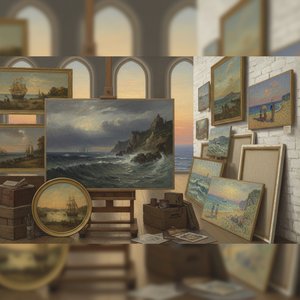
Andrew Webster: Capturing the Soul of Scottish Coastlines
Andrew Webster (born 1938) is a Scottish painter whose distinctive style has cemented his place as one of Scotland’s foremost marine artists, particularly celebrated for his depictions of Fraserburgh Harbour and Kinnaird Head Lighthouse. His canvases pulsate with an immediacy that conveys not merely visual representation but also the palpable atmosphere of the North Sea coast – a testament to his profound connection with the landscape and its history. Webster's artistic journey began in Dundee, where he honed his skills at Duncan Grant Studios, absorbing influences from Impressionism and Cubism while simultaneously developing his own unique approach. This formative period instilled in him a disciplined technique characterized by meticulous layering of paint—often employing encaustic wax alongside oil—creating surfaces that possess remarkable depth and luminosity. Unlike many artists who strive for photographic accuracy, Webster prioritizes capturing the emotional essence of his subjects; he seeks to convey not just what he sees but how he *feels* when confronted with the rugged beauty of Scotland’s coastline.
Webster's breakthrough came in the mid-1960s with a series of paintings depicting Fraserburgh Harbour, instantly establishing him as a master of capturing the dynamism and character of maritime environments. Webster's meticulous observation combined with an intuitive understanding of color and light resulted in images that are both technically brilliant and emotionally resonant. He wasn’t simply painting a harbor; he was portraying its spirit—the ceaseless movement of the waves, the weathered faces of fishermen, and the pervasive scent of salt air. This dedication to detail extended beyond mere visual representation; Webster painstakingly researched local folklore and history, incorporating elements of Scottish tradition into his compositions. His paintings are housed in numerous public collections, including the National Galleries of Scotland and Aberdeen Museums & Art Gallery, ensuring that his legacy as a visionary artist will endure for generations to come.
Webster’s artistic technique was marked by an unwavering commitment to plein air painting—working directly from nature—a practice that profoundly shaped his artistic vision. He firmly believed that true art emerges from an honest engagement with the world around us, a conviction that underpinned his entire creative process. His canvases are characterized by a masterful use of encaustic wax combined with oil paint, resulting in surfaces that possess exceptional luminosity and textural richness. This method allowed him to capture subtle nuances of light and atmosphere—essential components of conveying the emotional impact he sought from his subjects.
Throughout his career, Webster drew inspiration from Impressionist masters like Claude Monet and Pierre-Auguste Renoir, whose explorations of color and brushstroke influenced his own stylistic choices. Simultaneously, he absorbed elements of Cubism, particularly Picasso’s fragmented perspectives, which contributed to a sense of dynamism and complexity in his compositions. These influences blended seamlessly into Webster's distinctive visual language—a testament to his intellectual curiosity and artistic versatility.
Webster achieved international recognition throughout the 1970s and 80s, showcasing in galleries across Europe and America. He continued to produce paintings with unwavering commitment until his death in 2013, leaving behind a substantial body of work that continues to inspire admiration for its expressive power and artistic integrity. His enduring contribution to Scottish art lies not only in his stunning visual achievements but also in his unwavering dedication to preserving and celebrating Scotland’s maritime heritage.
Explore the dramatic marine paintings of John Wilson Carmichael (1800-1868), a Victorian master renowned for his realistic seascapes and historical naval scenes. Discover his life, style & available hand-painted reproductions at WahooArt.
Explore the rich history of coastal scenes in painting! Discover Impressionist masterpieces, American realism & contemporary visions. Learn about renowned artists and find your perfect seascape at WahooArt.
Explore the powerful life & art of Benny Andrews – a pivotal figure in African American expressionism. Discover his unique collage style, activism, and poignant depictions of identity & social justice. A must-read for collectors.