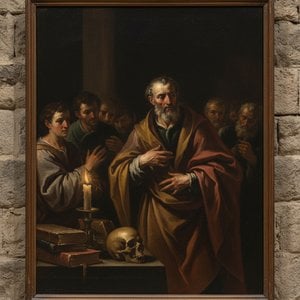
The Enigmatic Master of Toledo
The name Alejandro de Loarte, a painter active primarily in the early decades of the seventeenth century, often evokes a sense of intriguing mystery. Despite his undeniable talent and significant output, biographical details surrounding this Spanish artist remain frustratingly sparse, shrouded in the mists of historical record. Much of what we know is pieced together from scant documentation, stylistic analysis, and the echoes of his contemporaries—a process that reveals a compelling figure whose work reflects both the traditions of the late Renaissance and the burgeoning dynamism of the Baroque.
Born around 1590 or 1600, de Loarte’s early life is largely undocumented, though traces of his beginnings suggest an artistic lineage. He was the son of Jerónimo de Loarte, a painter himself, who likely served as his first instructor and shaped his initial technical foundation. While precise details regarding his childhood are elusive, we know that he established his own studio in Madrid around 1619, a period during which he married and began to make his mark on the Spanish art scene. This time in the capital was relatively brief; shortly thereafter, he relocated to Toledo, where he would spend the majority of his career and ultimately meet his untimely end in 1626.
A Mastery of Light and Stillness
De Loarte’s artistic legacy is primarily defined by two distinct yet interconnected genres: still lifes and religious compositions. He quickly established himself as a master of the bodegón, a genre that flourished in Spain during this era. These works are characterized by meticulously arranged scenes featuring everyday objects—fruits, vegetables, game, bread, and domestic utensils—often set against simple, austere backgrounds like stone slabs or wooden shelves. However, these are far from mere depictions of inanimate objects; they are imbued with a subtle sense of drama, light, and shadow, inviting the viewer to contemplate the arrangement and the implied narrative behind each carefully placed element.
His technical prowess is most evident in his remarkable control over texture and color. In his still lifes, one can almost feel the coolness of a ceramic vessel or the velvety skin of a ripening fruit. He possessed a unique ability to capture the freshness and vitality of his subjects, imbuing even the most humble kitchen scenes with a sense of dignity and permanence. This focus on impactful realism allowed him to create works that were not only visually stunning but also deeply grounded in the physical reality of the Spanish landscape.
Legacy and Historical Significance
Though his life was tragically short, de Loarte left behind a body of work that serves as a vital bridge between eras. His religious paintings varied in quality, yet they contributed to the rich devotional atmosphere of the period, providing much-needed imagery for the spiritual life of Toledo and Madrid. At the time of his death, he was in charge of a prestigious studio, and his influence continued through the artists he trained or inspired, such as Pedro Orrente, whom he named as his executor.
The historical significance of Alejandro de Loarte lies in his role as a pioneer of the Spanish Baroque. By elevating the bodegón from simple observation to a sophisticated exploration of light and form, he helped set the stage for the great masters who would follow. His ability to find the extraordinary within the ordinary remains his greatest achievement, ensuring that his name continues to resonate within the halls of art history.
Spørsmål og svar
Hvordan finner jeg verk av Alejandro De Loarte innenfor et spesifikt tema?
Utforsk Alejandro De Loarte sine verk via nøkkelord på kunstnerens Søk etter nøkkelord-side. Hvert nøkkelord grupperer de tilhørende kunstverkene.
Hvor kan jeg finne statistikk om verkene til Alejandro De Loarte?
Det finnes en Besøksstatistikk-side for Alejandro De Loarte, som viser statistikk over kunstnerens verk på denne nettsiden.
Hvor finner jeg Alejandro De Loarte sine kunstverk gruppert etter fargepalett?
For å finne verk av Alejandro De Loarte i en bestemt fargepalett, bruk kunstnerens Etter fargepalett-side.