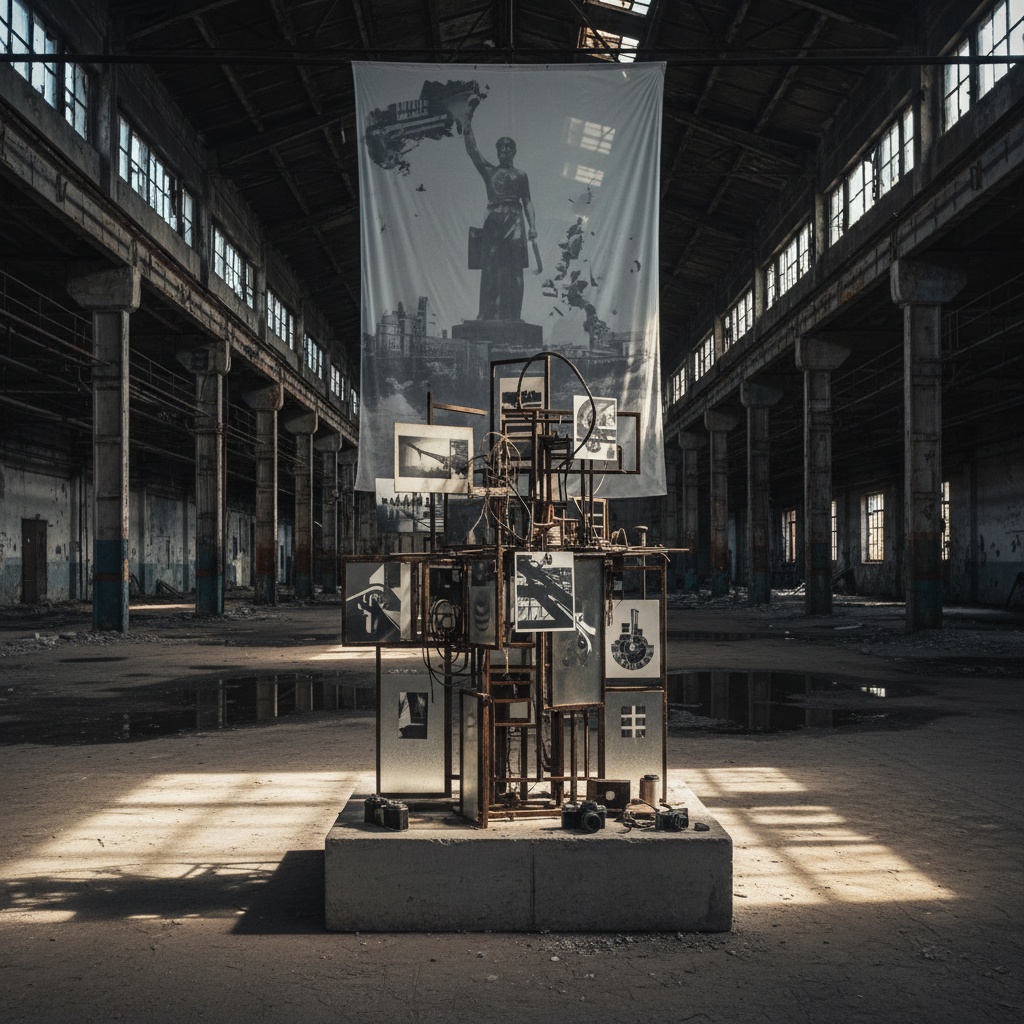
Early Life & Formation: A Ukrainian Identity Forged Through Displacement
Pavlo Mykolaiovych Makov (born August 28, 1958, in Leningrad) is a Ukrainian artist. He is a Member of the Royal Society of Painters and Graphic Artists of Great Britain, a Corresponding Member of the National Academy of Arts of Ukraine, and a Laurea...
Pavlo Makov’s artistic trajectory is inextricably linked to the complex geography of his life, a narrative woven with threads of displacement and a persistent search for identity within shifting political landscapes. Born in Leningrad (now St. Petersburg) in 1958 to parents both medical professionals, his early childhood was uprooted by a move to Ukraine at the age of five. This initial relocation—from the cultural heart of Russia to the Soviet republic of Ukraine—would prove formative, instilling a sense of belonging that was perpetually tempered by change. His upbringing unfolded across several Ukrainian cities – Rivne, Kyiv, and Simferopol – each leaving an imprint on his developing sensibility. While formal artistic training began at age twelve with three years at art school, Makov’s early passions lay not solely within the visual realm; a deep fascination with biology and literature coexisted alongside his burgeoning artistic talent, hinting at a mind attuned to both the concrete details of the natural world and the abstract power of narrative. This multifaceted intellectual curiosity would later become a defining characteristic of his work.
The years spent navigating these diverse environments fostered an acute awareness of cultural nuances and historical weight—a sensitivity that would ultimately fuel his artistic explorations. Though he pursued formal education at the Crimean Art School and later the Kharkiv Art and Industrial Institute, it was perhaps the informal education gleaned from a childhood steeped in transience that proved most impactful. His early studies in English, maintained through correspondence even during military service, suggest an outward-looking perspective, a desire to connect with broader intellectual currents beyond the confines of his immediate surroundings.
The Photographic Language of Memory: Grayscale Palettes and Urban Topographies
 Garden. Place
Explore Pavlo Makov’s ‘Garden. Place’: a complex mosaic of photographic images in a muted grayscale palette. Radial composition & nostalgic details evoke layers of memory.
Makov’s mature work is immediately recognizable for its distinctive visual language—a predominantly grayscale palette employed across a diverse range of photographic media. This deliberate aesthetic choice isn't merely stylistic; it evokes a sense of nostalgia, distance, and the faded quality of memory itself. His compositions often feature densely layered urban scenes, meticulously constructed from digital collage or painstakingly rendered etchings. Avenir, for example, presents a captivatingly intricate panorama of cityscapes bathed in cool blues and grays, unsettling in its detail and complexity. The effect is not one of straightforward representation but rather an accumulation of fragments—a visual echo of the fragmented experience of modern life.
Works like Garden. Place further exemplify this approach. Here, a complex mosaic of photographic images coalesces into a radial composition that draws the viewer inward, inviting contemplation of layered histories and personal associations. The muted tones and subtle details evoke a sense of longing, suggesting half-remembered moments and the elusive nature of place. This isn’t simply documentation; it's an excavation of emotional terrain. Makov masterfully employs repetition and seriality—techniques rooted in conceptual art traditions—to create works that are both visually arresting and intellectually stimulating.
Conceptual Strategies & Artistic Process: From Bookmaking to Installation
Conceptual photography is a type of photography that illustrates an idea. There have been illustrative photographs made since the medium's invention, for example in the earliest staged photographs, such as Hippolyte Bayard's Self Portrait as a Drown...
Central to understanding Makov’s practice is his embrace of conceptual strategies, a methodology where the idea behind the artwork takes precedence over purely formal concerns. This approach is particularly evident in his prolific production of artist books—intricate assemblages of images and text that function as self-contained narratives or visual essays. Beginning in 1992, these books became a crucial outlet for exploring themes of identity, history, and the complexities of post-Soviet Ukraine. Utopia. Chronicles of 1992–1995, for instance, serves as a poignant record of a nation grappling with newfound independence and the challenges of rebuilding.
However, Makov’s conceptual explorations extend beyond the confines of the book form. He seamlessly transitions between etching, digital collage, and large-scale installation, demonstrating a remarkable versatility in his chosen media. A.I. Garden, with its detailed 1700s-style topographical engraving, showcases his technical mastery and ability to blend historical aesthetics with contemporary concerns. This work, characterized by intricate hatching and geometric forms, creates an atmospheric piece that invites viewers to question the boundaries between representation and reality.
Deconstructing the Soviet Past: Symbolism, Nostalgia, and Critical Engagement
Soviet art is the visual art style produced after the Russian Revolution of 1917 and during the existence of the Soviet Union, until its collapse in 1991. The Russian Revolution led to an artistic and cultural shift within Russia and the Soviet Union...
The shadow of the Soviet past looms large over Makov’s oeuvre. His work isn't a straightforward condemnation of the regime but rather a nuanced exploration of its enduring legacy—the psychological scars, the lingering symbols, and the complex relationship between nostalgia and critical awareness. He doesn’t shy away from depicting elements associated with Soviet iconography, but he does so in a way that subverts their original meaning, often layering them with contemporary imagery or presenting them in fragmented form.
This deconstructive approach is particularly potent in his installations, where he creates immersive environments that challenge viewers to confront the weight of history. He utilizes symbolism and metaphor to evoke a sense of unease and disorientation, prompting reflection on the collective trauma of the Soviet era. His recent work, exemplified by his presentation at the Venice Biennale with “Fountain of Exhaustion,” continues this exploration, utilizing everyday objects and architectural elements to create poignant commentaries on the present-day realities of Ukraine.
Makov's International Recognition & Contemporary Relevance
Pavlo Makov’s artistic achievements have garnered significant international recognition. A member of the Royal Society of Painters and Graphic Artists of Great Britain, a Corresponding Member of the National Academy of Arts of Ukraine, and a recipient of the prestigious Taras Shevchenko National Prize of Ukraine (2018), he has exhibited extensively in museums and galleries worldwide, including the Victoria and Albert Museum, the National Art Gallery in Kyiv, and the Center for Contemporary Art in Osaka. His work is held in numerous private and public collections, solidifying his position as a leading figure in contemporary Ukrainian art.
In an era marked by geopolitical instability and cultural upheaval, Makov’s work resonates with particular urgency. His exploration of identity, memory, and the complexities of historical trauma speaks to universal human experiences while remaining deeply rooted in the specific context of Ukraine. He offers a powerful visual language for grappling with the challenges of the present—a testament to the enduring power of art as a means of both documentation and resistance.
Collecting Pavlo Makov: A Unique Investment in Ukrainian Art History
Acquiring a work by Pavlo Makov represents more than simply adding a piece to one’s collection; it is an investment in a vital voice within contemporary art, a commitment to supporting Ukrainian cultural heritage. His limited edition prints and unique works on paper offer accessible entry points for emerging collectors, while his larger installations and artist books represent significant acquisitions for established institutions and discerning private buyers. The increasing international recognition of Makov’s work suggests a strong potential for long-term value appreciation.
WahooArt.com offers a curated selection of Pavlo Makov's works, providing an opportunity to engage with his compelling artistic vision. From meticulously reproduced prints to custom reproductions tailored to your specifications, we strive to make the masterpieces of history—and the powerful contemporary voices shaping its future—accessible to all. Explore our collection today and discover the enduring beauty and intellectual depth of Pavlo Makov’s art.