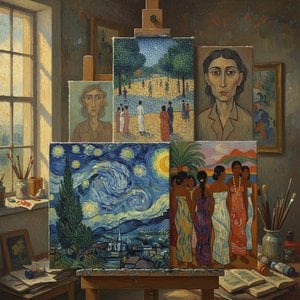
The Seeds of Rebellion: From Impressionism’s Light to New Artistic Visions
Post-Impressionism (also spelled Postimpressionism) was a predominantly French art movement which developed roughly between 1886 and 1905, from the last Impressionist exhibition to the birth of Fauvism. Post-Impressionism emerged as a reaction agains...
The late 19th century witnessed a seismic shift in the art world, one that began with a fascination for capturing fleeting moments of light and color – Impressionism. Artists like Monet, Renoir, and Degas revolutionized painting by prioritizing optical sensations over academic precision. However, this very pursuit of immediacy contained the seeds of its own evolution. For some, the emphasis on transient effects felt limiting, lacking in substantial form and deeper emotional resonance. A new generation sought to move beyond merely *recording* what they saw to expressing how they *felt*, and it was from this desire that Post-Impressionism blossomed.
The term itself, coined by critic Roger Fry, is somewhat of an umbrella, encompassing a diverse group of artists united not by a shared style but by their rejection of Impressionism’s constraints. They weren't seeking to dismantle the movement entirely; rather, they built upon its foundations – the vibrant palettes, broken brushstrokes – while simultaneously forging new paths toward greater subjectivity and structural integrity. This period wasn’t about abandoning color or light, but about imbuing them with personal meaning and exploring the underlying architecture of perception.
Paul Cézanne: The Bridge Between Worlds – Structure, Form, and the Foundations of Modern Art
 Madame Cezanne with Unbound Hair
Discover Paul Cézanne’s ‘Madame Cézanne with Unbound Hair.’ A poignant Post-Impressionist portrait capturing emotion & form. Explore this iconic artwork's beauty & legacy.
Central to understanding Post-Impressionism is the figure of Paul Cézanne. Often hailed as “the father of modern art,” Cézanne embarked on a relentless quest to bring order and permanence to his paintings. Dissatisfied with the Impressionists’ focus on fleeting impressions, he sought to capture the essential forms of nature – not as they appeared at a single moment, but as enduring structures. His landscapes, particularly those depicting Mont Sainte-Victoire, are not simply depictions of a mountain; they are investigations into geometric volumes, meticulously constructed from cylinders, spheres, and cones.
Cézanne’s approach was revolutionary. He abandoned traditional perspective in favor of multiple viewpoints, creating canvases that felt both dynamic and intellectually rigorous. His brushstrokes, though visible, weren't merely decorative; they were integral to building form and conveying a sense of depth. Works like “In the Forest” (1899) demonstrate his masterful use of color – vibrant oranges and bold applications of paint capture not just the *look* of nature but its very essence. This focus on structure, coupled with his exploration of subjective perception, laid the groundwork for Cubism and other 20th-century movements.
Van Gogh & Gauguin: Emotion, Symbolism, and the Pursuit of Subjective Truth
 Visionaries & Revolutionaries: Artists Who Transformed the Art World
Explore the lives & works of revolutionary artists who transformed art history! Discover key movements, iconic masterpieces, and lasting influences with .
While Cézanne sought order through form, Vincent van Gogh and Paul Gauguin pursued emotional intensity and symbolic meaning. Van Gogh’s paintings are visceral expressions of his inner turmoil and profound connection to nature. His iconic brushstrokes – swirling, impastoed, and often applied directly from the tube – convey a sense of raw energy and psychological depth. “Starry Night,” perhaps his most famous work, is not simply a depiction of a night sky; it’s a projection of Van Gogh’s emotional state, a landscape imbued with longing, isolation, and spiritual yearning.
Gauguin, meanwhile, rejected the industrialization of modern life in favor of what he perceived as the primitive authenticity of Polynesian culture. He sought to capture symbolic truths through simplified forms, flattened perspectives, and bold, non-naturalistic colors. “The Vision after the Sermon,” for example, is a powerful depiction of religious fervor, rendered with an intensity that transcends mere representation. Both Van Gogh and Gauguin prioritized subjective experience over objective reality, paving the way for Expressionism and other movements focused on inner states.
Seurat and Neo-Impressionism: A Scientific Approach to Color and Light
Georges Seurat took a decidedly different path, applying scientific principles to the art of painting. Dissatisfied with the spontaneity of Impressionism, he developed Pointillism – a technique that involved meticulously applying tiny dots of contrasting colors to create luminous effects. His masterpiece, “A Sunday on La Grande Jatte,” is a testament to his methodical approach. From a distance, the individual dots blend together to form a vibrant and harmonious composition.
Seurat’s work wasn't simply about optical illusion; it was rooted in color theory and a desire to create paintings that were both scientifically precise and aesthetically pleasing. He believed that by understanding the principles of optics, he could achieve greater luminosity and visual impact. While Neo-Impressionism didn’t last long as a dominant movement, its influence can be seen in later experiments with abstraction and color field painting.
Beyond Representation: How Post-Impressionists Expanded Artistic Expression
The legacy of the Post-Impressionists lies not in a unified style but in their collective rejection of artistic conventions and their embrace of individual expression. They expanded the possibilities of painting by exploring new subject matter, experimenting with form and color, and prioritizing emotional depth over mere representation. Cézanne’s focus on structure paved the way for Cubism; Van Gogh and Gauguin’s emphasis on emotion influenced Expressionism; and Seurat’s scientific approach informed later experiments with abstraction.
Madame Cézanne with Unbound Hair, a poignant portrait, exemplifies this shift. It's not merely a likeness of his wife but an intimate exploration of form, color, and the complexities of human emotion. Even works like Paul Cézanne’s haunting “Strangled Woman” (1872), though early in his career, demonstrate a willingness to confront difficult subjects and explore psychological states – a departure from the more idyllic themes favored by earlier artists.
Collecting Post-Impressionism: Investing in a Legacy of Innovation
Today, Post-Impressionist works are highly sought after by collectors worldwide. Their enduring appeal lies not only in their aesthetic beauty but also in their historical significance and investment potential. These paintings represent a pivotal moment in art history – the transition from representation to abstraction, from objective observation to subjective expression.
Investing in Post-Impressionism is investing in a legacy of innovation. Whether you’re drawn to Cézanne’s structural rigor, Van Gogh’s emotional intensity, or Gauguin’s symbolic power, these works offer a profound and lasting connection to the artistic spirit. At WahooArt.com, we provide museum-quality reproductions that capture the essence of these masterpieces, allowing you to experience the beauty and innovation of Post-Impressionism in your own home. Explore our collection today and discover the transformative power of art.