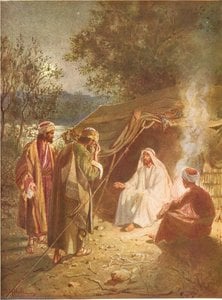
William Brassey Hole: Life & Art
William Brassey Hole’s life was a testament to artistic passion and unwavering dedication to capturing the spirit of Scotland. Born in Salisbury, Wiltshire, on November 7th, 1846, he experienced profound loss early on when his father, Richard Hole—a respected physician—passed away from cholera just three years later. This tragedy spurred his family’s relocation to Edinburgh, where he received a robust education at Edinburgh Academy and subsequently undertook a challenging apprenticeship as a civil engineer – an endeavor that ultimately proved less fulfilling than his burgeoning artistic aspirations.Early Travels & Artistic Awakening
Determined to pursue painting seriously, Hole embarked on a transformative six-month sketching tour of Italy in 1869, beginning in Genoa. This journey ignited his creative spirit and solidified his conviction that art was his true vocation. Crucially, he encountered Keeley Halswelle in Rome, whose astute guidance and critical feedback fueled his ambition to establish himself as a professional painter. Halswelle’s encouragement proved invaluable in shaping Hole's artistic trajectory. Upon returning to Edinburgh, he enrolled at the School of Design and subsequently gained admission to the life school of the Royal Scottish Academy (RSA) in 1873 – marking a pivotal moment in his formal artistic training.Academic Recognition & Artistic Style
His talent quickly garnered recognition within the RSA, earning him associate membership in 1878 and full membership in 1885. Alongside his academic pursuits, Hole joined the Royal Society of Painters-Etchers (RE) in 1885 and the Royal Scottish Watercolour Society (RSW) in 1884 – broadening his artistic horizons and fostering collaborations with fellow artists. Hole’s distinctive style was characterized by a meticulous attention to detail and an ability to convey emotion through carefully considered compositions. He excelled particularly in etching, mastering this technique to translate color and textural nuances into striking prints that captured the essence of Scottish landscapes and historical narratives.Scottish Focus & Notable Works
Despite his English birth, Hole devoted considerable energy to depicting Scotland’s national identity and heritage. His oeuvre encompassed a diverse range of subjects—industrial scenes reflecting the burgeoning Victorian era, monumental historical events commemorating pivotal moments in Scottish history, and evocative biblical narratives exploring themes of faith and morality. Among his most celebrated paintings are “End of the ‘45” (1879), portraying the aftermath of Bonnie Prince Charlie’s failed rebellion; "Prince Charlie's Parliament" (1882), capturing a significant political gathering; “If thou hadst known” (1885); and “The Canterbury Pilgrims” (1889)—each demonstrating Hole’s masterful storytelling abilities. Furthermore, he created a monumental frieze for Edinburgh City Chambers—a testament to his artistic vision and technical prowess—and produced stunning watercolors illustrating Robert Louis Stevenson's "Treasure Island" and J.M. Barrie’s “Peter Pan.” His enduring legacy resides in the profound beauty and emotional resonance of his artworks, which continue to inspire admiration and scholarly study.A Master Etcher & Artistic Legacy
William Brassey Hole’s contribution to Scottish art is undeniable. He elevated etching as a medium for artistic expression, achieving unparalleled technical skill and capturing the spirit of Scotland with remarkable sensitivity. His prints—particularly those depicting the rugged coastline of Argyll—remain treasured examples of Victorian landscape artistry. Through his unwavering dedication to his craft and his profound engagement with both history and faith, Hole established himself as one of Scotland’s most distinguished artists – a figure whose work continues to resonate with audiences today.Vraag & Antwoord
Waar kan ik de kunstwerken van William Brassey Hole in chronologische volgorde bekijken?
Er bestaat een tijdlijn van de werken van William Brassey Hole: de Tijdlijn kunstwerken pagina van de kunstenaar toont de kunstwerken in chronologische volgorde van creatie.
Kan ik de kunstwerken van William Brassey Hole sorteren op kleur?
De Spectraal index van William Brassey Hole is een pagina waarop de kunstwerken van de kunstenaar zijn georganiseerd op kleur.
Waar komt William Brassey Hole vandaan?
William Brassey Hole werd geboren in Verenigd Koninkrijk.