

Saint Louis Forgiving Pierre de Bretagne (1817) is het beroemdste schilderij van Georges Rouget, in de collectie van het Musée des Beaux-Arts de Quimper in Quimper. Sketch for the church Saint Gervais "Ecce Homo" (1819) en Jean-Nicolas Houchard (1835) zijn de volgende twee werken die de wereld het beste kent. Van de 39 werken van Georges Rouget in onze catalogus zijn dit de 39 meest bekeken werken door verzamelaars en museumbezoekers, inclusief het jaar, het museum en het verhaal achter elk werk.
Gerangschikt op basis van onze populariteitsscore, die de zoekopdrachten, bezoeken en bestellingen voor elk werk combineert. Bijgewerkt in oktober 2026. Elk meesterwerk op deze pagina kan worden besteld als een handgeschilderde olieverfreproductie van museumkwaliteit of als een fine art print, in de door u gekozen afmeting.


A middle-aged man sits in a moment of profound stillness, his gaze drifting toward the upper right as if caught by a sudden, unspoken thought. He is draped in the heavy, dark navy blue of a jacket that absorbs the light, contrasting sharply against the crisp, creamy white of his cravat. The light strikes the left side of his face with a deliberate intensity, sculpting the sharp lines of his…


The canvas before you presents not merely a likeness, but an embodiment of the 19th century’s fascination with portraiture – a meticulously rendered study in dignity and quiet authority. Painted by Georges Rouget between 1803 and 1857, this depiction of Jean Pierre Thenot is more than just a representation; it's a window into a specific moment in French history, imbued with the formal elegance and restrained emotion characteristic of his…


Georges Rouget's "Mesdemoiselles Mollien," painted in 1811, is more than just a portrait; it’s a window into the refined world of early 19th-century French society and a testament…
Bestel een reproductie →
Georges Rouget’s portrait of François Chasseloup Laubat stands as a quintessential example of Neoclassical artistic expression during Napoleon's reign—a period defined by grandeur, order, and an unwavering belief…
Bestel een handgeschilderde kopie →
This striking portrait depicts Emmanuel de Grouchy, Colonel du 2e Dragon in 1792. Painted by Georges Rouget, a neoclassical French painter known for his historical scenes and association…
Bestel een reproductie →De vier onderwerpen die het meest voorkomen in deze meesterwerken, met van elk het mooiste voorbeeld.
De 8 musea met de meeste schilderijen op deze pagina.
| Museum | Stad | Werken van Georges Rouget | Schilderijen uit deze lijst |
|---|---|---|---|
 Opera House |
Versailles | 6 | Achille Alexandre Alphonse, Viscount de Cailleux (1788-1876), Director of the Musées royaux, ALEXANDRE FRANCOIS MARIE, VICOMTE DE BEAUHARNAIS, GENERAL EN CHEF DE L'ARMEE DU RHIN (1760 1794), VICTOR GUY BARON DUPERRE, MATELOT EN 1792 (1775 1846) |
 Louvre |
Parijs | 2 | JEAN PIERRE THENOT (1803 1857), MESDEMOISELLES MOLLIEN |
 Musée des Beaux-Arts de Quimper |
Quimper | 1 | Saint Louis Forgiving Pierre de Bretagne |
 Petit Palais |
Parijs | 1 | Sketch for the church Saint Gervais "Ecce Homo" |
 Musée de l'Armée |
Parijs | 1 | Jean-Nicolas Houchard |
 Bayerische Staatsgemäldesammlungen |
München | 1 | Jacques-Louis David |
 Musée Fesch |
Aix-en-Provence | 1 | The King of Rome in the Tuileries Garden |
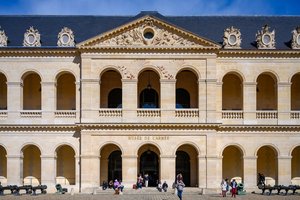 Ministère de la Défense Nationale |
Parijs | 1 | FRANCOIS CHASSELOUP LAUBAT, GÉNÉRAL DE DIVISION |


Saint Louis Forgiving Pierre de Bretagne (1817), Musée des Beaux-Arts de Quimper, Quimper. Daarna volgen Sketch for the church Saint Gervais "Ecce Homo" (1819) en Jean-Nicolas Houchard (1835).
34 jaar oud: Saint Louis Forgiving Pierre de Bretagne dateert uit 1817 en Georges Rouget werd geboren in 1783.
Saint Louis Forgiving Pierre de Bretagne, Sketch for the church Saint Gervais "Ecce Homo", Jean-Nicolas Houchard, Jacques-Louis David, Achille Alexandre Alphonse, Viscount de Cailleux (1788-1876), Director of the Musées royaux, The King of Rome in the Tuileries Garden, JEAN PIERRE THENOT (1803 1857), DEBARQUEMENT DE SAINT LOUIS EN EGYPTE.4 JUIN 1249, ALEXANDRE FRANCOIS MARIE, VICOMTE DE BEAUHARNAIS, GENERAL EN CHEF DE L'ARMEE DU RHIN (1760 1794) en FRANCOIS CHRISTOPHE KELLERMAN, GENERAL EN CHEF DE L'ARMEE DE LA MOSELLE EN 1792 (1735 1820). De bovenstaande ranglijst vermeldt het jaar en het museum van elk werk.
Onze catalogus bevat 39 werken van Georges Rouget, gedateerd van 1817 tot 1850.
De meeste bevinden zich in Opera House (Versailles), Louvre (Parijs) en Musée des Beaux-Arts de Quimper (Quimper). De bovenstaande tabel somt de musea één voor één op.
In 1810s: 2 van de 39 werken op deze pagina dateren uit die periode, waaronder Saint Louis Forgiving Pierre de Bretagne.
De oudste op deze pagina is Saint Louis Forgiving Pierre de Bretagne (1817), de nieuwste The King of Rome in the Tuileries Garden (1850).
Portrait (4), Dignified (3) en Formal (2), van de 39 werken op deze pagina.
Oil On Canvas: 3 van de 39 werken op deze pagina.
Neoclassicism, zoals de schilderijen op deze pagina laten zien.
Achille Alexandre Alphonse, Viscount de Cailleux (1788-1876), Director of the Musées royaux, ALEXANDRE FRANCOIS MARIE, VICOMTE DE BEAUHARNAIS, GENERAL EN CHEF DE L'ARMEE DU RHIN (1760 1794) en VICTOR GUY BARON DUPERRE, MATELOT EN 1792 (1775 1846) behoren tot de 6 werken op deze pagina die in het Opera House, Versailles worden bewaard.
Ja. Elk schilderij op deze pagina kan worden besteld als een handgeschilderde olieverfreproductie van museumkwaliteit of als een fine art print, in de door u gekozen afmeting, via de eigen pagina van het schilderij.

