Georges Rouault, 1871 – 1958

De 100 beroemdste schilderijen van Georges Rouault

Het schilderij dat Georges Rouault beroemd maakte, is Head of Christ. Head of Christ 1 en The Breton Wedding (1937) volgen in de harten van verzamelaars en museumbezoekers. Van de 268 werken van Georges Rouault in onze catalogus zijn dit de 100 meest bewonderde, elk gepresenteerd met de datum, het museum en wat het uniek maakt.

Gerangschikt op basis van onze populariteitsscore, die de zoekopdrachten, bezoeken en bestellingen voor elk werk combineert. Bijgewerkt in oktober 2026.

Portret van Georges Rouault
Georges Rouault · 1871 – 1958
Geboren · overleden
1871 – 1958, 19e arrondissement van Parijs
Stroming
Fauvism
Werken in onze catalogus
268
Meest bekend
Head of Christ
Meeste werken in
Art Institute of Chicago

Georges Rouault: de tien meesterwerken

Head of Christ door Georges Rouault
1

Head of Christ

Oil On Panel

The face emerges from a deep, saturated blue background. It is a man's countenance, fixed with an intense and focused gaze that meets the viewer directly. His eyes are wide, open, and heavy with a quiet, introspective weight. A beard provides a rough texture to his features, grounding the ethereal color of the backdrop in something physical and tactile. On the left side of the face, a small bird rests,…

Head of Christ 1 door Georges Rouault
2

Head of Christ 1

Oil On Panel

In this portrait, the face of Christ emerges from a profound, saturated blue, a space that offers no horizon and no sense of physical depth. The subject's countenance is fixed with an intense, focused gaze that meets the viewer directly, creating an immediate sense of intimacy and confrontation. There is a heavy, introspective weight in the eyes, which appear wide and open, as if carrying the gravity of existence itself.…

The Breton Wedding (1937) door Georges Rouault
3

The Breton Wedding

1937 · Oil On Canvas

Georges Rouault’s “The Breton Wedding” is not merely a depiction of a rural ceremony; it's a profound meditation on faith, community, and the quiet dignity of everyday life. Painted in 1937, this canvas pulsates with an intensely personal vision, born from Rouault’s own devout Catholic beliefs and his deep empathy for the marginalized. The scene unfolds within a church or cathedral – a space traditionally imbued with solemnity – yet…

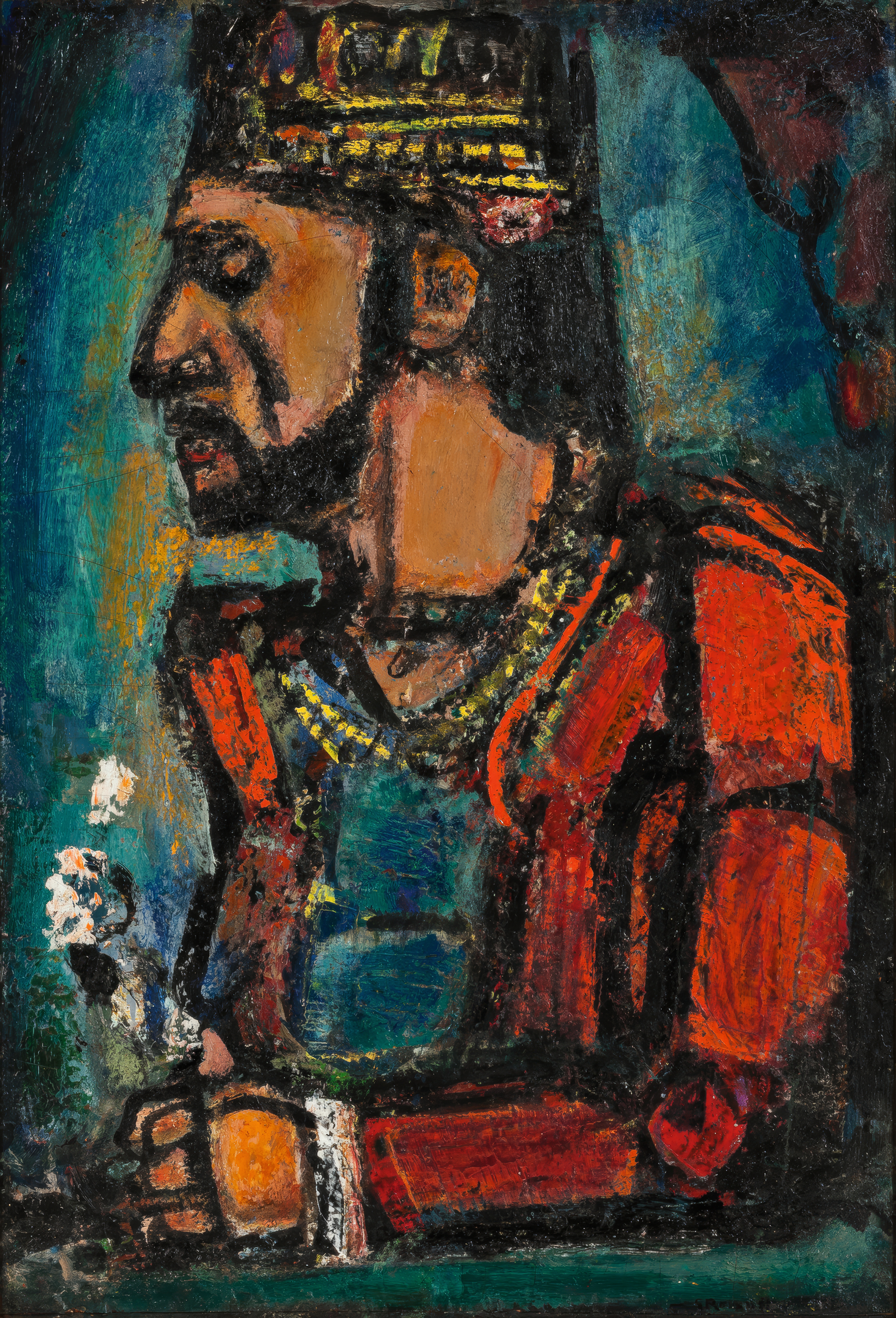
The old king (1937) door Georges Rouault
4

The old king

1937 · Oil On Canvas

In the quiet, heavy atmosphere of Georges Rouault’s 1937 masterpiece, The Old King, one encounters a profound meditation on the human condition. The painting presents a solitary monarch, captured in profile, whose very presence seems to vibrate with an introspective melancholy. Draped in rich, crimson robes that catch the light with a somber intensity, the figure gazes inward, his expression etched with a deep, palpable sadness. This is not merely…

Jesus on the cross as forgotten there door Georges Rouault
5

Jesus on the cross as forgotten there

Acrylic On Canvas

Georges Rouault’s “Jesus on the Cross as Forgotten There”: A Descent Into Spiritual Darkness The artwork presents a haunting meditation on faith and suffering, embodied in Georges Rouault's monumental print, "Jesus on the Cross as Forgotten There." Created in 1946 during the Second World War, amidst the pervasive anxieties of occupation and loss, this piece transcends mere depiction; it plunges into the abyss of existential despair, mirroring the artist’s own…

Femme Affranchie, A Quatorze Heures, Chante Midi door Georges Rouault
6

Femme Affranchie, A Quatorze Heures, Chante Midi

Acrylic

Georges Rouault’s Femme Affranchie: A Portrait of Resilience Amidst Darkness The Denver Art Museum houses Georges Rouault's “Femme Affranchie, à Quatorze Heures, Chante Midi” (Woman Freed at Noon), a hauntingly beautiful engraving from his seminal Miserere et Guerre series completed in 1923. This artwork transcends mere visual representation; it embodies Rouault’s deeply felt empathy for the vulnerable and his unwavering commitment to exploring profound spiritual themes—a legacy born from witnessing…

The Judges (1908) door Georges Rouault
7

The Judges

1908 · Oil · Statens Museum for Kunst, Kopenhagen

In this 1908 oil painting, three seated figures occupy a shallow, darkened space. The composition is arranged horizontally, with the figures positioned in a way that fills the frame, creating a sense of enclosure. The lighting is low-key, emerging from an indistinct source to illuminate only specific portions of the subjects, such as the pale, ghostly whites of facial features and the edges of clothing. The rest of the scene…

Hollow dream door Georges Rouault
8

Hollow dream

Oil On Canvas

The artwork Hollow dream is an oil painting on canvas that presents a portrait of a person, likely male, rendered in an expressionistic style. The composition is a vertical frame that is tightly focused on the head and shoulders, with the subject facing forward and slightly turned toward the viewer's left. The figure fills most of the frame against a dark, undefined background.

Meer meesterwerken van Georges Rouault, van 11 tot 100

Bouquet II (1938) door Georges Rouault
#13

Bouquet II

1938

Georges Rouault: Bouquet II – A Meditation on Suffering and Beauty Georges Rouault’s “Bouquet II,” painted in 1929, stands as a poignant testament to the artist's unwavering commitment…

Christ door Georges Rouault
#14

Christ

The painting is a portrait of Jesus with his head bowed down. The background features a sky that appears to be blue in color.

Away the smile of Reims door Georges Rouault
#15

Away the smile of Reims

A single figure occupies the center of the frame, a presence carved from darkness and light. The face is elongated, pulled by invisible forces into a mask of…

The Three Judges (1928) door Georges Rouault
#18

The Three Judges

1928 · Art Institute of Chicago

The Three Judges is an oil and gouache work on paper, mounted on cardboard and backed with canvas, created by the French artist Georges Rouault. The piece was…

Dolls, puppets fire hall and the ''Bride'' door Georges Rouault
#19

Dolls, puppets fire hall and the ''Bride''

The air feels heavy, thick with the scent of old dust and greasepaint. In this claustrophobic corner of a theatrical world, three figures huddle together, their presence casting…

Legendary Landscape (1935) door Georges Rouault
#20

Legendary Landscape

1935

The artwork is a vertically oriented oil painting on canvas that presents a stylized, dreamlike landscape. The composition features a simplified architectural structure, possibly a church or monastery,…

'Man of myrrh' door Georges Rouault
#22

'Man of myrrh'

The artwork presents a somber and emotionally charged scene depicting what appears to be a biblical or allegorical narrative. The composition is centered around a reclining figure, presumably…

Pierrot (1910) door Georges Rouault
#24

Pierrot

1910

is a work by the French artist Georges Rouault, executed in 1910. Born in Paris, France, in 1871, Rouault remained connected to his home city until his death…

Grotesque (1917) door Georges Rouault
#25

Grotesque

1917

Completed in 1917, Georges Rouault’s Grotesque is a profound exploration of human vulnerability and spiritual resilience. Created against the backdrop of the escalating anxieties of World War I,…

Crucifixion door Georges Rouault
#26

Crucifixion

The painting depicts a crucifixion scene where the central figure of Jesus Christ is shown on the cross. He is rendered with an elongated torso and contorted limbs,…

Two Women's Heads (1902) door Georges Rouault
#27

Two Women's Heads

1902

The painting depicts two women's heads positioned within the frame. On the left side, a woman with long hair is shown looking toward something in front of her,…

The holy face door Georges Rouault
#28

The holy face

The artwork presents a stylized and emotionally charged depiction of a human face, likely intended to represent Christ or a holy figure. The composition is centered around the…

Project for the reincarnation of Father Ubu 3 door Georges Rouault
#29

Project for the reincarnation of Father Ubu 3

Georges Rouault's “Project for the Reincarnation of Father Ubu 3” presents not merely a depiction, but an immersion into a world sculpted by anxiety and unsettling satire. This…

Christ and the Fisherman door Georges Rouault
#30

Christ and the Fisherman

Fine Arts Museums of San Francisco

Christ and the Fisherman is an oil painting by Georges Rouault. Created in France, the work emerged around 1937. The artist applied oil to paper, which was then…

Eternally scourged door Georges Rouault
#31

Eternally scourged

In this somber composition, we find ourselves face to face with a figure caught in a moment of profound exhaustion. The subject is positioned slightly off-center, its body…

King Ubu 1 door Georges Rouault
#34

King Ubu 1

The artwork presents a stylized and somewhat grotesque depiction of a seated figure, identified by the title as King Ubu. The composition is dominated by this central figure,…

The Superman (1916) door Georges Rouault
#35

The Superman

1916

In the heavy, somber atmosphere of 1916, as the Great War tore through the heart of Europe, Georges Rouault captured something far more profound than a mere portrait;…

The Dwarf (1937) door Georges Rouault
#36

The Dwarf

1937 · Art Institute of Chicago

In this 1937 work, The Dwarf, Georges Rouault presents a figure that occupies the periphery of social visibility. The artist, a Frenchman, turned his attention toward those living…

Dancer for the Ballets Russes door Georges Rouault
#37

Dancer for the Ballets Russes

Georges Rouault's "Dancer for the Ballets Russes" is a striking portrait that encapsulates the spirit of early 20th-century artistic innovation. Created likely around 1929, this artwork offers a…

Pierrot 2 door Georges Rouault
#38

Pierrot 2

Georges Rouault's 'Pierrot 2' isn’t merely a depiction of the iconic commedia dell’arte figure; it’s an immersion into a world steeped in sorrow, isolation, and a profound spiritual…

Twilight or Ile de France door Georges Rouault
#39

Twilight or Ile de France

Georges Rouault’s “Twilight or Ile de France” is a captivating exploration of light, color, and human emotion, firmly rooted in the heart of the Fauvist movement. Painted in…

Night Fall door Georges Rouault
#40

Night Fall

The artwork presents a stylized and emotionally charged scene depicting figures in what appears to be a coastal or rural setting at night. It carries a somber and…

'... when the night came. The moon rose' door Georges Rouault
#41

'... when the night came. The moon rose'

In the hauntingly beautiful tableau titled '... when the night came. The moon rose,' Georges Rouault invites us into a world where the boundaries between the physical landscape…

The blind man sometimes consoles the light door Georges Rouault
#42

The blind man sometimes consoles the light

Georges Rouault's “The Blind Man Sometimes Consoles the Light” is not merely a depiction of two figures; it’s an immersion into a world steeped in sorrow, faith, and…

Nude with arms raised (combed) door Georges Rouault
#43

Nude with arms raised (combed)

In the quiet, heavy atmosphere of Georges Rouault’s 1937 masterpiece, Nude with Arms Raised (combed), one does not merely observe a figure; one encounters a soul in the…

Dura Lex Sed Lex door Georges Rouault
#44

Dura Lex Sed Lex

“Dura lex sed lex” – "The law is hard, but it is the law" – this stark and profoundly moving portrait by Georges Rouault transcends a simple depiction…

Schilderijen van Georges Rouault per periode

Early 20th Century

1907 – 1910 · 3 werken in deze lijst

De onderwerpen die Georges Rouault het meest schilderde

De vier onderwerpen die het meest voorkomen in deze meesterwerken, met van elk het mooiste voorbeeld.

Waar u de schilderijen van Georges Rouault kunt bekijken

De 7 musea met de meeste schilderijen op deze pagina.

Museum Stad Werken van Georges Rouault Schilderijen uit deze lijst
Art Institute of Chicago, ChicagoArt Institute of Chicago Chicago 2 The Three Judges, The Dwarf
The Phillips Collection, Washington, D.C.The Phillips Collection Washington, D.C. 3 Verlaine
Statens Museum for Kunst, KopenhagenStatens Museum for Kunst Kopenhagen 1 The Judges
Fine Arts Museums of San Francisco, San FranciscoFine Arts Museums of San Francisco San Francisco 1 Christ and the Fisherman
Koninklijk Museum voor Schone Kunsten Antwerpen, AntwerpenKoninklijk Museum voor Schone Kunsten Antwerpen Antwerpen 1 Newspaper Seller
National Gallery of Canada, OttawaNational Gallery of Canada Ottawa 1 Christ on the Cross
Chimei Museum, TainanChimei Museum Tainan 1 Profile of a Woman

Georges Rouault, decennium voor decennium: het iconische schilderij van elk tijdperk

  1. 1900s
    The Judges (1908) door Georges Rouault
    Rang 7 / 100

    The Judges

    Leeftijd 29 – 38 · Statens Museum for Kunst

    In this 1908 oil painting, three seated figures occupy a shallow, darkened space. The composition is arranged horizontally, with the figures positioned in a way that fills the…

  2. 1910s
  3. 1920s
    The Three Judges (1928) door Georges Rouault
    Nr. 18 van 100

    The Three Judges

    Leeftijd 49 – 58 · Art Institute of Chicago

    The Three Judges is an oil and gouache work on paper, mounted on cardboard and backed with canvas, created by the French artist Georges Rouault. The piece was…

  4. 1930s
    The Breton Wedding (1937) door Georges Rouault
    #3 van 100

    The Breton Wedding

    Leeftijd 59 – 68

    Georges Rouault’s “The Breton Wedding” is not merely a depiction of a rural ceremony; it's a profound meditation on faith, community, and the quiet dignity of everyday life.…

Meesterwerken van Georges Rouault: vragen en antwoorden

Waar is Georges Rouault het meest bekend om?Toon het antwoord

Head of Christ. Daarna volgen Head of Christ 1 en The Breton Wedding (1937).

Wat zijn de tien grootste schilderijen van Georges Rouault?Toon het antwoord

Head of Christ, Head of Christ 1, The Breton Wedding, The old king, Jesus on the cross as forgotten there, Femme Affranchie, A Quatorze Heures, Chante Midi, The Judges, Hollow dream, The Poulot or partner, Red Zone en Landscape from the Bible, Christ and the fishermen. De bovenstaande ranglijst vermeldt het jaar en het museum van elk werk.

Hoeveel werken heeft Georges Rouault geschilderd?Toon het antwoord

Onze catalogus bevat 268 werken van Georges Rouault, gedateerd van 1902 tot 1938.

In welke musea kan ik de meesterwerken van Georges Rouault bewonderen?Toon het antwoord

De meeste bevinden zich in Art Institute of Chicago (Chicago), The Phillips Collection (Washington, D.C.) en Statens Museum for Kunst (Kopenhagen). De bovenstaande tabel somt de musea één voor één op.

Wanneer schilderde Georges Rouault de meesterwerken?Toon het antwoord

In 1900s: 5 van de 100 werken op deze pagina dateren uit die periode, waaronder The Judges.

Wat zijn de eerste en laatste beroemde schilderijen van Georges Rouault?Toon het antwoord

De oudste op deze pagina is Two Women's Heads (1902), de nieuwste Bouquet II (1938).

Wat waren de favoriete onderwerpen van Georges Rouault?Toon het antwoord

Suffering (13), Darkness (11) en Portrait (7), van de 100 werken op deze pagina.

Welke techniek had Georges Rouault de voorkeur?Toon het antwoord

Oil On Canvas: 11 van de 100 werken op deze pagina.

Bij welke kunststroming hoort Georges Rouault?Toon het antwoord

Fauvism en Expressionism, zoals de schilderijen op deze pagina laten zien.

Welke meesterwerken van Georges Rouault hangen in het Art Institute of Chicago?Toon het antwoord

The Three Judges en The Dwarf behoren tot de 2 werken op deze pagina die in het Art Institute of Chicago, Chicago worden bewaard.

Het leven van Georges Rouault

Georges Rouault: A Life Painted in Shadows and Light

Georges Rouault, geboren in Parijs in 1871, leefde een leven dat diep geworteld was in zowel armoede als spirituele zoektocht. Zijn vroege jaren waren werkelijk in de schaduw – zijn familie zoekt onderdak in een kelder tijdens de bombardementen op de stad, een gebeurtenis die resoneren zou met zijn artistieke visie. Deze bescheiden begin, gecombineerd met een devote katholieke opvoeding gefosterd door zijn moeder, instilled binnen hem een diepe empathie voor de gemarginaliseerden en lijdende, thema’s die centraal zouden staan in zijn oeuvre. Hij was niet bestemd voor formele academische privileges; in plaats daarvan begon hij aan een leerlingschap als glaskunstenaar op veertienjarige leeftijd, een vak dat zijn esthetische zintuigen diepgaand zou vormen. De levendige kleuren en gedurfdse lijnen in glaswerk werden fundamentele elementen van zijn volwassen stijl – een kenmerkende gebruik van donkere contouren die heldere kleurvelden omkaderden, herinnerend aan middeleeuwse kunst. Deze vroege onderdompeling was niet alleen technisch; het was spiritueel, waardoor hij een waardering ontwikkelde voor de narratieve kracht van licht en beeld. Tegelijkertijd volgde hij formele training op de École des Beaux-Arts, waar hij zich toegewijd maakte aan de leerling van Gustave Moreau, wiens symbolistische neigingen zijn neiging tot emotioneel geladen onderwerpweefsel verder voedden.

De Vroege Jaren: Van Glas naar Kunst

Rouault’s artistieke reis was niet één van onmiddellijke erkenning of gemakkelijke categorisering. Hoewel hij aanvankelijk werd beïnvloed door Symbolisten, vond hij zichzelf in de vroege 20e eeuw aangetrokken tot de opkomende Fauvistische beweging. Hij maakte kennis met kunstenaars zoals Henri Matisse en Albert Marquet, die deelnamen aan tentoonstellingen samen met hen, maar zijn temperament leidde hem altijd naar een somberer en introspectievere weg dan de puur esthetische verkenningen van zijn tijdgenoten. De levendige kleuren van Fauvisme dienden als een springplank, maar Rouault overtrof deze beperkingen snel, door zijn doeken te verrijken met emotionele intensiteit die foreshadowde Expressionisme. Hij begon zich te richten op onderwerpen die vaak werden overzien of beschouwd als onwaardig voor artistieke aandacht: prostituees, clowns, rechters en gevangenen. Deze waren niet alleen representaties van maatschappelijke uitgestoten; het waren aangrijpende allegorieën voor de menselijke conditie – verkenningen van zonde, verlossing en de inherente waardigheid in lijden. Zijn karikaturen, vaak grotesk maar diep medelijdig, resoneerden met een groeiend gevoel van onbehagen en vervreemding in moderne samenlevingen, waardoor een generatie expressionistische kunstenaars werd geïnspireerd om hun innerlijke tumult te uiten door vervormde vormen en schokkende kleuren.

Van Fauvisme naar Expressionisme

Rouault’s artistieke reis was niet één van onmiddellijke erkenning of gemakkelijke categorisering. Hoewel hij aanvankelijk werd beïnvloed door Symbolisten, vond hij zichzelf in de vroege 20e eeuw aangetrokken tot de opkomende Fauvistische beweging. Hij maakte kennis met kunstenaars zoals Henri Matisse en Albert Marquet, die deelnamen aan tentoonstellingen samen met hen, maar zijn temperament leidde hem altijd naar een somberer en introspectievere weg dan de puur esthetische verkenningen van zijn tijdgenoten. De levendige kleuren van Fauvisme dienden als een springplank, maar Rouault overtrof deze beperkingen snel, door zijn doeken te verrijken met emotionele intensiteit die foreshadowde Expressionisme. Hij begon zich te richten op onderwerpen vaak overzien of beschouwd als onwaardig voor artistieke aandacht: prostituees, clowns, rechters en gevangenen. Deze waren niet alleen representaties van maatschappelijke uitgestoten; het waren aangrijpende allegorieën voor de menselijke conditie – verkenningen van zonde, verlossing en de inherente waardigheid in lijden. Zijn karikaturen, vaak grotesk maar diep medelijdig, resoneerden met een groeiend gevoel van onbehagen en vervreemding in moderne samenlevingen, waardoor een generatie expressionistische kunstenaars werd geïnspireerd om hun innerlijke tumult te uiten door vervormde vormen en schokkende kleuren.

Een Moreel Kompas op Doek en Grafiek

De Eerste Wereldoorlog bleek een cruciale moment voor Rouault, waarbij zijn toewijding aan spirituele geloof werd versterkt en de morele gewicht van zijn kunst dieper werd. Hij trok zich grotendeels terug uit het openbare circuit tijdens deze periode, en devote zich volledig aan persoonlijke projecten zoals de *Miserere*-cyclus – een monumentale reeks gravures geïnspireerd op de Psalmen. Deze werken, gecreëerd over meer dan tien jaar, worden algemeen beschouwd als zijn meest krachtige en blijvende prestaties. De platen zelf werden herhaaldelijk herschreven, weerspiegelend Rouault’s onvermoeibare zoektocht naar emotionele waarheid en spirituele begrip. Hij was niet geïnteresseerd in eenvoudige representatie; hij zocht de rauwe essentie van menselijke ervaring vast te leggen – het lijden, de wanhoop, maar ook de glimp van hoop die zelfs in de donkerste hoeken van het bestaan blijft bestaan. Naast *Miserere* bleef hij zich richten op vergelijkbare thema’s, vaak figuren afbeelden die geïsoleerd en belast zijn door hun omstandigheden, maar toch een stille waardigheid uitstralen. Zijn karikaturen, bijvoorbeeld, waren niet alleen komische; het waren tragische figuren die de absurditeit en eenzaamheid van het leven vertegenwoordigden.

Een Erfgoed van Passie en Spirituele Resonantie

Georges Rouault’s artistieke nalatenschap strekt zich verder uit dan zijn technische innovaties of stijlinvloeden. Hij was een diep spirituele kunstenaar die zijn vak gebruikte als middel tot morele onderzoek en empathische verbinding. Zijn werk daagt conventionele opvattingen over schoonheid uit, waarbij onschoonheid en lijden worden beschouwd als integrale aspecten van de menselijke ervaring. Hij verwerkte de puur decoratieve in plaats van kunst die kijkers confronteert met ongemakkelijke waarheden over zichzelf en hun samenleving. In latere jaren ontving hij opdrachten voor religieuze werken, waaronder ontwerpen voor Sergei Diaghilev’s ballet *The Prodigal Son*, wat zijn reputatie als een uniek devote kunstenaar verder bevestigde. Een curiosum en misschien een tragisch onderdeel van zijn carrière is het feit dat Rouault laat in zijn leven 300 van zijn schilderijen vernietigde – een daad gedreven door zelfkritiek en een onveranderlijke toewijding aan het uiten van zijn innerlijke visie. Dit dramatische gebaar onderstreept de intensiteit van zijn creatieve proces en zijn onwrikbare toewijding aan het uitdrukken van zijn innerlijke visie. Rouault stierf in Parijs in 1958, nalatend een corpus werk dat tot op vandaag blijft resoneren bij het publiek – een getuigenis van de blijvende kracht van kunst die voortkomt uit compassie, geloof en een onwrikbare blik op de complexiteit van het menselijk hart.

Alle 268 werken van Georges Rouault →