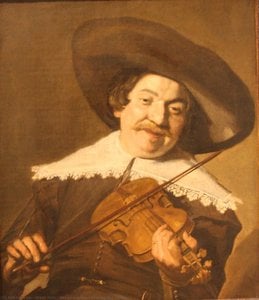
Frans Hals, 1580 – 1666

Frans Hals Paintings: The 100 Most Famous Works, Ranked

Frans Hals's most famous painting is De Giggellende Ridder (1624), in the Wallace Collection, Londen. With gypsy girl and Malle Babbe (1633), it completes the three works everyone recognises. Our catalogue lists 428 works by Frans Hals; the 100 below are the ones the world looks at most, each with its year, the museum that holds it and why it matters.

Ranked by our popularity score, which combines the searches, visits and orders for each work. Updated oktober 2026. Every masterpiece on this page can be ordered as a museum-quality, hand-painted oil reproduction or a fine art print, at the size you choose.

Portrait of Frans Hals
Frans Hals · 1580 – 1666
Born · died
1580 – 1666, Antwerpen
Movement
Baroque brilliance
Works in our catalogue
428
Most famous
De Giggellende Ridder (1624)
Most works at
Metropolitan Museum of Art

The 10 most famous Frans Hals paintings

De Giggellende Ridder (1624) by Frans Hals
1

De Giggellende Ridder

1624 · Olieverf op canvas · Wallace Collection, Londen

De Charisma van "The Laughing Cavalier" Frans Hals’ “The Laughing Cavalier” is meer dan een schilderij; het is een moment gevangen in de tijd, een blik in de ziel van de Nederlandse Gouden Eeuw. Dit iconische portret, geschapen rond 1624, straalt een onmiskenbare zelfverzekerdheid en verfijning uit – een kunstwerk dat zowel kunstliefhebbers als verzamelaars aanspreekt. Het is een symfonie van kleur, licht en beweging, uitgevoerd met Hals’ kenmerkende, losse…

gypsy girl by Frans Hals
2

gypsy girl

Oil

The gypsy girl is a work by the Dutch Golden Age painter Frans Hals. Executed between 1628 and 1630, this half-length portrait presents a young woman in a manner characteristic of the tronie genre. Rather than a formal commissioned portrait, the work functions as a study of facial expression and unusual costume.

Malle Babbe (1633) by Frans Hals
3

Malle Babbe

1633 · Oil · Gemäldegalerie, Berlijn

In the vast tapestry of the Dutch Golden Age, few portraits capture the raw, unbridled spirit of humanity quite like Frans Hals’s Malle Babbe. This masterpiece serves as more than just a likeness; it is a window into the vibrant, often gritty, and deeply expressive soul of seventeenth-century Haarlem. The subject, famously known as "Malle Babbe" (Mad Babbe), is presented not with the stiff, aristocratic poise typical of formal portraiture,…

The Meagre Company (detail) (1633) by Frans Hals
4

The Meagre Company (detail)

1633 · Oil On Canvas · Rijksmuseum, Amsterdam

In the grand tapestry of the Dutch Golden Age, few threads shimmer with as much spontaneous energy as Frans Hals’s 1633 masterpiece, The Meagre Company. To gaze upon this work is to step directly into a bustling seventeenth-century Haarlem, where the air feels thick with the quiet confidence of the merchant elite. Unlike the static, posed portraits that often define the era, this painting captures an exquisite instantaneity—a fleeting breath…

Marriage Portrait of Isaac Massa and Beatrix van der Laen (1622) by Frans Hals
5

Marriage Portrait of Isaac Massa and Beatrix van der Laen

1622 · Oil On Canvas · Rijksmuseum, Amsterdam

Introduction to the Painting Frans Hals's Marriage Portrait of Isaac Massa and Beatrix van der Laen is a remarkable painting that showcases the artist's mastery of portraiture. Painted around 1622, this oil on canvas work measures 140 x 167 cm and is currently housed in the Rijksmuseum in Amsterdam. Background and Historical Significance The painting depicts Isaac Massa, a wealthy Dutch merchant, and his bride Beatrix van der Laen on…

Portrait of a Woman (1650) by Frans Hals
6

Portrait of a Woman

1650 · Oil On Canvas · Metropolitan Museum of Art, New York

To stand before Frans Hals I’s "Portrait of a Woman" is to encounter a moment suspended in time, a direct confrontation with a spirit that has endured since 1650. In an era when Antwerp and Haarlem pulsed with the nervous energy of religious and political transformation, this masterpiece emerged not merely as a record of a face, but as a profound exploration of human dignity. The subject, seated in a…

Regents of the St Elizabeth Hospital of Haarlem (1641) by Frans Hals
7

Regents of the St Elizabeth Hospital of Haarlem

1641 · Oil On Canvas · Frans Hals Museum, Haren

The scene depicts six men seated around a table, dressed in the formal attire of the period. Each figure possesses a distinct personality, conveyed through Hals' masterful use of light and shadow. Notice the subtle variations in their expressions – some are engaged in animated conversation, others appear contemplative, while still others maintain a dignified reserve. This isn’t merely a group portrait; it’s a tableau vivant, a fleeting moment frozen…

Paulus Verschuur (1643) by Frans Hals
8

Paulus Verschuur

1643 · Oil On Canvas · Metropolitan Museum of Art, New York

Introduction to the Artist and Painting Frans Hals, a prominent Dutch Golden Age painter, is renowned for his innovative techniques and evocative portraits. Among his notable works is 'Paulus Verschuur', an oil on canvas masterpiece measuring 119 x 97 cm. This painting is housed in the esteemed Metropolitan Museum of Art in New York, United States. Historical Context and Significance Created during the 17th century, 'Paulus Verschuur' embodies the dynamic…

Willem Coenraetsz Coymans (1645) by Frans Hals
9

Willem Coenraetsz Coymans

1645 · Oil On Canvas · National Gallery of Art, Washington

Frans Hals’s 1645 portrait of Willem Coenraetsz Coymans isn't merely a likeness; it’s a vibrant snapshot of a man, imbued with confidence and the subtle nuances of his social standing. Painted during the height of the Dutch Golden Age, this work transcends the conventions of formal portraiture, offering an intimate glimpse into the life of a Haarlem citizen. Hals masterfully captures not just physical appearance but also the very essence…

Portrait of a Man (17) (1622) by Frans Hals
10

Portrait of a Man (17)

1622 · Oil On Canvas · Devonshire Collection, Chatsworth

In the heart of the Dutch Golden Age, amidst the burgeoning mercantile prosperity of Haarlem, Frans Hals I captured more than just faces; he captured the very essence of human vitality. His masterpiece, Portrait of a Man (17), completed around 1622, serves as a profound window into an era defined by both immense wealth and deep psychological introspection. The subject, often identified as the affluent merchant Isaac Massa, does not…

Frans Hals, paintings 11 to 100

The Merry Drinker (1628) by Frans Hals
#11

The Merry Drinker

1628

In the heart of the seventeenth century, amidst the burgeoning prosperity of the Dutch Golden Age, there emerged a style of painting that captured not just the likeness…

Order a reproduction →
Portrait of a Man (1654) by Frans Hals
#13

Portrait of a Man

1654 · Szépművészeti Múzeum

To stand before this portrait of a man is to encounter not merely a likeness, but a moment suspended in time—a breath caught between thoughts. Executed in the…

Order a reproduction →
Laughing Child (1620) by Frans Hals
#14

Laughing Child

1620 · Mauritshuis

Frans Hals' "Laughing Child," painted around 1620-1625, isn’t merely a portrait; it’s a fleeting capture of pure, unadulterated joy. This small panel painting, measuring just 29 x 29…

Bring it home →
Portrait of a Man Holding a Skull (1611) by Frans Hals
#15

Portrait of a Man Holding a Skull

1611 · Barber Institute of Fine Arts

In the quiet, contemplative depths of the Dutch Golden Age, few images command the viewer's attention with such visceral intensity as Frans Hals I’s “Portrait of a Man…

Bring it home →
Malle Babbe (1635) by Frans Hals
#16

Malle Babbe

1635 · Metropolitan Museum of Art

Subject and Composition This captivating portrait centers on a woman whose expressive face and poised posture draw viewers into a moment of quiet introspection. Likely representing a domestic…

Bring it home →
Portrait of a Man (29) (1650) by Frans Hals
#17

Portrait of a Man (29)

1650 · Hermitage Museum

“Portrait of a Man,” executed in 1650 by Frans Hals I, stands as a quintessential emblem of the Dutch Golden Age—a period defined by unprecedented artistic flourishing and…

Order a reproduction →
Family Group in a Landscape (1648) by Frans Hals
#19

Family Group in a Landscape

1648 · National Gallery

Introduction to Frans Hals and his Artistic Style Frans Hals (c. 1580-1666) was a Dutch Golden Age painter, renowned for his lively and expressive portraits. He is considered…

Bring it home →
Portrait of a Man (15) (1640) by Frans Hals
#20

Portrait of a Man (15)

1640 · Wallraf-Richartz-Museum

Frans Hals' "Portrait of a Man (15)," painted around 1640, isn’t merely a depiction of an individual; it’s a vibrant snapshot of Haarlem in the Dutch Golden Age…

Order a reproduction →
The Drinker (1626) by Frans Hals
#21

The Drinker

1626 · Musée Marmottan Monet

The artwork titled The Drinker was executed by the artist Frans Hals. This oil on canvas work is dated about 1628. The composition focuses on a single male…

Bring it home →
Boy with a Skull (1628) by Frans Hals
#23

Boy with a Skull

1628

The artwork titled Boy with a Skull is a painting by the artist Frans Hals. This work, dated 1628, presents a portrait of a young boy holding a…

Bring it home →
Jasper Schade (1645) by Frans Hals
#25

Jasper Schade

1645 · Nationale Galerie Praag

Frans Hals I's 1645 portrait of Jasper Schade van Westrum is more than just a likeness; it’s a vibrant snapshot of a pivotal moment in Dutch history and…

Order a reproduction →
Portrait of a Man (1654) by Frans Hals
#26

Portrait of a Man

1654 · Szépművészeti Múzeum

Frans Hals' "Portrait of a Man," painted around 1654, isn’t merely a depiction of an individual; it’s a carefully constructed embodiment of status, intellect, and a subtle, almost…

Order a reproduction →
Portrait of Sara Andriesdr. Hessix (1626) by Frans Hals
#27

Portrait of Sara Andriesdr. Hessix

1626 · Calouste Gulbenkian Foundation

Frans Hals’s “Portrait of Sara Andriesdr. Hessix,” painted in 1626, isn't merely a likeness; it’s a carefully constructed tableau of quiet dignity and understated wealth within the vibrant…

Bring it home →
René Descartes (1649) by Frans Hals
#30

René Descartes

1649 · Statens Museum for Kunst

Frans Hals’s 1649 portrait of René Descartes is more than just a likeness; it's a carefully constructed embodiment of the burgeoning spirit of rationalism and the dawn of…

Commission a hand-painted copy →
Regents of the Old Men's Almshouse (detail) (1664) by Frans Hals
#31

Regents of the Old Men's Almshouse (detail)

1664 · Frans Halsmuseum

Frans Hals’ “Regents of the Old Men’s Almshouse (detail)” isn’t merely a portrait; it’s a carefully constructed tableau of civic responsibility, quiet contemplation, and the subtle drama inherent…

Bring it home →
Shrovetide Revellers (1615) by Frans Hals
#32

Shrovetide Revellers

1615 · Metropolitan Museum of Art

To stand before this depiction of Shrovetide Revellers is to be instantly transported across the centuries, right into the warm, intoxicating glow of a communal celebration. This large…

Commission a hand-painted copy →
Cornelia Claesdr Vooght (1631) by Frans Hals
#34

Cornelia Claesdr Vooght

1631 · Frans Halsmuseum

To stand before this portrait of Cornelia Claesdr Vooght is to encounter not merely a likeness, but a profound moment suspended in the amber glow of the early…

Bring it home →
Willem Croes (detail) (1662) by Frans Hals
#36

Willem Croes (detail)

1662 · Alte Pinakothek

To stand before this portrait is to encounter a moment suspended in time—a quiet communion between the sitter and the viewer. Willem Croes, captured here with such arresting…

Order a reproduction →
Buffoon Playing a Lute (1623) by Frans Hals
#37

Buffoon Playing a Lute

1623 · Louvre

In the heart of the seventeenth century, amidst the bustling prosperity of the Dutch Republic, there emerged a style of painting that breathed life into the mundane. Frans…

Order a reproduction →
Portrait of a Man (1660) by Frans Hals
#38

Portrait of a Man

1660 · The Frick Collection

Frans Hals' “Portrait of a Man,” painted around 1660, isn’t merely a likeness; it’s an invitation into the contemplative world of a discerning gentleman. This captivating work, housed…

Commission a hand-painted copy →
The Meagre Company (detail) (1633) by Frans Hals
#39

The Meagre Company (detail)

1633 · Rijksmuseum

To stand before a detail from The Meagre Company is to be instantly transported across the centuries, right into the vibrant, bustling heart of 17th-century Dutch life. This…

Bring it home →
Portrait of a Woman (11) (1640) by Frans Hals
#43

Portrait of a Woman (11)

1640 · Museum voor Schone Kunsten

To stand before a portrait by Frans Hals is not merely to observe paint on canvas; it is to encounter a moment suspended in time, a direct confrontation…

Order a reproduction →
Catharina Hooft with her Nurse (1619) by Frans Hals
#44

Catharina Hooft with her Nurse

1619 · Staatliche Museen zu Berlin

In the quiet intimacy of 1619, Frans Hals I captured a moment that transcends the boundaries of time, inviting us into the private, nurturing world of Catharina Hooft…

Bring it home →
Michiel de Wael (1628) by Frans Hals
#45

Michiel de Wael

1628 · Taft Museum of Art

Frans Hals’s portrait of Michiel de Wael, completed in 1628, isn't merely a likeness; it’s a carefully constructed tableau of status, wealth, and the quiet contemplation characteristic of…

Bring it home →
Portrait of a Man (1660) by Frans Hals
#46

Portrait of a Man

1660 · Nationaal Museum van Denemarken

Frans Hals's “Portrait of a Man,” painted around 1660, isn’t merely a depiction of an individual; it’s a window into the soul of the Dutch Golden Age. This…

Order a reproduction →
Portrait of a Man (12) (1634) by Frans Hals
#48

Portrait of a Man (12)

1634 · Szépművészeti Múzeum

To gaze upon Frans Hals’s Portrait of a Man is to step through a portal into the vibrant, bustling heart of the Dutch Golden Age. Painted during an…

Bring it home →
Portrait of Frans Hals (1648) by Frans Hals
#49

Portrait of Frans Hals

1648 · Museum of Art

To gaze upon Frans Hals I’s Portrait of a Man is to step through a portal into the vibrant, bustling heart of seventeenth-century Haarlem. Completed in 1648, this…

Bring it home →
Portrait of a Man (1660) by Frans Hals
#50

Portrait of a Man

1660 · Museum of Fine Arts

In the heart of the Dutch Golden Age, a period defined by the burgeoning prosperity of Haarlem, Frans Hals I captured more than just a likeness; he arrested…

Bring it home →
Paulus Verschuur (1643) by Frans Hals
#51

Paulus Verschuur

1643 · Metropolitan Museum of Art

Frans Hals’s “Paulus Verschuur,” painted in 1643, is more than simply a portrait; it's a meticulously crafted study in Dutch Golden Age formality and understated power. The painting…

Order a reproduction →
The Merry Drinker (1628) by Frans Hals
#53

The Merry Drinker

1628 · Rijksmuseum

To gaze upon Frans Hals I’s “The Merry Drinker” is to be instantly swept into the vibrant, boisterous energy of a seventeenth-century Haarlem tavern. Painted around 1628, this…

Bring it home →
Frans Hals (1650) by Frans Hals
#55

Frans Hals

1650 · Metropolitan Museum of Art

To gaze upon this masterful portrait by Frans Hals is to step through a portal into the vibrant, bustling heart of the Dutch Golden Age. Painted during an…

Order a reproduction →
Peeckelhaering (detail) (1628) by Frans Hals
#57

Peeckelhaering (detail)

1628 · Staatliche Kunstsammlungen Kassel

In the quiet corners of art history, certain details possess the power to command an entire room, much like a whispered secret shared between the viewer and the…

Order a reproduction →
Shrovetide Revellers (detail) (1615) by Frans Hals
#59

Shrovetide Revellers (detail)

1615 · Metropolitan Museum of Art

Frans Hals' "Shrovetide Revellers (detail)," painted around 1615, isn’t merely a portrait; it’s a vibrant snapshot of communal joy and the intoxicating spirit of celebration. This captivating work,…

Order a reproduction →
Peeckelhaering (1628) by Frans Hals
#60

Peeckelhaering

1628 · Staatliche Kunstsammlungen Kassel

Frans Hals's "Peeckelhaering": A Glimpse into Dutch Golden Age Merriment Painted in 1628, Frans Hals’s “Peeckelhaering” is more than just a portrait; it’s a vibrant snapshot of the…

Commission a hand-painted copy →
Malle Babbe (detail) (1633) by Frans Hals
#61

Malle Babbe (detail)

1633 · Staatliche Museen zu Berlin

Frans Hals' “Malle Babbe,” painted around 1635, isn’t merely a portrait; it’s an arresting psychological study, a fleeting moment captured with astonishing immediacy. This captivating work, currently residing…

Order a reproduction →
Malle Babbe (1633) by Frans Hals
#62

Malle Babbe

1633 · Staatliche Museen zu Berlin

Frans Hals' "Malle Babbe," painted in 1633, is far more than just a portrait; it’s a window into the complexities of human nature and a masterful demonstration of…

Commission a hand-painted copy →
Portrait of a Man (10) by Frans Hals
#63

Portrait of a Man (10)

Statens Museum for Kunst

To stand before Frans Hals I's Portrait of a Man is to encounter the very heartbeat of the seventeenth-century Dutch Golden Age. This is not merely a static…

Order a reproduction →
Portrait of a Man (13) (1650) by Frans Hals
#64

Portrait of a Man (13)

1650 · Metropolitan Museum of Art

Frans Hals' "Portrait of a Man (13)," painted around 1650, isn’t merely a depiction of an individual; it’s a carefully constructed tableau of status, personality, and the burgeoning…

Commission a hand-painted copy →
The Fisher Boy (1630) by Frans Hals
#65

The Fisher Boy

1630 · Koninklijk KMSKA Antwerpen

Frans Hals's "The Fisher Boy," painted circa 1632, isn't merely a portrait; it’s a vibrant snapshot of early 17th-century Dutch life, brimming with youthful energy and an intimate…

Bring it home →
Portrait of an Elderly Man (1627) by Frans Hals
#66

Portrait of an Elderly Man

1627 · The Frick Collection

Frans Hals' "Portrait of an Elderly Man," painted circa 1627-30, isn’t merely a depiction of a gentleman; it’s a carefully constructed tableau of character, age, and the subtle…

Bring it home →
Singing Boy with a Flute (1623) by Frans Hals
#67

Singing Boy with a Flute

1623 · Staatliche Museen zu Berlin

Frans Hals’ “Singing Boy with a Flute,” painted in 1623, isn't merely a portrait; it’s a vibrant snapshot of a fleeting moment, a testament to the artist’s revolutionary…

Bring it home →
Mulatto (so-called) (1628) by Frans Hals
#69

Mulatto (so-called)

1628 · Museum der bildenden Künste

Frans Hals I (1580 – 1666) stands as one of the most celebrated figures of the Dutch Golden Age, an era defined by artistic innovation and cultural flourishing.…

Order a reproduction →
A Young Man in a Large Hat (1628) by Frans Hals
#71

A Young Man in a Large Hat

1628 · National Gallery of Art

A Portrait of Youthful Confidence: Exploring Frans Hals’ ‘A Young Man in a Large Hat’ Frans Hals I's “A Young Man in a Large Hat,” painted circa 1628,…

Order a reproduction →
the laughing cavalier (1624) by Frans Hals
#72

the laughing cavalier

1624 · Wallace Collection

The Laughing Cavalier is a portrait by Frans Hals, executed in 1624. The subject is a man captured in a moment of subtle expression, his face marked by…

Bring it home →
Portrait of Rene Descartes (1649) by Frans Hals
#74

Portrait of Rene Descartes

1649 · Louvre

We are looking at the Portrait of Rene Descartes, a work executed by the Dutch painter Frans Hals. This portrait, dated 1649, presents us with a focused study…

Bring it home →
Portrait of a Man (1630) by Frans Hals
#76

Portrait of a Man

1630 · Royal Collection

A Portrait of Dignified Presence: Frans Hals’ Masterpiece Frans Hals I's “Portrait of a Man,” painted circa 1630, stands as an emblem of the Dutch Golden Age—a testament…

Bring it home →
Portrait of a Woman (1639) by Frans Hals
#78

Portrait of a Woman

1639 · National Gallery

A three-quarter view portrait captures a middle-aged woman against a dark, indeterminate background. The composition focuses on the subject from the waist up, utilizing a restrained palette of…

Commission a hand-painted copy →
Portrait of an artist (1644) by Frans Hals
#79

Portrait of an artist

1644 · Art Institute of Chicago

A single man occupies the space, caught in a three-quarter view that pulls the viewer into his immediate presence. He wears a wide, crisp white collar that cuts…

Bring it home →
Jonker Ramp en zijn Geliefde (1623) by Frans Hals
#80

Jonker Ramp en zijn Geliefde

1623 · Metropolitan Museum of Art

Frans Hals I, een Nederlandse Gouden Eeuw schilder geboren rond 1580 in Antwerpen, België, staat bekend om zijn baanbrekende stijl binnen het genre portret en zijn vermogen om…

Bring it home →
Boy with a Lute (1625) by Frans Hals
#81

Boy with a Lute

1625 · Metropolitan Museum of Art

A Snapshot of Haarlem’s Artistic Soul: Frans Hals and ‘Boy with a Lute’ Frans Hals I, born in Antwerp around 1580, stands as an undeniable titan amongst Dutch…

Order a reproduction →
Pieter Cornelisz van der Morsch (1616) by Frans Hals
#82

Pieter Cornelisz van der Morsch

1616 · Carnegie Museum of Art

Pieter Cornelisz van der Morsch: A Glimpse of Dutch Golden Age Dignity Frans Hals’s “Pieter Cornelisz van der Morsch,” painted in 1616, isn't merely a portrait; it’s a…

Bring it home →
Nicolaes Woutersz van der Meer (1631) by Frans Hals
#83

Nicolaes Woutersz van der Meer

1631 · Frans Halsmuseum

In the quiet, commanding presence of Frans Hals I’s portrait of Nicolaes Woutersz van der Meer, we encounter more than just a likeness of a seventeenth-century magistrate; we…

Bring it home →
Portrait of a Woman (1649) by Frans Hals
#85

Portrait of a Woman

1649 · Kunsthistorisches Museum

In this 1649 portrait, we encounter a woman who meets our gaze with a quiet, steady confidence. She is positioned in a three-quarter length view, her body turned…

Bring it home →
Feyntje van Steenkiste (1635) by Frans Hals
#86

Feyntje van Steenkiste

1635 · Rijksmuseum

The Portrait of Feyntje van Steenkiste is an oil on canvas painting executed by Frans Hals in 1635. The subject, Feyntje van Steenkiste, was the wife of Lucas…

Order a reproduction →
F. Portrait of a man, before (1660) by Frans Hals
#88

F. Portrait of a man, before

1660

This captivating portrait offers a window into the world of 17th-century Dutch society. Likely dating back to around 1660, it depicts a gentleman or official with an air…

Bring it home →
Portrait of a Boy facing Left (1620) by Frans Hals
#89

Portrait of a Boy facing Left

1620 · Philadelphia Museum of Art

A young boy is captured in profile, his gaze directed toward the left. The composition focuses tightly on the face and upper shoulder, utilizing a dramatic chiaroscuro effect…

Order a reproduction →
Adriaen van Ostade (1648) by Frans Hals
#90

Adriaen van Ostade

1648 · National Gallery of Art

This portrait by Frans Hals presents us with Adriaen van Ostade, a painter from Haarlem known for his depictions of rural life. The work is dated 1646/1648. In…

Order a reproduction →
Portrait of Tieleman Roosterman (1634) by Frans Hals
#91

Portrait of Tieleman Roosterman

1634 · Cleveland Museum of Art

Frans Hals’s "Portrait of Tieleman Roosterman," painted in 1634, is more than just a likeness; it's a window into the world of 17th-century Haarlem. This striking portrait captures…

Bring it home →
Portrait of a Boy (1620) by Frans Hals
#92

Portrait of a Boy

1620 · Philadelphia Museum of Art

Portrait of a Boy by Frans Hals, executed around 1620, presents a bust-length study of a single youth. The subject is captured in profile, positioned against a dark,…

Bring it home →

The subjects Frans Hals painted most

The four subjects that return most often among these masterpieces, with the finest example of each.

Where to see Frans Hals's paintings

The 8 museums that hold the most of the paintings on this page.

Museum City Works by Frans Hals Paintings from this list
Metropolitan Museum of Art, New YorkMetropolitan Museum of Art New York 21 Portrait of a Woman, Paulus Verschuur, Malle Babbe
Rijksmuseum, AmsterdamRijksmuseum Amsterdam 22 The Meagre Company (detail), Marriage Portrait of Isaac Massa and Beatrix van der Laen, Married Couple in a Garden (detail)
Frans Halsmuseum, HarenFrans Halsmuseum Haren 12 Regents of the Old Men's Almshouse (detail), Banquet of the Officers of the St Hadrian Civic Guard Company, Cornelia Claesdr Vooght
Staatliche Museen zu Berlin, BerlijnStaatliche Museen zu Berlin Berlijn 7 Catharina Hooft with her Nurse, Malle Babbe (detail), Malle Babbe
National Gallery of Art, WashingtonNational Gallery of Art Washington 10 Willem Coenraetsz Coymans, A Young Man in a Large Hat, Adriaen van Ostade
National Gallery, LondenNational Gallery Londen 8 Family Group in a Landscape, Young Man with a Skull (Vanitas), Portrait of a Woman
Szépművészeti Múzeum, BoedapestSzépművészeti Múzeum Boedapest 5 Portrait of a Man, Portrait of a Man, Portrait of a Man (12)
Louvre, ParijsLouvre Parijs 4 Portrait of a Woman, Buffoon Playing a Lute, Portrait of Rene Descartes

Frans Hals's most famous painting of each decade

  1. 1600s
  2. 1610s
    Portrait of a Man Holding a Skull (1611) by Frans Hals
    Rank 15 / 100

    Portrait of a Man Holding a Skull

    Age 30 – 39 · Barber Institute of Fine Arts

    In the quiet, contemplative depths of the Dutch Golden Age, few images command the viewer's attention with such visceral intensity as Frans Hals I’s “Portrait of a Man…

  3. 1620s
    De Giggellende Ridder (1624) by Frans Hals
    Rank 1 / 100

    De Giggellende Ridder

    Age 40 – 49 · Wallace Collection

    De Charisma van "The Laughing Cavalier" Frans Hals’ “The Laughing Cavalier” is meer dan een schilderij; het is een moment gevangen in de tijd, een blik in de…

  4. 1630s
    Malle Babbe (1633) by Frans Hals
    #3 of 100

    Malle Babbe

    Age 50 – 59 · Gemäldegalerie

    In the vast tapestry of the Dutch Golden Age, few portraits capture the raw, unbridled spirit of humanity quite like Frans Hals’s Malle Babbe. This masterpiece serves as…

  5. 1640s
    Regents of the St Elizabeth Hospital of Haarlem (1641) by Frans Hals
    No. 7 of 100

    Regents of the St Elizabeth Hospital of Haarlem

    Age 60 – 69 · Frans Hals Museum

    The scene depicts six men seated around a table, dressed in the formal attire of the period. Each figure possesses a distinct personality, conveyed through Hals' masterful use…

  6. 1650s
    Portrait of a Woman (1650) by Frans Hals
    #6 of 100

    Portrait of a Woman

    Age 70 – 79 · Metropolitan Museum of Art

    To stand before Frans Hals I’s "Portrait of a Woman" is to encounter a moment suspended in time, a direct confrontation with a spirit that has endured since…

  7. 1660s
    Regents of the Old Men's Almshouse (detail) (1664) by Frans Hals
    Rank 31 / 100

    Regents of the Old Men's Almshouse (detail)

    Age 80 – 86 · Frans Halsmuseum

    Frans Hals’ “Regents of the Old Men’s Almshouse (detail)” isn’t merely a portrait; it’s a carefully constructed tableau of civic responsibility, quiet contemplation, and the subtle drama inherent…

Questions about Frans Hals's paintings

What is Frans Hals's most famous painting?Show the answer

De Giggellende Ridder (1624), Wallace Collection, Londen. Next come gypsy girl and Malle Babbe (1633).

How old was Frans Hals when De Giggellende Ridder was painted?Show the answer

44 years old: De Giggellende Ridder dates from 1624 and Frans Hals was born in 1580.

What are the top 10 paintings by Frans Hals?Show the answer

De Giggellende Ridder, gypsy girl, Malle Babbe, The Meagre Company (detail), Marriage Portrait of Isaac Massa and Beatrix van der Laen, Portrait of a Woman, Regents of the St Elizabeth Hospital of Haarlem, Paulus Verschuur, Willem Coenraetsz Coymans and Portrait of a Man (17). The ranking above gives the year and the museum of each.

How many paintings did Frans Hals make?Show the answer

Our catalogue lists 428 works by Frans Hals, dated from 1600 to 1664.

Where are Frans Hals's most famous paintings?Show the answer

Most of them are in Metropolitan Museum of Art (New York), Rijksmuseum (Amsterdam) and Frans Halsmuseum (Haren). The table above lists the museums one by one.

When did Frans Hals paint the most famous works?Show the answer

In 1620s: 30 of the 100 works on this page date from then, among them De Giggellende Ridder.

What are Frans Hals's earliest and latest famous paintings?Show the answer

The earliest on this page is Banquet in a Park (1600), the latest Regents of the Old Men's Almshouse (detail) (1664).

What did Frans Hals paint most often?Show the answer

Portraiture (44), Portrait (26) and 17th century (21), among the 100 works on this page.

What medium did Frans Hals use most?Show the answer

Oil On Canvas: 69 of the 100 works on this page.

Which art movement does Frans Hals belong to?Show the answer

Baroque brilliance and Dutch golden age, as the paintings on this page show.

Which Frans Hals paintings can I see at the Metropolitan Museum of Art?Show the answer

Portrait of a Woman, Paulus Verschuur and Malle Babbe are among the 11 works on this page held by the Metropolitan Museum of Art, New York.

Can I buy a reproduction of a Frans Hals painting?Show the answer

Yes. Every painting on this page can be ordered as a museum-quality, hand-painted oil reproduction or a fine art print, in the size you choose, from the painting's own page.

About Frans Hals

Frans Hals I: Een leven in schilderkunst

Frans Hals I werd geboren rond 1580 in Antwerpen, België, een stad die zich tijdens zijn tijd bevond aan de rand van het Spaanse Rijk. Zijn vroegste levensgeschiedenis blijft enigszins gehuld in mysterie, maar hij steeg op tot een van de meest prominente figuren van de Gouden Eeuw, geroemd om zijn innovatieve portretten en genrebeelden.

Vroege levensloop en opleiding

Er zijn weinig gegevens over Hals’s jeugdige jaren. Het wordt beweerd dat hij aanvankelijke artistieke training ontving in Antwerpen, een belangrijke kunstcentrum op het moment. Echter, vanwege religieuze en politieke turbulentie verhuisde zijn familie naar Haarlem in Nederland. Hij werd lid van de Haarlems Gildenaarstekerkracht in 1610, wat het officiële begin vormde van zijn professionele carrière.

Artistieke stijl en ontwikkeling

Hals onderscheidde zich door een buitengewoon fris en spontaan stijl. Anders dan veel van zijn tijdgenoten die voor fijn gedetailleerde werken vochten, gebruikte hij een losse en expressieve penseelstrek. Deze techniek gaf zijn schilderijen een gevoel van urgentie en levensenergie, waardoor hij de persoonlijkheid en karakter van zijn onderwerpen op een manier vastlegde die revolutionair was voor zijn tijd. Hij verkende nieuwe mogelijkheden binnen het genre portret, waarbij hij zich richtte op het weergeven van emoties en beweging, iets wat veel andere kunstenaars nog niet hadden gedaan. Zijn stijl werd sterk beïnvloed door de werken van Pieter Bruegel de Oudere, een belangrijke figuur van het Vlaamse primitieven beweging. Hij ontwikkelde een manier om licht en schaduw te gebruiken die een dramatische dimensie gaf aan zijn composities en een gevoel voor atmosfeer creëerde dat typerend was voor zijn tijd.

Bekende werken

Hoewel Hals een breed scala aan kunstwerken produceerde, staat hij vooral bekend om zijn portretten. Een aantal van zijn meest beroemde schilderijen omvat:
  • De Giggellende Ridder (1624) – Een klassiek voorbeeld van zijn vermogen om karakter en beweging vast te leggen. Het werk vangt een moment van spontane vreugde en zelfbewustzijn, waarbij de onderwerpen niet alleen lijken maar ook emoties uitdrukken die hun persoonlijkheid weergeven.
  • Malle Babbe (c. 1633-1635) – Een opvallende afbeelding van een oude vrouw, die Hals’s bekwaamheid laat zien om leeftijd en karakter weer te geven. Het schilderij is gekenmerkt door een warme kleurgebruik en een gedetailleerde weergave van het gezicht en de houding van Malle Babbe.
  • Portretten van de Regents van het Oudemannenhuis in Haarlem (1664) – Een prachtige groepsprent die Hals’s beheersing van groepsprenten laat zien. De werken zijn een hoogtepunt van zijn stijl en bieden een fascinerende kijk op het sociale leven van Haarlem tijdens zijn tijd.
Hij creëerde ook boeiende genrebeelden – afbeeldingen van het dagelijks leven – die een glimp gaven van Nederlandse samenleving. Zijn werk wordt vaak beschouwd als een belangrijk onderdeel van de kunstgeschiedenis van de Gouden Eeuw en heeft een blijvende invloed gehad op latere kunstenaars.

Invloeden en Erfenis

Hals’ stijl werd sterk beïnvloed door het werk van andere kunstenaars, waaronder Pieter Bruegel de Oudere en Rembrandt Harmensz van Rijn. Hij verkende nieuwe mogelijkheden binnen het genre portret, waarbij hij zich richtte op het weergeven van emoties en beweging, iets wat veel andere kunstenaars nog niet hadden gedaan. Zijn stijl werd ook sterk beïnvloed door de werken van Duitse kunstenaars zoals Albrecht Dürer en Matthias Grünewald. Hij ontwikkelde een manier om licht en schaduw te gebruiken die een dramatische dimensie gaf aan zijn composities en een gevoel voor atmosfeer creëerde dat typerend was voor zijn tijd. Zijn stijl werd ook sterk beïnvloed door de werken van Italiaanse kunstenaars zoals Leonardo da Vinci en Michelangelo Buonarroti. Hij verkende nieuwe mogelijkheden binnen het genre portret, waarbij hij zich richtte op het weergeven van emoties en beweging, iets wat veel andere kunstenaars nog niet hadden gedaan. Zijn stijl werd ook sterk beïnvloed door de werken van Vlaamse kunstenaars zoals Jan Vermeulen en Pieter Claesz. Hij verkende nieuwe mogelijkheden binnen het genre portret, waarbij hij zich richtte op het weergeven van emoties en beweging, iets wat veel andere kunstenaars nog niet hadden gedaan. Zijn stijl werd ook sterk beïnvloed door de werken van Duitse kunstenaars zoals Albrecht Dürer en Matthias Grünewald. Hij verkende nieuwe mogelijkheden binnen het genre portret, waarbij hij zich richtte op het weergeven van emoties en beweging, iets wat veel andere kunstenaars nog niet hadden gedaan. Zijn stijl werd ook sterk beïnvloed door de werken van Italiaanse kunstenaars zoals Leonardo da Vinci en Michelangelo Buonarroti. Hij verkende nieuwe mogelijkheden binnen het genre portret, waarbij hij zich richtte op het weergeven van emoties en beweging, iets wat veel andere kunstenaars nog niet hadden gedaan. Zijn stijl werd ook sterk beïnvloed door de werken van Vlaamse kunstenaars zoals Jan Vermeulen en Pieter Claesz. Hij verkende nieuwe mogelijkheden binnen het genre portret, waarbij hij zich richtte op het weergeven van emoties en beweging, iets wat veel andere kunstenaars nog niet hadden gedaan. Zijn stijl werd ook sterk beïnvloed door de werken van Duitse kunstenaars zoals Albrecht Dürer en Matthias Grünewald. Hij verkende nieuwe mogelijkheden binnen het genre portret, waarbij hij zich richtte op het weergeven van emoties en beweging, iets wat veel andere kunstenaars nog niet hadden gedaan. Zijn stijl werd ook sterk beïnvloed door de werken van Italiaanse kunstenaars zoals Leonardo da Vinci en Michelangelo Buonarroti. Hij verkende nieuwe mogelijkheden binnen het genre portret, waarbij hij zich richtte op het weergeven van emoties en beweging, iets wat veel andere kunstenaars nog niet hadden gedaan. Zijn stijl werd ook sterk beïnvloed door de werken van Vlaamse kunstenaars zoals Jan Vermeulen en Pieter Claesz. Hij verkende nieuwe mogelijkheden binnen het genre portret, waarbij hij zich richtte op het weergeven van emoties en beweging, iets wat veel andere kunstenaars nog niet hadden gedaan. Zijn stijl werd ook sterk beïnvloed door de werken van Duitse kunstenaars zoals Albrecht Dürer en Matthias Grünewald. Hij verkende nieuwe mogelijkheden binnen het genre portret, waarbij hij zich richtte op het weergeven van emoties en beweging, iets wat veel andere kunstenaars nog niet hadden gedaan. Zijn stijl werd ook sterk beïnvloed door de werken van Italiaanse kunstenaars zoals Leonardo da Vinci en Michelangelo Buonarroti. Hij verkende nieuwe mogelijkheden binnen het genre portret, waarbij hij zich richtte op het weergeven van emoties en beweging, iets wat veel andere kunstenaars nog niet hadden gedaan. Zijn stijl werd ook sterk beïnvloed door de werken van Vlaamse kunstenaars zoals Jan Vermeulen en Pieter Claesz. Hij verkende nieuwe mogelijkheden binnen het genre portret, waarbij hij zich richtte op het weergeven van emoties en beweging, iets wat veel andere kunstenaars nog niet hadden gedaan. Zijn stijl werd ook sterk beïnvloed door de werken van Duitse kunstenaars zoals Albrecht Dürer en Matthias Grünewald. Hij verkende nieuwe mogelijkheden binnen het genre portret, waarbij hij zich richtte op het weergeven van emoties en beweging, iets wat veel andere kunstenaars nog niet hadden gedaan. Zijn stijl werd ook sterk beïnvloed door de werken van Italiaanse kunstenaars zoals Leonardo da Vinci en Michelangelo Buonarroti. Hij verkende nieuwe mogelijkheden binnen het genre portret, waarbij hij zich richtte op het weergeven van emoties en beweging, iets wat veel andere kunstenaars nog niet hadden gedaan. Zijn stijl werd ook sterk beïnvloed door de werken van Vlaamse kunstenaars zoals Jan Vermeulen en Pieter Claesz. Hij verkende nieuwe mogelijkheden binnen het genre portret, waarbij hij zich richtte op het weergeven van emoties en beweging, iets wat veel andere kunstenaars nog niet hadden gedaan. Zijn stijl werd ook sterk beïnvloed door de werken van Duitse kunstenaars zoals Albrecht Dürer en Matthias Grünewald. Hij verkende nieuwe mogelijkheden binnen het genre portret, waarbij hij zich richtte op het weergeven van emoties en beweging, iets wat veel andere kunstenaars nog niet hadden gedaan. Zijn stijl werd ook sterk beïnvloed door de werken van Italiaanse kunstenaars zoals Leonardo da Vinci en Michelangelo Buonarroti. Hij verkende nieuwe mogelijkheden binnen het genre portret, waarbij hij zich richtte op het weergeven van emoties en

All 428 works by Frans Hals →