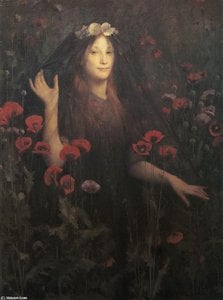
Early Life and Education
Thomas Cooper Gotch, a name now synonymous with the vibrant landscapes and evocative portraits of Cornwall, was born on December 10th, 1854, in Kettering, Northamptonshire – a quiet market town nestled within England’s Midlands. His lineage traced back to a family deeply rooted in tradition; his father, John Henry Gotch, a skilled shoemaker, possessed an entrepreneurial spirit that culminated in the establishment of *J.C. Gotch & Sons*, a bank that would become a vital artery for the local economy. His elder brother, John Alfred Gotch, followed suit, dedicating himself to architecture and designing buildings across Britain – a testament to the family’s commitment to both craftsmanship and commerce. Thomas's upbringing was far from ordinary; his parents recognized his artistic inclinations early on, providing him with opportunities that extended beyond the typical education of the time. He attended Heatherley’s Art School in London, immersing himself in the techniques of academic painting, and subsequently enrolled at Slade School of Fine Art alongside figures like Henry Scott Tuke and Caroline Yates – a formative encounter that would profoundly shape his artistic sensibilities. These institutions instilled not only technical proficiency but also an appreciation for the aesthetic ideals championed by the Pre-Raphaelites, a movement characterized by its reverence for beauty, imaginative storytelling, and meticulous attention to detail.The Influence of Pre-Raphaelite Aesthetics
Gotch’s artistic journey was inextricably linked to the Pre-Raphaelite Brotherhood – a group of artists who deliberately rejected the conventions of academic art and sought inspiration in the art of the Middle Ages and medieval literature. Artists such as Dante Gabriel Rossetti, William Holman Hunt, and John Everett Millais advocated for a return to sincerity and an idealized depiction of nature, rejecting the artificiality often associated with Neoclassical styles. Gotch wholeheartedly embraced these principles, evident in his early landscapes – characterized by muted colours, atmospheric perspective, and a painstaking observation of the natural world. He was particularly drawn to the Barbizon School’s emphasis on *plein air* painting – working directly from nature outdoors – a technique championed by artists like Jean-François Millet. This approach allowed him to capture fleeting moments of beauty and convey a sense of immediacy that resonated deeply with the Pre-Raphaelite ethos, prioritizing direct observation over academic representation. Furthermore, Gotch’s artistic vision was significantly influenced by Japanese prints, particularly those created by Hiroshige and Utagawa Kunichika. The delicate compositions, vibrant colours, and intricate patterns found in these works informed his own approach to composition and decorative elements – a defining characteristic of the Pre-Raphaelite aesthetic.Newlyn School and Artistic Development
Around 1881, Gotch embarked on a new chapter in his life by marrying Caroline Burland Yates – another aspiring artist who shared his passion for Pre-Raphaelite ideals. Together, they established a home in Newlyn, Cornwall – a thriving artistic colony that attracted artists seeking to capture the rugged beauty of the Cornish coastline and its dramatic sunsets. This relocation marked a pivotal moment in Gotch’s artistic development; he began to immerse himself in the distinctive style of the Newlyn School – characterized by bold colours, loose brushwork, and an expressive handling of paint. Influenced by Whistler's techniques for creating compositions and paintings, Gotch moved away from the subdued palette of his earlier landscapes towards a more dynamic and vibrant visual language. He skillfully blended Pre-Raphaelite influences with Cornish landscape traditions, producing evocative depictions of Mount’s Bay and its surrounding hills – works that continue to captivate viewers today. Notably, he employed glazing techniques to create luminous surfaces and enhance the depth of colour, contributing to the rich and atmospheric quality of his paintings.Notable Works and Recognition
Gotch's artistic output spanned a remarkable range of subjects – from portraits of children and women to expansive landscapes and allegorical genre scenes. His daughter, Phyllis Marion Gotch, frequently served as a model for his paintings, capturing her youthful beauty in canvases imbued with Pre-Raphaelite colour palettes and compositional dynamism. Among his most celebrated works are *The Orchard* (1887), *Ruby* (1892) and *The Exile* (1893)—each demonstrating Gotch’s mastery of technique and his ability to convey profound emotion through visual imagery. His painting *My Crown and Sceptre*, completed in 1892, exemplifies his embrace of Symbolist aesthetics – incorporating decorative Italian textiles and a static order reminiscent of early Renaissance art – a stylistic shift that garnered considerable acclaim from critics like Tate who recognised Gotch’s newfound artistic vision. He was awarded RBA membership in 1885 and RI membership in 1912, cementing his position as one of Britain's leading artists of the era. His works are held in collections across Australia, New Zealand, South Africa and the United Kingdom – a testament to their enduring beauty and artistic significance.Legacy and Influence
Thomas Cooper Gotch passed away on May 1st, 1931, in London during an exhibition of his work—leaving behind a legacy as one of Cornwall’s most accomplished Pre-Raphaelite painters. His dedication to capturing the essence of Cornish landscape and his masterful execution of Pre-Raphaelite principles continue to inspire artists today. He was buried in Sancreed churchyard alongside fellow Newlyn School artists Stanhope Alexander Forbes and Elizabeth Adele Forbes – a poignant reminder of Cornwall’s rich artistic heritage. Gotch's influence extended beyond his own paintings; he established the Newlyn Industrial Classes, fostering artistic education amongst young people, and served on the committee of the Newlyn Art Gallery—actively promoting Cornish art and culture throughout his life. His work remains a cornerstone of British painting history, embodying the ideals of beauty, imagination, and meticulous observation that defined the Pre-Raphaelite movement – a testament to Gotch’s enduring artistic vision.Vraag & Antwoord
In welke perioden is de carrière van Thomas Cooper Gotch onderverdeeld?
De carrière van Thomas Cooper Gotch ontvouwt zich periode voor periode op de Chronologie pagina van de kunstenaar: een horizontale tijdlijn van de kunstwerken, gegroepeerd in hoofdstukken per carrièreperiode.
Waar zijn de kunstwerken van Thomas Cooper Gotch gegroepeerd op kleurpalet te vinden?
De Op kleurpalet-pagina groepeert de kunstwerken van Thomas Cooper Gotch op basis van hun kleurenpalet.
Onder welke andere namen is Thomas Cooper Gotch bekend?
Thomas Cooper Gotch staat ook bekend als T. C. Gotch.