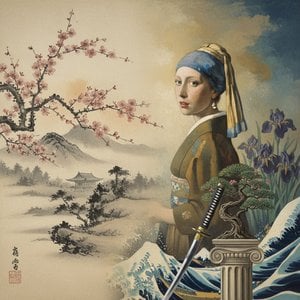
Takashina Takakane is a contemporary Japanese artist whose work exists in a fascinating space between tradition and innovation, realism and the surreal. While biographical details remain intentionally scarce – Takakane prefers to let the paintings speak for themselves – his art has steadily garnered international recognition for its meticulous technique, haunting beauty, and deeply symbolic narratives. Born in Japan (the exact year remains undisclosed), Takakane’s artistic journey is one of quiet dedication, a sustained exploration of themes relating to memory, identity, and the ephemeral nature of existence. He continues to live and work today, consistently producing pieces that challenge viewers to look beyond the surface and contemplate the hidden layers within.
A Dialogue with Tradition: Nihonga and Beyond
Takakane’s foundation lies firmly rooted in the classical Japanese painting style known as Nihonga. This tradition, meaning “Japanese-style painting,” emphasizes natural materials – typically mineral pigments ground from stone and shell, applied with brushes made of animal hair to handmade washi paper. However, Takakane doesn’t simply replicate Nihonga; he subtly subverts it. While mastering the painstaking techniques of his predecessors—the layering of translucent colors, the delicate rendering of detail—he introduces a distinctly contemporary sensibility. His paintings often depict figures and scenes that feel both ancient and utterly new, populated by individuals with melancholic expressions and set within dreamlike landscapes. The influence of Ukiyo-e, traditional Japanese woodblock prints, is also visible in his compositions and use of space, though Takakane’s palette is far more restrained, favoring muted tones and subtle gradations.
The Poetics of Absence: Recurring Motifs and Symbolism
A defining characteristic of Takashina Takakane's work is its pervasive sense of longing and quietude. His paintings are rarely narratives in a straightforward sense; instead, they evoke moods and suggest stories through carefully chosen motifs. Water features prominently – rivers, lakes, oceans – often acting as metaphors for the flow of time and the subconscious. Figures are frequently depicted gazing into the distance or partially obscured by mist or shadow, creating an atmosphere of mystery and introspection. Animals, particularly birds and fish, appear repeatedly, carrying symbolic weight related to freedom, transformation, and the fragility of life. The artist’s use of empty space is equally crucial; it isn't merely a backdrop but an active element that invites contemplation and allows the viewer to project their own emotions onto the scene. The recurring presence of traditional Japanese architecture – temples, gardens, bridges – further grounds his work in a specific cultural context while simultaneously suggesting a sense of loss or displacement.
Technical Mastery: A Labor of Love
Takakane’s commitment to Nihonga is evident not only in the subject matter but also in the sheer labor involved in creating each piece. The process is incredibly time-consuming, requiring years of training and unwavering patience. He meticulously prepares his own pigments from raw materials, a practice that connects him directly to centuries of artistic tradition. Each layer of paint is applied with delicate brushstrokes, building up depth and luminosity over many months—sometimes even years—to achieve the subtle effects he desires. This dedication to traditional methods isn’t simply about preserving the past; it's about achieving a level of nuance and emotional resonance that would be impossible with more modern techniques. The resulting surfaces are remarkably smooth and luminous, possessing an almost otherworldly quality that draws the viewer in.
Historical Significance: A Contemporary Voice
Takashina Takakane occupies a unique position within contemporary art. He isn’t easily categorized, resisting simple labels of “traditional” or “modern.” His work bridges cultural divides, appealing to audiences both in Japan and internationally. In an era dominated by mass production and digital imagery, his painstaking technique and focus on handcrafted beauty offer a powerful counterpoint.
He represents a continuation of the Japanese aesthetic tradition.
His paintings explore universal themes of memory, identity, and loss in a deeply personal way.
Takakane’s work challenges viewers to slow down and appreciate the subtleties of visual experience.
While he maintains a deliberate distance from public scrutiny, his art speaks volumes—a testament to the enduring power of quiet contemplation and meticulous craftsmanship. His significance lies in his ability to revitalize an ancient tradition while simultaneously forging a distinctly contemporary artistic voice.
Explore the profound beauty of Japanese landscape painting. From Hokusai's iconic vistas to Zen-inspired compositions, discover the spiritual depth and historical mastery of Ukiyo-e art in this expert cultural retrospective.
Explore the profound influence of Japanese artistry on global masterpieces. From Ukiyo-e prints to Zen aesthetics, discover how Eastern elegance transformed Western art history in this deep cultural reflection for fine art enthusiasts and collectors.
Explore the ephemeral beauty of Japanese Ukiyo-e art. From the dynamic warriors of Kuniyoshi to serene landscapes, discover the profound history, masterful techniques, and global influence of these iconic woodblock prints in our deep cultural retrospective.
Hoi! Ik kan je helpen bij het kiezen van een kunstwerk, het volgen van een bestelling of het beantwoorden van vragen over de garantie. Waarmee kan ik je van dienst zijn?