The Architect of the Avant-Garde: The Life and Vision of Tadeusz Peiper
In the turbulent, transformative landscape of early 20th-century Europe, few voices resonated with as much structural precision and radical foresight as Tadeusz Peiper. Born in 1891 in Kilmontów, Poland, Peiper emerged not merely as a poet, but as a profound theoretician of the soul and the machine. His journey was one of deep personal and intellectual metamorphosis; born into a Jewish family, his early conversion to Catholicism provided a spiritual foundation that would later intertwine with his fascination for the secular, industrial pulse of modernity. This unique duality—a blend of spiritual depth and a relentless drive toward the future—allowed him to navigate the complex cultural currents of an era caught between tradition and the burgeoning technological age.
Peiper’s formative years were significantly enriched by his time in Spain, a period that acted as a vital bridge between Polish sensibilities and the broader European avant-garde. Living in Madrid amidst the vibrant Ultraist circles, he absorbed the energy of artists like Robert and Sonia Delaunay and engaged with the intellectual rigor of thinkers such as José Ortega y Gasset. These international encounters were not merely biographical footnotes; they were the crucible in which his theories of constructivism were forged. He returned to Poland not just with memories, however, but with a mission to dismantle the stagnant poetic conventions of the past and replace them with a language capable of articulating the speed, noise, and rhythm of the modern world.
City, Mass, Machine: The Constructivist Manifesto
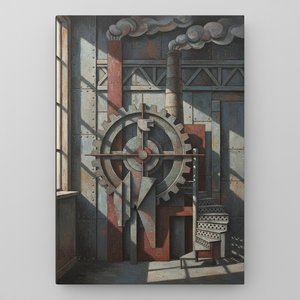
The heart of Peiper’s artistic legacy lies in his role as the primary architect of the Awangarda Krakowska (Kraków Avant-garde). He did not seek to simply write new poems; he sought to engineer a new way of perceiving reality. Through his influential journal, Zwrotnica, Peiper provided a platform for a generation of writers to experiment with the very fabric of language. His most enduring contribution to the cultural lexicon was the iconic slogan: “Miasto, Masa, Maszyna” (City, Mass, Machine). This triad served as more than a theme; it was a manifesto for an era defined by urban expansion, the collective power of the masses, and the unstoppable momentum of industrial progress.
To Peiper, the poet was akin to a skilled craftsman or an engineer, tasked with the meticulous assembly of words to create a structural harmony that mirrored the dynamism of a locomotive or the geometry of a skyscraper. His work rejected the nebulous emotionalism of previous eras in favor of a disciplined, constructivist approach. He believed that art must engage actively with the forces shaping society, reflecting the organized complexity of modern life. This vision demanded a poetry of precision, where every syllable served a functional purpose within the larger architectural design of the poem.
A Legacy Carved in Modernity
The historical significance of Tadeusz Peiper extends far beyond the boundaries of Polish literature. He was a pivotal figure who helped integrate Polish artistic thought into the wider European movement, ensuring that the nation's cultural identity was inextricably linked to the progress of the avant-garde. While his influence was most potent during the interwar period—a time of immense creative ferment in the Second Polish Republic—his impact remained a cornerstone for subsequent generations of experimentalists.
Even as the political tides of the mid-20th century shifted toward more restrictive ideologies, Peiper’s theoretical foundations continued to resonate. His ability to synthesize the spiritual and the mechanical, the local and the international, remains a testament to his genius. Today, he is remembered not only as a pioneer of Polish poetry but as a visionary who saw in the smoke of factories and the bustle of crowded streets the blueprint for a new human consciousness. His life stands as a monument to the belief that art, through its structural integrity and bold experimentation, possesses the power to shape the very essence of civilization.