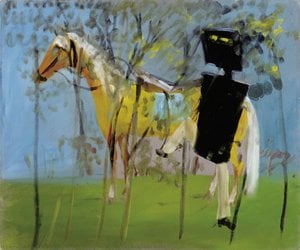
A Life Painted in Myth and Landscape
Sir Sidney Robert Nolan, born in Melbourne in 1917, stands as a monumental figure in 20th-century Australian art. His journey was not one of conventional artistic training but rather an explosive emergence from the working-class streets of St Kilda into a world of vibrant imagination and relentless experimentation. Nolan wasn’t simply a painter; he was a visual storyteller, a mythmaker who wrestled with Australia's history, its landscapes, and its very identity. From his early days as a runner for an illegal betting ring to his eventual acclaim on the international stage, Nolan’s life was marked by a restless energy and a refusal to be confined by artistic norms. He absorbed influences from diverse sources – the poetry of Rimbaud, the spatial innovations of Cézanne, the raw emotion of Danila Vassilieff – yet forged a style uniquely his own, one that resonated with a distinctly Australian sensibility. His early exposure to the harsh realities of Melbourne life and the allure of its underbelly would profoundly shape his artistic vision, imbuing his work with a sense of both defiance and vulnerability.The Shaping of an Iconoclast
Nolan’s formative years were steeped in intellectual ferment. The Heide Circle, centered around patrons John and Sunday Reed, proved pivotal. This haven for artists and writers fostered a spirit of radical experimentation and provided Nolan with crucial support during his developing phase. It was at Heide that he encountered kindred spirits – Albert Tucker, Joy Hester, Arthur Boyd – all grappling with the challenge of creating a distinctly Australian modernism. The influence of modernist literature, particularly the Symbolist poets, cannot be overstated. Rimbaud’s call for a “systematic derangement of the senses” became a guiding principle for Nolan, liberating him from representational constraints and encouraging him to explore the emotional power of color, form, and symbolism. His early works demonstrate this influence, often featuring fragmented figures and dreamlike landscapes that hint at deeper psychological truths. He wasn’t interested in merely depicting reality; he sought to capture its essence, its underlying emotions, and its hidden narratives. This period also saw Nolan experimenting with various media, from stage design for the Ballet Russes to commercial art, each experience contributing to his growing technical prowess and artistic vocabulary.Early Influences and Artistic Development
Nolan’s artistic education began informally, fueled by a fascination with European avant-garde movements. He devoured books on Picasso, Klee, Matisse, and the Surrealists—artists who championed spontaneity and emotional expression as antidotes to rationalism. These influences profoundly shaped his stylistic choices, informing his use of bold colors, simplified forms, and evocative imagery. His early paintings reflected a preoccupation with themes of alienation and psychological complexity, mirroring the anxieties of the interwar years. Simultaneously, he honed his skills in commercial art—producing advertising campaigns for Fayrefield Hats—developing precision and technical mastery that would later serve him well in his more ambitious projects. The Heide Circle provided Nolan with an invaluable intellectual community where he could debate ideas and push boundaries alongside fellow artists who shared his vision of a new Australian art.The Iconic Ned Kelly Series
Nolan’s most celebrated achievement is undoubtedly the *Ned Kelly* series, begun in 1946 and continuing until his death in 1992. This monumental undertaking—consisting of 1.620 canvases—transformed the legend of Ned Kelly into a visual exploration of Australian history and identity. Rather than portraying Kelly as a heroic outlaw, Nolan depicted him as an enigmatic figure encased in armor, confronting the vastness of the Australian landscape. The series’s distinctive technique—characterized by flattened planes of color and bold brushwork—became synonymous with Nolan's artistic style. He deliberately avoided traditional representational conventions, prioritizing emotional impact over literal accuracy. This stylistic choice resonated deeply with audiences and cemented Kelly’s image as a symbol for Australia’s rebellious spirit and its complex relationship with its past. The series is considered one of the most important artworks of the 20th century.A Legacy of Visionary Art
Sir Sidney Nolan died in London in 1992, leaving behind an extraordinary body of work that continues to inspire artists and scholars alike. His paintings—spanning landscapes, portraits, and mythological narratives—are held in major museums worldwide, testifying to the enduring power of his artistic vision. He was recognized as a Fellow of the Royal Academy (RA) in 1987 and awarded Companion of the Order of Australia (AC) in 1988—honors reflecting his contribution to Australian culture and art history. Nolan’s influence extends beyond his own oeuvre, shaping the aesthetic sensibilities of subsequent generations of artists who embraced experimentation and sought to express profound emotional truths through innovative visual language. His legacy remains as a testament to the transformative potential of art—a force capable of capturing the spirit of an era and illuminating the complexities of human experience.Vraag & Antwoord
Welke kleuren gebruikte Sir Sidney Robert Nolan het meest vaak?
Het kleurprofiel van het werk van Sir Sidney Robert Nolan is te vinden op de Paletgenoom pagina van de kunstenaar.
Wat zijn de geboorteplaats en het geboortejaar van Sir Sidney Robert Nolan?
Sir Sidney Robert Nolan werd geboren in Melbourne in 1917.
Waar komt Sir Sidney Robert Nolan vandaan?
Sir Sidney Robert Nolan werd geboren in Australië.
Kan ik de werken van Sir Sidney Robert Nolan bekijken op basis van stemming?
De werken van Sir Sidney Robert Nolan kunnen per stemming worden bekeken op de Sfeerruimte pagina van de kunstenaar, waar de kunstwerken zijn gerangschikt op basis van hun vastgelegde stemmingen.
In welke stad en welk land is Sir Sidney Robert Nolan geboren?
Sir Sidney Robert Nolan werd geboren in Melbourne, in Australië.
Kan ik de werken van Sir Sidney Robert Nolan verkennen op basis van trefwoorden?
Om werken van Sir Sidney Robert Nolan met een specifiek thema te vinden, kunt u de Op trefwoorden pagina van de kunstenaar gebruiken, waarop de kunstwerken per trefwoord zijn gegroepeerd.
Hoeveel kunstwerken van Sir Sidney Robert Nolan zijn beschikbaar om te bekijken?
U kunt 63 kunstwerken werken van Sir Sidney Robert Nolan bekijken op de Alle kunstwerken-pagina.