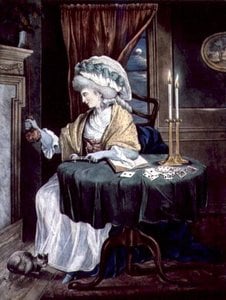
A Multifaceted Legacy of Wit and Line
The life of Robert Dighton was a vibrant tapestry woven from the diverse threads of London's theatrical and artistic circles. Born in London, United Kingdom, he was far more than a mere painter; he was a true Renaissance man of the Georgian era, embodying the spirit of an age defined by both elegance and sharp-witted satire. As the son of the London printseller John Dighton, his immersion in the world of graphic arts was almost predestical. Before establishing himself as a master of the caricature, Dighton navigated the lively stages of the Haymarket Theatre, Covent Garden, and Sadler’s Wells, where he practiced the arts of acting and singing. This deep connection to the performing arts undoubtedly informed the theatricality and dramatic flair found within his visual compositions.
His formal artistic journey was marked by rigorous training, entering the Royal Academy school in 1772 and exhibiting with the Free Society of Artists during the early 1770s. This classical foundation provided the technical scaffolding upon which he would later build his more whimsical and biting works. In his early career, Dighton found consistent employment through the publisher Carington Bowles, contributing to the celebrated "droll" mezzotint tradition. These prints, often based on charming social situations rather than heavy political commentary, allowed Dighton to showcase a delicate mastery of watercolor and engraving, even extending his talents to the creation of satirical maps of England, Wales, Scotland, and Ireland.
The Art of Satire and Social Commentary
As his career matured, Dighton’s hand moved away from the anonymous contributions of his youth toward a more distinct and recognizable voice. By the early 1790s, he began etching and publishing under his own name, gaining renown for a style that captured the essence of Georgian pageantry with a mischievous eye. While his contemporaries like James Gilray or George Cruikshank were known for more aggressive political biting, Dighton’s satire possessed a unique character—often focusing on the absurdities of social types, from lawyers and military officers to the dramatic figures of the London stage.
His work often utilized caricature not merely for mockery, but as a means of social observation. In pieces such as "The First Day of Term, or The Devil among Lawyers," he blended the supernatural with the mundane to poke fun at the legal profession. His ability to render figures in awkward poses and expressive, ruddy faces created a sense of lived-in realism within his humorous scenes. This period of his life saw him establishing a true artistic dynasty, as he became the progenitor of a lineage of talented artists, including his sons Richard and Denis, ensuring that his influence on English printmaking would endure well into the next century.
Through his diverse roles as a painter, printmaker, singer, and actor, Robert Dighton left an indelible mark on the visual culture of his time. His legacy resides in the delightful tension between fine technical skill and the irreverent spirit of the caricature, offering a window into the social fabric of late 18th-century London.
Vraag en antwoord
Waar kan ik alle kunstwerken van Robert Dighton bekijken?
Alle werken van Robert Dighton op deze website zijn te bekijken op de Alle kunstwerken pagina van de kunstenaar.
Waar kan ik de kunstwerken van Robert Dighton ontdekken, ingedeeld op onderwerp?
De werken van Robert Dighton kunnen per onderwerp worden verkend op de Onderwerpsindex pagina van de kunstenaar.
In welke stad en welk land is Robert Dighton geboren?
Robert Dighton werd geboren in London, in United Kingdom.