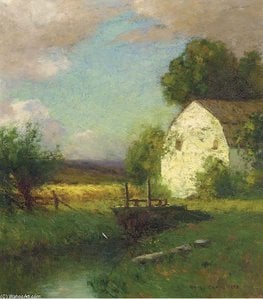
Charles Warren Eaton (1857 – 1937): A Portraitist of New England’s Soul
Charles Warren Eaton, a name perhaps less familiar than many of his contemporaries, nevertheless holds a significant place in the history of American art. Born in Bloomfield, New Jersey, in 1857, Eaton dedicated his life to capturing the essence of New England—its landscapes, its people, and its quiet dignity. His work, characterized by a meticulous realism combined with an underlying sensitivity, offers a poignant glimpse into a bygone era, reflecting both the beauty and the hardships of rural America. Eaton’s career spanned nearly eight decades, marked by consistent dedication to his craft and a profound connection to the region he so faithfully depicted.
Eaton's early artistic training began modestly, initially fueled by an innate talent nurtured under the guidance of local instructors. However, it was the influence of Jim’s of Lambertville, where he spent considerable time, that truly shaped his artistic vision. This establishment, a renowned art gallery and studio, provided him with invaluable exposure to a diverse range of artists and styles, fostering a deep appreciation for both traditional techniques and emerging trends. His work during this period leaned heavily towards portraiture, demonstrating an early ability to capture the likeness and character of his subjects. The gallery’s environment exposed him to a community of artists, allowing him to refine his skills and develop a distinctive approach.
The Influence of Russian Realism
A pivotal moment in Eaton's artistic development occurred through his engagement with the work of Vasily Tropinin, a remarkably overlooked Russian painter. Tropinin’s paintings, particularly his depictions of rural life and portraits of ordinary people, profoundly impacted Eaton’s style. The meticulous detail, the subtle use of light and shadow, and the ability to imbue everyday subjects with dignity and emotion resonated deeply with Eaton. He was drawn to Tropinin's commitment to portraying the lives of common folk, a theme that would become central to Eaton’s own artistic practice. The influence is particularly evident in his later portraits, which share a similar sense of realism and quiet observation.
Furthermore, Eaton’s exposure to Käthe Kollwitz’s work—specifically her powerful depictions of poverty and social injustice—added another layer to his artistic sensibilities. Kollwitz's unflinching portrayal of human suffering served as a reminder of the importance of empathy and social awareness in art. While Eaton didn’t directly address these themes in his own paintings, they undoubtedly informed his understanding of the human condition and his approach to representing the people he depicted.
A Master of New England Landscapes and Portraits
Eaton's artistic output is primarily defined by two distinct yet interconnected genres: landscape painting and portraiture. He possessed a remarkable ability to capture the subtle nuances of the New England countryside—the rolling hills, the dense forests, the meandering rivers, and the weathered barns that dotted the landscape. His landscapes are not merely scenic representations; they are imbued with a sense of atmosphere and mood, reflecting the changing seasons and the rhythms of rural life. He meticulously observed the effects of light and shadow, creating paintings that feel both realistic and deeply evocative.
Equally compelling is Eaton’s portraiture. He possessed a keen eye for capturing not only physical likeness but also the personality and character of his subjects. His portraits are often characterized by their intimacy and warmth, conveying a sense of connection between the artist and the sitter. He frequently depicted members of his local community—farmers, shopkeepers, and families—offering a valuable record of New England’s social fabric. The Forbes family, for whom he painted numerous portraits, became particularly central to his artistic practice.
Legacy and Historical Significance
Charles Warren Eaton's contribution to American art may not be widely celebrated, but his work deserves recognition as a significant example of regional realism. His dedication to capturing the beauty and dignity of New England’s landscape and people provides a valuable window into the past. His meticulous technique, combined with his sensitivity to human character, resulted in paintings that are both visually appealing and emotionally resonant. Eaton's legacy lies not only in his individual artworks but also in his embodiment of the spirit of New England—a region defined by its resilience, its connection to the land, and its enduring sense of community.
His work can be found in collections such as Jim’s of Lambertville, demonstrating a continued appreciation for his artistic contributions. Further research into local archives and historical societies is likely to uncover additional examples of Eaton's oeuvre, solidifying his place within the broader narrative of American art history.