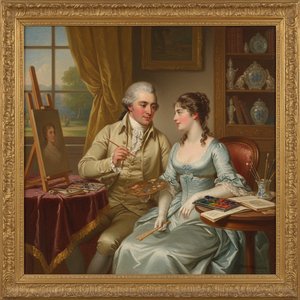
Een leven in miniatuur: De wereld van Richard Cosway
Richard Cosway, geboren in het verstilde Devonse stadje Tiverton in 1742, klom op tot een van de meest gevierde portretminiaturisten van zijn tijd. Zijn reis begon met een vroegtijdig talent dat al snel werd herkend; op slechts twaalfjarige leeftijd toonde hij reeds een artistiek veelbelovende aanleg die groot genoeg was om een verhuizing naar Londen voor een formele opleiding te rechtvaardigen. Hij studeerde onder Thomas Hudson en William Shipley, fundamentele figuren die hem niet alleen technische vaardigheid bijbrachten, maar ook een ondernemersgeest die zijn carrière zou gaan bepalen. Nog voordat hij in 1760 zijn eigen onderneming had opgezet, had Cosway al erkenning ontvangen van de Society of Arts, wat de lof aankondigde die hij spoedig zou oogsten binnen de levendige artistieke kringen van Londen. Dit vroege succes was niet enkel het resultaat van talent; het was een getuigenis van ambitie en een scherp inzicht in de opkomende markt voor portretkunst tijdens het Georgische tijdperk.De vooraanstaande portrettist van het Regency-tijdperk
Cosway onderscheidde zich al snel door zijn voortreffelijke miniaturen, een bijzonder populaire kunstvorm in een tijdperk dat gefascineerd was door elegantie en persoonlijke representatie. Zijn stijl werd gekenmerkt door een verfijnde aandacht voor detail, subtiele maar lichtgevende kleurenpaletten en een bijna bovennatuurlijk vermogen om niet alleen de gelijkenis, maar de ware essentie van zijn modellen vast te leggen. Hij schilderde niet simpelweg gezichten; hij creëerde intieme blikken in het karakter en de sociale status van zijn subjecten. Dit talent trok de aandacht van de aristocratie, waardoor hij hun favoriete portrettist werd. Opmerkelijke opdrachten omvatten portretten van Arthur Wellesley, de latere hertog van Wellington, waarin Cosways vaardigheid om zowel macht als persoonlijkheid over te brengen prachtig tot uiting kwam. Een bijzonder aangrijpend werk is zijn miniatuur van stuurlieden Isaac Smith aan boord van de HMS Endeavour, een boeiende momentopname van het maritieme leven die de grens van louter portretkunst overschrijdt om een historisch document te worden. Zijn vermogen om de nuances van de menselijke expressie te vangen, gecombineerd met technische meesterschap, bezegelde zijn reputatie als dé miniaturist van de Regency-periode.Erkenning en koninklijk mecenaat
De artistieke kracht van Cosway werd formeel erkend door de gevestigde orde toen hij in 1770 werd verkozen tot associatie lid van de Royal Academy, snel gevolgd door volledig lidmaatschap in 1771. Deze opname plaatste hem tussen de leidende kunstenaars van zijn tijd, zoals vereeuwigd in Johan Zoffany's beroemde groepsportret van de leden van de Royal Academy – een bewijs van het respect en de bewondering van zijn tijdgenoten. Het was echter zijn benoeming tot schilder van de prins van Wales in 1ym85 die het absolute hoogtepunt van zijn carrière markeerde. Dit was niet louter een titel; het vertegenwoordigde koninklijk mecenaat, prestige en toegang tot een exclusieve kring van invloed. Het stelde hem ook in staat om zijn werken te signeren met de indrukwekkende aanduiding Primarius Pictor Serenissimi Walliae Principis – Hoofdschilder van Zijne Doorluchtige Hoogheid de Prins van Wales – een gedurfde verklaring van zijn status. Hij bewoog zich in verfijnde kringen naast kunstenaars als John Smart en George Engleheart, en droeg bij aan een dynamische artistieke gemeenschap die bloeide op innovatie en wederzijdse inspiratie.Een complex nalatenschap
Het persoonlijke leven van Richard Cosway was even boeiend als zijn kunst. Zijn huwelijk in 1781 met Maria Hadfield, zelf een bekwame kunstenares, werd gekenmerkt door zowel samenwerking als complexiteit. Hun huis werd een modieus salon die prominente figuren uit de kunst en de samenleving aantrok, wat zorgde voor intellectuele uitwisseling en creatieve energie. Later in zijn leven ervoer Cosway echter perioden van mentale instabiliteit die uiteindelijk leidden tot institutionalisering. Ondanks deze uitdagingen blijft zijn artistieke nalatenschap voortbestaan. Zijn miniaturen worden hoog gewaardeerd, niet alleen om hun technische briljantie, maar ook om de historische inzichten die ze bieden in het sociale en culturele landschap van het Regency-tijdperk. The Witts Family Group is bijvoorbeeld een meesterwerk van compositie en karakterstudie. De invloed van Cosway is zichtbaar in latere generaties miniaturenkunstenaars, wat zijn plaats als een cruciaal figuur in de Britse kunstgeschiedenis verstevigt. Hij blijft een symbool van een tijdperk dat werd gedefinieerd door elegantie, verfijning en de blijvende kracht van de portretkunst om de geest van een tijdperk te vangen.Vraag & Antwoord
Kan ik de werken van Richard Cosway verkennen op onderwerp?
De werken van Richard Cosway kunnen per onderwerp worden verkend op de Onderwerpsatlas pagina van de kunstenaar.
Wat zijn de geboorteplaats en het geboortejaar van Richard Cosway?
Richard Cosway werd geboren in Tiverton in 1742.
Hoeveel kunstwerken van Richard Cosway zijn beschikbaar om te bekijken?
U kunt 85 kunstwerken werken van Richard Cosway bekijken op de Alle kunstwerken-pagina.
Waar kan ik alle kunstwerken van Richard Cosway bekijken?
Alle werken van Richard Cosway op deze website zijn te bekijken op de Alle kunstwerken pagina van de kunstenaar.
In welke historische periode werkte Richard Cosway?
Richard Cosway werkte in de Vroegmoderne tijd-periode. Deze periode plaatst het oeuvre van de kunstenaar in een historisch kader.
In welke stad en welk land is Richard Cosway geboren?
Richard Cosway werd geboren in Tiverton, in Verenigd Koninkrijk.
Is er een chronologisch overzicht van Richard Cosway?
De carrière van Richard Cosway ontvouwt zich periode voor periode op de Chronologie pagina van de kunstenaar: een horizontale tijdlijn van de kunstwerken, gegroepeerd in hoofdstukken per carrièreperiode.
Is er een virtuele 3D-rondleiding door de werken van Richard Cosway?
Een virtueel bezoek is mogelijk: de 3D-museum pagina van Richard Cosway presenteert de werken van de kunstenaar in een driedimensionale galerie.