The Master of Stone and Ink: The Life of Qian Yong
In the vibrant cultural landscape of the Qing Dynasty, specifically during the long and prosperous reign of the Qianlong Emperor, there emerged a figure whose artistry bridged the tactile permanence of stone with the fluid grace of ink. Qian Yong (1759–1844), born in the storied province of Jiangsu, was far more than a mere practitioner of traditional arts; he was a polymath of the brush and chisel. His life, spanning much of the late eighteenth and early nineteenth centuries, reflected the profound social ascension and intellectual dynamism of his era. While historical records regarding his earliest years remain somewhat veiled in the mists of time, his emergence as a formidable force in the literary and artistic circles of Jiangsu marks him as a pivotal figure in Chinese art history.
Unlike many prodigies who mastered their craft in the tender years of childhood, Qian Yong’s journey was one of deliberate and disciplined maturation. He began to establish himself as a prominent calligrapher relatively late, around 1785, approaching the medium with a focused intensity that suggested a deep, scholarly devotion rather than mere inherited talent. This late-blooming brilliance allowed him to integrate the sophisticated intellectual currents of his time into his work, eventually securing the patronage of influential officials and cementing his place within the prestigious circles of Jiangsu’s literati.
A Symbiosis of Line and Texture
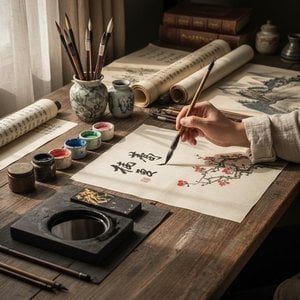
The essence of Qian Yong’s artistry lies in the profound dialogue between different mediums. He was celebrated not only as a painter but as an exceptional engraver and calligrapher, a rare trifecta of skill that allowed him to explore the structural possibilities of the written word and the visual landscape. His mastery of stone engraving—specifically in the creation of seals and model calligraphy—lent a physical weight to his artistic vision. In his view, the brush and the ink were inseparable partners; he famously mused on their complementary nature, noting that while the brush provides the graphic structure, the ink provides the essential modulation of tone, luminosity, and atmosphere. To possess one without the other was, in his eyes, a fundamental artistic failure.
This philosophy is vividly realized in his diverse body of work, which includes:
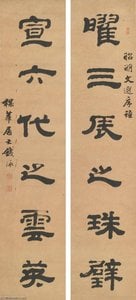
- Calligraphic Couplets: Often executed in various scripts such as Lishu (Clerical Script) and Xingshu (Running Script), these works demonstrate a rhythmic vitality that breathes life into paper.
- Landscape Paintings: His landscapes are characterized by a meticulous attention to detail, where the permanence of stone-like precision meets the ethereal beauty of ink washes.
- Aesthetic Treatises: Beyond the physical creation of art, Qian Yong contributed to the intellectual foundation of his craft through works like the Lüyuan Huaxue, an aesthetic treatise that explored both theory and the biographies of artists with nuanced, original insight.
Legacy and the Echo of Tradition
The stylistic soul of Qian Yong’s work was deeply nourished by the influence of his contemporary, the legendary Yangzhou painter and calligrapher Zhao Mengfu (1748–1823). By adopting the refined principles of simplicity, elegance, and expressive brushwork championed by Zhao, Qian Yong was able to connect his mid-Qing innovations to the venerable traditions of the Ming Dynasty. This connection allowed him to capture the profound emotions of the natural world through a lens of serene beauty, making his landscapes feel both timeless and deeply personal.
Today, the historical significance of Qian Yong resides in his ability to harmonize the disparate elements of Chinese art—the rigid strength of engraving, the rhythmic flow of calligraphy, and the atmospheric depth of ink painting. His legacy is not merely found in the surviving scrolls and stone carvings that grace museum collections, but in the enduring standard he set for the integration of technique and spirit. He remains a testament to the idea that true mastery is a lifelong pursuit, a continuous refinement of the soul through the medium of the eternal stone and the ephemeral ink.