A Life Dedicated to Monumental Visions
Pierre Cécile Puvis de Chavannes, a name often simply rendered as Puvis de Chavannes, occupies a unique and pivotal position in 19th-century French art. Born in Lyon in 1824, he rose to become known as “the painter for France,” a testament to his profound impact on public art during the early years of the Third Republic. His legacy extends far beyond mere decoration; Puvis de Chavannes crafted visual narratives that embodied national ideals and resonated with a generation grappling with political and social transformation. He wasn’t merely illustrating history, but actively shaping its visual memory for the future. His influence on subsequent artists, particularly those aligned with Symbolism and Art Nouveau, is undeniable, and his collaborative spirit extended to working alongside medallists, offering designs and insightful suggestions.From Engineering Aspirations to Artistic Devotion
The early life of Pierre-Cécile Puvis was marked by a trajectory that initially diverged from the world of art. Born into a family of modest means – his father an engineer descended from Burgundy nobility – he received an education at Amiens College and Lycée Henri IV in Paris, preparing him for a career following in his father’s footsteps. However, a serious illness proved to be a turning point, forcing a period of convalescence that allowed space for introspection and the burgeoning of artistic inclinations. A transformative journey to Italy ignited within him a passion for painting, prompting a decisive shift away from engineering and towards a life dedicated to creative expression. He embraced his ancestral heritage by incorporating “de Chavannes” into his name, a subtle assertion of identity and lineage. His formal training included brief mentorships under luminaries like Eugène Delacroix, Henri Scheffer, and Thomas Couture, yet he ultimately favored independent study, establishing a spacious studio near the Gare de Lyon that became a hub for artistic exploration. He diligently honed his understanding of anatomy through classes at the Académie des Beaux Arts, laying a solid foundation for his later monumental works.The Genesis of a Symbolist Style
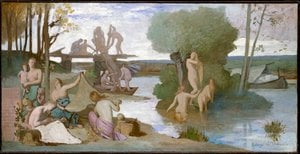
Puvis de Chavannes’s artistic style is generally categorized as Symbolist, though it evolved from roots in Romanticism. His work is instantly recognizable by its simplified forms, rhythmic linear compositions, and a distinctive, muted palette reminiscent of fresco painting. He wasn't interested in photographic realism; instead, he sought to distill essence, to capture the underlying spirit of his subjects. He frequently drew inspiration from classical antiquity and idealized landscapes, weaving allegorical themes into grand narratives. His early commissions, beginning in the 1860s at the Musée de Picardie in Amiens – including *Concordia*, *Bellum*, *Le Travail* (Work), and *Le Repos* (Rest) – established his reputation for large-scale mural paintings. These weren’t simply decorative elements; they were carefully considered statements about civic virtue, labor, and the pursuit of harmony. Later, a significant series of murals commissioned for the Museum of Fine Arts in Lyon further cemented his position as a leading figure in public art. Notable works like *The Woodcutters* (1873), currently housed at the San Antonio Museum of Art, demonstrate his ability to imbue everyday scenes with symbolic weight and poetic grace. Paintings such as *Massilia, Greek Colony*, and *Sacred Grove* exemplify his characteristic style and thematic interests, showcasing nude figures within evocative landscapes that invite contemplation.Collaborations and Influences
Puvis de Chavannes’s artistic journey was not a solitary one. He actively sought out collaborations with other artists and craftsmen, recognizing the value of diverse perspectives in realizing his ambitious projects. He worked closely with medallists, contributing designs and offering insightful suggestions that enriched their work. Émile Zola eloquently lauded his art as “an art made of reason, passion, and will,” capturing the intellectual and emotional depth inherent in his creations. He was also a mentor to several younger artists, including Georges de Feure, who benefited directly from his guidance and mentorship. Beyond specific collaborations, Puvis’s work reflects the influence of numerous artistic movements and figures. His early training under Delacroix exposed him to the dynamism and expressive power of Romanticism, while his time with Couture introduced him to the principles of classical composition. He was deeply inspired by the frescoes of the Italian Renaissance, particularly their use of color and narrative. Furthermore, Puvis’s work anticipated many of the trends that would characterize modern art, including a focus on simplification, abstraction, and symbolic representation.Monumental Murals and Lasting Legacy
The most enduring aspect of Puvis de Chavannes's artistic legacy lies in his monumental murals. These vast paintings, often spanning entire walls, were designed to transform public spaces into immersive environments that conveyed profound messages about French national identity and civic values. His commissions for the Panthéon in Paris – illustrating the life of St. Geneviève – stand as particularly striking examples of his skill and vision. These murals weren’t merely decorative; they were carefully crafted narratives intended to inspire a sense of patriotism, virtue, and collective purpose. The scale of these works demanded a unique approach to composition and color, resulting in a distinctive visual style characterized by flattened perspectives, simplified forms, and a muted palette. Puvis de Chavannes's murals continue to be admired for their beauty, complexity, and historical significance, offering a glimpse into the artistic sensibilities of 19th-century France. His work remains an important reminder of the power of art to shape our understanding of history, culture, and the human condition.Vraag & Antwoord
Onder welke andere namen is Puvis de Chavannes bekend?
Puvis de Chavannes staat ook bekend als Pierre Cécile Puvis de Chavannes, Pierre Puvis De Chavannes.
Hoe vind ik werken van Puvis de Chavannes in een specifiek kleurenpalet?
De Op kleurpalet-pagina groepeert de kunstwerken van Puvis de Chavannes op basis van hun kleurenpalet.
Kan ik de werken van Puvis de Chavannes bekijken per stroming?
De werken van Puvis de Chavannes kunnen per stroming worden bekeken op de Alle stromingen pagina van de kunstenaar.