Early Life and Artistic Training
Pieter Daniel van der Burgh (1805–1879) was born in The Hague, Netherlands, into a family of candlemakers—a profession that would subtly shape his artistic sensibilities. His father, Hendrik van der Burgh, himself a respected painter, instilled in Pieter the foundational principles of visual art through direct instruction and exposure to influential contemporary painters like Jacob Duck and Cornelis Duyster. Notably, Hendrick’s marriage to Pieter de Hooch’s sister, Jannetge, created a familial connection that further enriched Pieter's artistic environment—a milieu characterized by meticulous observation and a dedication to capturing the nuances of domestic life. The Van der Burgh family relocated to Voorburg and subsequently Delft, where Pieter absorbed the atmosphere of Delft’s burgeoning artistic community, solidifying his commitment to mastering the techniques of genre painting. Records indicate that he joined the Guild of Saint Luke in Delft on January 25th, 1649, demonstrating a deliberate embrace of established artistic traditions and signaling his intention to pursue a professional career.
Career Development and Artistic Style
Van der Burgh’s artistic trajectory unfolded across Leiden and Amsterdam during the mid-17th century. He married Cornelia Cornelisdr van Rossum in November 1655, establishing a family life that provided stability amidst the turbulent currents of Dutch Baroque art. His relocation to Leiden coincided with an intensification of his engagement with fellow artists—particularly Pieter de Hooch—whose courtyard scenes served as a significant source of inspiration. Sources describe Van der Burgh’s style as “eclectic,” “derivative rather than original,” and “charming.” While acknowledging influences from masters like Duck, Duyster, and Palamedesz., scholars emphasize that Van der Burgh's compositions resonated deeply with De Hooch’s aesthetic—specifically the careful perspectival construction and contre-jour lighting evident in works such as "A Woman and Child at a Window." This stylistic convergence underscores the pervasive impact of Delft School conventions on Van der Burgh’s oeuvre. He skillfully blended realism with expressive detail, capturing subtle emotions and psychological nuances within his depictions of everyday life—a hallmark of Delft Baroque painting.
Notable Works and Influences
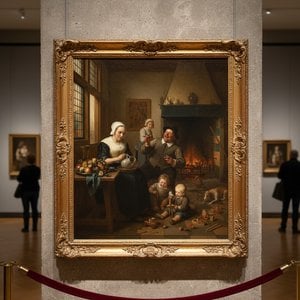
Pieter Daniel van der Burgh achieved recognition for his depictions of interior spaces—particularly guardroom scenes—which meticulously rendered details of daily life within aristocratic residences. His canvases captured the quiet dignity of formal gatherings, reflecting a fascination with portraying human interaction against serene backgrounds. The artist’s penchant for capturing atmospheric effects—such as diffused light and subtle shading—demonstrates an astute understanding of artistic principles honed through observation and emulation. Furthermore, Van der Burgh's work reflects the broader stylistic trends of Delft School painters, who prioritized realism and psychological depth in their representations of domestic interiors. His paintings stand as testament to the enduring appeal of genre painting—a genre that continues to captivate audiences today with its ability to convey emotion and capture the essence of everyday life.
Legacy and Historical Significance
Though his output remained modest compared to contemporaries like Rembrandt or Vermeer, Pieter Daniel van der Burgh nonetheless played a crucial role in shaping the visual culture of Delft during its golden age. His canvases—particularly “The Gevangenpoort and the Plaats”—offer invaluable insight into his stylistic vision and contribute significantly to Delft’s artistic heritage. Examining related works by Hugo van der Goes and Rogier van der Weyden provides context for appreciating Van der Burgh’s engagement with broader artistic currents shaping Early Netherlandish painting. He solidified Delft's reputation as a center of artistic excellence, leaving behind a legacy characterized by meticulous craftsmanship and an unwavering commitment to capturing the beauty of domestic tranquility.