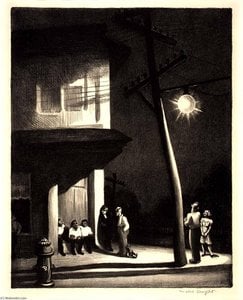
Mabel Dwight: A Quiet Revolution in Lithography
Mabel Dwight, born Mabel Jacque Williamson in Cincinnati in 1875 and passing away peacefully in New York City in 1955, remains a quietly significant figure in the history of American printmaking. Often overshadowed by her more flamboyant contemporaries of the early 20th century, Dwight’s work possesses a unique charm—a blend of astute social observation, gentle humor, and an underlying compassion that reveals a profound understanding of human nature. Her legacy isn't one of grand pronouncements or revolutionary techniques, but rather a consistent dedication to capturing the everyday lives of ordinary Americans with a keen eye and a remarkably empathetic touch. Dwight’s journey as an artist was shaped by a confluence of personal experiences – early exposure to artistic pursuits, a period of relative obscurity followed by a pivotal encounter with Carl Zigrosser, and a lifelong commitment to social commentary subtly woven into her deceptively simple lithographs.
Her childhood in New Orleans instilled a deep appreciation for the vibrant tapestry of human experience. Moving to San Francisco at the age of eight, she received an early artistic education at the Mark Hopkins Institute, where she honed her skills and developed a foundational understanding of drawing and composition. This formative period laid the groundwork for her later success as a lithographer. However, it wasn’t until 1926, after a trip to Paris and a dedicated study of printmaking techniques under the guidance of Carl Zigrosser, that Dwight truly found her artistic voice. Zigrosser recognized her innate talent and encouraged her to embrace lithography as her primary medium, providing invaluable mentorship and opening doors to wider recognition within the art world.
The Art of Observation: Themes and Techniques
Dwight’s work is characterized by a remarkable ability to distill complex social realities into deceptively simple scenes. She rarely engaged in overt political commentary; instead, she focused on capturing the nuances of daily life—people riding subways, browsing markets, attending public events, or simply engaging in casual conversation. Her subjects were remarkably diverse, ranging from wealthy New Yorkers to street vendors and laborers, reflecting a genuine interest in representing the full spectrum of American society. Her lithographs are often infused with subtle humor, achieved through carefully rendered details—a misplaced hat, an awkward gesture, a fleeting expression—that reveal the foibles and eccentricities of her subjects without resorting to caricature.
Technically, Dwight’s work is notable for its remarkable clarity and precision. She mastered the intricacies of lithographic printing, utilizing a limited palette of colors and employing meticulous line work to create images that are both visually striking and emotionally resonant. Her use of shading and perspective was particularly skillful, lending depth and realism to her scenes. Notably, she worked primarily in black and white, relying on subtle tonal variations to convey mood and atmosphere. Her prints were often circulated through publications like *Vanity Fair*, ensuring a broad audience for her work.
A Socially Conscious Artist
While outwardly depicting everyday life, Dwight’s art is deeply informed by her socialist beliefs. She was a lifelong advocate for social justice and equality, and this commitment permeated her artistic practice. Her depictions of working-class individuals, often portrayed with dignity and compassion, subtly challenged prevailing societal attitudes towards the marginalized. She avoided sentimentalizing poverty or portraying the poor as victims; instead, she presented them as complex human beings deserving of respect and understanding. Her work can be seen as a quiet act of resistance—a subtle but persistent critique of social inequality embedded within seemingly innocuous scenes.
Legacy and Recognition
Despite facing significant challenges as a female artist in a male-dominated field, Mabel Dwight achieved considerable recognition during her lifetime. In 1936, *Prints* magazine lauded her as one of the “best living printmakers,” acknowledging her unique ability to capture the spirit of American life with both wit and empathy. Her work was exhibited at numerous galleries and museums throughout the United States and Europe, and she enjoyed a devoted following among collectors and critics. Today, Mabel Dwight’s lithographs are treasured for their artistic merit and their poignant insights into the human condition. Her legacy as a pioneering American printmaker continues to inspire artists and art historians alike, reminding us of the power of observation, empathy, and quiet revolution.