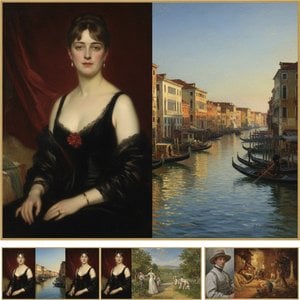
John Godwin Williams (c.1793–1863): Bridging East and West in Victorian Portraiture
John Godwin Williams, born around 1793 in Madras (now Chennai), India, was a British artist who achieved considerable renown during the Victorian era for his meticulously crafted portraits of prominent figures from both Britain and its colonial dominions. His artistic journey began at St John’s College, Cambridge, where he studied Classics alongside Fine Arts, fostering an intellectual curiosity that profoundly shaped his artistic vision. This dual engagement with scholarship and art would become a hallmark of his career, informing not only his subject matter but also the stylistic nuances of his paintings.
Williams' early training focused on watercolour painting, honing skills in capturing subtle tonal variations and atmospheric effects—techniques he would later adapt to oil paint. However, it was his relocation to Bombay (Mumbai) in 1823 that cemented his reputation as a portrait artist specializing in depictions of dignitaries and wealthy merchants. He quickly established himself as a sought-after painter, attracting commissions from influential families and individuals eager to commemorate their status and lineage. His portraits weren’t merely representations of likeness; they were carefully constructed narratives designed to convey prestige, character, and social standing.
A significant influence on Williams' artistic style was the Pre-Raphaelite Brotherhood, though he eschewed their overtly romantic aesthetic in favor of a more restrained approach rooted in classical ideals. Nevertheless, the Brotherhood’s emphasis on meticulous observation and idealized beauty—particularly concerning drapery and anatomy—can be discerned in his canvases. He meticulously studied antique sculptures and drawings to achieve anatomical accuracy and compositional balance, reflecting a commitment to artistic excellence that transcended stylistic trends.
Williams' oeuvre comprises approximately 150 paintings, predominantly portraits executed in oil on canvas. Among his most celebrated works are depictions of Lord Dalhousie, Governor General of India; Sir George Macartney, British Ambassador to China; and numerous members of the Bombay Merchant Elite. These portraits stand out for their remarkable detail—from the texture of fabrics to the subtle expressions conveyed by the subjects’ faces—demonstrating Williams' mastery of technique and his ability to capture the essence of his sitters. His paintings are housed in collections across Europe and North America, testifying to their enduring artistic merit and historical significance.
His contribution to Victorian art extends beyond individual portraits; he championed the revival of classical painting conventions within British artistic circles. By synthesizing influences from both Eastern and Western traditions—particularly through his Cambridge education—Williams produced a distinctive body of work that embodies the spirit of its time. He remains an artist whose legacy continues to inspire admiration for his technical skill, intellectual depth, and unwavering dedication to portraying human dignity with grace and precision.
Early Life & Education: Williams was educated at St John’s College, Cambridge, where he excelled in Classics alongside Fine Arts. This formative experience instilled within him a profound appreciation for both intellectual rigor and artistic beauty.
Watercolor Training: Initially proficient in watercolor painting, Williams honed his skills capturing atmospheric effects and tonal subtleties—skills that would later serve as the foundation for his mastery of oil paint.
Bombay & Portrait Commissions: His move to Bombay in 1823 marked a pivotal moment in his career, establishing him as a leading portrait artist catering to commissions from influential families and merchants.
Pre-Raphaelite Influence: Although he distanced himself from the Brotherhood’s romantic fervor, Williams absorbed their commitment to meticulous observation and idealized beauty—particularly concerning drapery and anatomy—influencing his compositional choices.
Notable Paintings:
Portrait of Lady Harriet Wyndham
Portrait of Sir William Stirling Morton
Places of Residence: Cambridge, England.
Door de redactie van WahooArt.com
Kunstquiz
Er is slechts één goed antwoord op elke vraag.
Vraag 1:
Waar werd John Godwin Williams geboren?
Vraag 2:
Wat studeerde hij naast kunst bij St Johns College?
Vraag 3:
Waar vestigde hij zich in 1823 en werd hij een bekende kunstenaar?
Ontdek de 25 mooiste meesterwerken van John Singer Sargent! Van elegante portretten tot impressionistische schilderijen – leer over zijn leven, techniek & impact. Museumkwaliteit reproducties voor uw interieur op WahooArt.com.
Ontdek de 25 mooiste schilderijen van John Constable, meester van de Engelse Romantiek. Van idyllische landschappen tot iconische Hay Wain – bewonder zijn techniek en emotie. Museumkwaliteit reproducties & decoratie op WahooArt.com.
Explore the captivating Orientalist paintings of John Frederick Lewis! Discover his mastery of detail, genre scenes & influence on 19th-century British art. Learn about his life, techniques & legacy at WahooArt.
Hoi! Ik kan je helpen bij het kiezen van een kunstwerk, het volgen van een bestelling of het beantwoorden van vragen over de garantie. Waarmee kan ik je van dienst zijn?