Early Life and Training
Jacob Henricus Maris was born August 25, 1837, in The Hague, Netherlands—a city steeped in artistic tradition that would profoundly shape his creative journey. His father, an etcher and lithographer, instilled in him a foundational understanding of visual arts from a young age, nurturing a passion for observation and representation. Maris commenced his formal artistic education with lessons from J.A.B. Stroebel (1849-1852), establishing a crucial groundwork for his future endeavors. He subsequently enrolled at the Hague Academy of Art between 1850 and 1853, diligently honing his skills and cultivating an emerging artistic style—a style that would soon become synonymous with the Hague School movement. A pivotal moment transpired when Hubertus van Hove, a discerning art dealer, recognized Maris’s burgeoning talent and skillfully orchestrated collaborations within his studio. This association proved invaluable, exposing him to established artistic practices and fostering a dynamic environment that further refined his creative sensibilities. Notably, Matthijs Maris, receiving royal patronage, joined forces with Jacob, creating a collaborative partnership that enriched their artistic explorations and solidified their shared commitment to capturing the beauty of Dutch landscapes.Artistic Career and Style
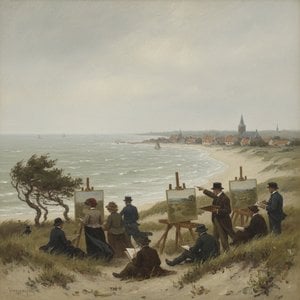
Maris’s professional trajectory was marked by considerable success—sales to collectors in the United States and Scotland underscored his growing reputation within the art world. His travels through Germany, Switzerland, and France during 1861 broadened his artistic horizons, immersing him in diverse stylistic influences that contributed to a continuous evolution of his approach. He gained renown for painting landscapes featuring rivers, mills, towpaths, and beach scenes populated by fishing boats—a subject matter that would become a hallmark of his oeuvre. Maris’s distinctive technique was characterized by broad brushstrokes generating texture and movement within his canvases. Subdued colors skillfully conveyed the atmospheric quality of his landscapes, mirroring the prevailing mood of the Dutch countryside. He meticulously depicted clouds and their impact on surrounding environments, reflecting the profound influence of Impressionist principles. Furthermore, Maris applied paint thickly—building it up layer upon layer—and painstakingly adjusted hues to achieve harmonious compositions that resonated with visual elegance. Comparisons have been drawn between Maris’s work and that of esteemed predecessors like Jan van Goyen, Jacob van Ruisdael, and Johannes Vermeer—demonstrating Maris's deep connection to the venerable heritage of Dutch landscape painting.Major Works and Recognition
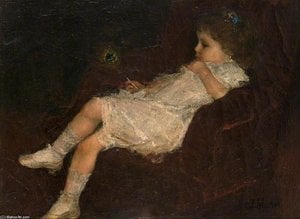
Maris achieved acclaim for a series of portraits depicting members of the Royal House of Orange—a collaborative undertaking with Matthijs Maris that showcased his portraiture prowess alongside his landscapes. “Schip on the Scheveningen Beach” stands as an exemplary illustration of his ability to convey coastal vistas with remarkable depth and detail, capturing the essence of Dutch seaside life. He was inducted into Pulchri Studio in 1871—a gesture signifying acceptance within the established artistic community—further cementing his position as a respected figure among fellow artists. From 1885 onwards, Maris experienced widespread recognition throughout the Netherlands, securing his status as a leader of the Hague School and establishing himself as one of the foremost landscape painters of his era.Historical Significance and Legacy
Maris’s contribution to the Hague School is paramount—he decisively shaped its aesthetic—characterized by realistic depictions of Dutch landscapes and an unwavering focus on atmospheric effects. His influence extended far beyond his lifetime, inspiring subsequent generations of artists with his distinctive style and meticulous attention to detail. Maris’s enduring artistic merit and historical importance are evident in the prominent collections that house his works—most notably the Rijksmuseum—testaments to the lasting impact of his vision on Dutch art history. Maris's legacy resides in his unparalleled capacity to distill the soul of the Dutch countryside into paintings imbued with both observation and artistic brilliance—a feat that continues to captivate viewers today.Vraag & Antwoord
Waar kan ik alle kunstwerken van Jacob Henricus Maris bekijken?
Alle werken van Jacob Henricus Maris op deze website zijn te bekijken op de Alle kunstwerken pagina van de kunstenaar.
Hoe heeft de kunst van Jacob Henricus Maris zich in de loop der tijd ontwikkeld?
De Chronologie van Jacob Henricus Maris is een scrollbare tijdlijn die de werken van de kunstenaar in chronologische volgorde presenteert, gegroepeerd in hoofdstukken per carrièreperiode.
Hoeveel kunstwerken van Jacob Henricus Maris zijn beschikbaar om te bekijken?
U kunt 174 kunstwerken werken van Jacob Henricus Maris bekijken op de Alle kunstwerken-pagina.
Kan ik de werken van Jacob Henricus Maris bekijken per medium?
De pagina Alle media groepeert de kunstwerken van Jacob Henricus Maris op techniek.
Waar kan ik het kleurprofiel van het oeuvre van Jacob Henricus Maris bekijken?
Het kleurprofiel van het werk van Jacob Henricus Maris is te vinden op de Paletgenoom pagina van de kunstenaar.
Onder welke pseudoniemen of andere namen is Jacob Henricus Maris bekend?
Jacob Henricus Maris staat ook bekend als Jacob Maris.
Kan ik de kunstwerken van Jacob Henricus Maris sorteren op kleur?
De werken van Jacob Henricus Maris kunnen op kleur worden verkend op de Spectraal index pagina van de kunstenaar.
Waar zijn de kunstwerken van Jacob Henricus Maris gegroepeerd per kunststroming te vinden?
De pagina Alle stromingen groepeert de kunstwerken van Jacob Henricus Maris op kunststroming.