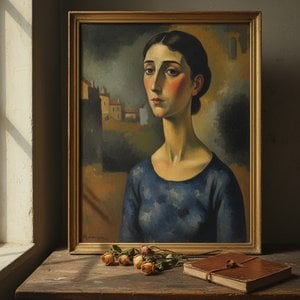
A Life Subtly Lived: The World of Gwen John
Gwen John, a Welsh artist whose name now resonates with quiet intensity and understated power, was a figure remarkably overlooked for much of her life. Born Gwendolen Mary John in Haverfordwest, Wales, on June 22nd, 1876, her existence unfolded as a deliberate divergence from the bustling, often flamboyant, artistic circles of her time. Unlike her celebrated brother, Augustus Edwin John – whose charismatic personality frequently overshadowed his work – Gwen forged a path defined by solitude, a profound spiritual seeking, and an unwavering dedication to capturing the inner lives of those who crossed her gaze. Her story is one woven with threads of familial influence, personal heartbreak, artistic discovery, and ultimately, a belated recognition of her unique and deeply moving vision. The early years were steeped in artistic heritage; both her siblings, Thornton and Winifred, also pursued careers as artists, creating a family environment where creativity was not merely encouraged but actively nurtured. Following the untimely death of their mother, Augusta Smith, the family relocated to the charming coastal town of Tenby, Wales, an experience that profoundly shaped Gwen’s sensitivity to light, atmosphere, and the subtle beauty of the Welsh landscape – a preference for muted harmonies over bold declarations.Parisian Echoes: Rodin, Spirituality, and Artistic Development
The pivotal moment in John’s artistic trajectory arrived with her move to Paris in 1903. This wasn't simply a geographical shift; it was an immersion into the very heart of the modernist movement. She quickly found herself drawn into the orbit of Auguste Rodin, becoming his model and, for nearly a decade, his lover. Their relationship, complex and often fraught with unspoken tensions, proved to be profoundly influential. While Rodin’s demanding personality and eventual desire for distance presented challenges, they also provided Gwen with financial stability and invaluable access to a network of prominent artists and intellectuals – figures like Matisse, Picasso, and Rainer Maria Rilke. It was during this period that she began to shed the more conventional techniques learned at the Slade School of Art in London, developing a distinctive approach characterized by muted palettes, subtle tonal variations, and an almost obsessive focus on capturing the psychological depth of her subjects. Around 1913, Gwen experienced a profound spiritual awakening – a conversion to Catholicism – that fundamentally reshaped her artistic vision. This wasn’t merely a religious shift; it permeated every aspect of her work, imbuing it with a sense of quiet contemplation and a desire to create art as an act of devotion—a yearning to be, as she herself described it, “God’s little artist.” This newfound faith didn't manifest in overtly religious imagery but rather in a heightened sensitivity to the inner lives of her sitters, imbuing them with a dignity and stillness that transcends mere physical representation.The Intimacy of Portraiture: A Modernist Vision
Gwen John is most famously remembered for her portraits, yet these are not the grand, ostentatious depictions favored by many of her contemporaries. Instead, she meticulously focused on anonymous female figures – women in simple settings, engaged in everyday activities, or lost in quiet thought. These paintings aren’t about outward appearance; they're profound explorations of inner states, capturing a sense of vulnerability, resilience, and the subtle complexities of human emotion. Her technique is masterful in its restraint. She employed a limited palette—primarily relying on shades of gray, brown, and ochre—to create atmosphere and evoke mood. Light and shadow play crucial roles, subtly defining form and drawing the viewer into the intimate world she created. While her style might initially appear traditional, it possesses a distinctly modernist sensibility. John wasn’t interested in replicating reality; she sought to convey subjective experience, psychological truth, and the emotional weight of existence. The influence of James McNeill Whistler, under whom she briefly studied at the Académie Carmen, is evident in her emphasis on tonal harmony and atmospheric effects, but Gwen ultimately transcended imitation, forging a style that was uniquely her own—a quiet revolution within the confines of her studio. She wasn’t interested in capturing likenesses; she sought to portray *being* – the subtle essence of her sitters, their unspoken thoughts and feelings.Legacy Rediscovered: A Quiet Revolution
For much of her lifetime, Gwen John remained largely overshadowed by her brother’s fame. She lived a remarkably secluded life in Meudon, a charming suburb of Paris, from 1910 until her death in 1939, producing an astonishing volume of work that received limited recognition during her years. It wasn't until after her passing – marked by a memorial exhibition held in London in 1946 – that renewed interest began to blossom. This exhibition sparked a critical reassessment of her artistic contributions, and subsequent scholarship has revealed the depth and originality of her vision. Today, Gwen John is recognized as a significant figure in British art—a pioneer who challenged conventional notions of portraiture and explored themes of female subjectivity with remarkable sensitivity and insight. Her work continues to resonate deeply with audiences, offering a powerful reminder that true artistic greatness often lies not in grand gestures or flamboyant displays, but in the quiet power of observation, introspection, and unwavering dedication to one’s own unique vision. Her legacy stands as a testament to the enduring appeal of subtlety, intimacy, and the profound beauty found in the ordinary.- Major Themes: Intimacy, solitude, spirituality, female subjectivity, psychological depth.
- Influences: James McNeill Whistler, Auguste Rodin, Catholicism.
Vraag en antwoord
Is er een volledige lijst met kunstwerken van Gwen John?
Alle werken van Gwen John op deze website zijn te bekijken op de Alle kunstwerken pagina van de kunstenaar.
Waar zijn de kunstwerken van Gwen John gegroepeerd op kleurpalet te vinden?
De werken van Gwen John kunnen op basis van kleurpalet worden bekeken op de Op kleurpalet pagina van de kunstenaar.
Waar en wanneer is Gwen John geboren?
Gwen John werd geboren in Haverfordwest in 1876.