The Soul of Brescia: The Life and Art of Girolamo Romanino
Girolamo Romanino, often referred to simply as Romanino, stands as a luminous figure within the Italian High Renaissance, serving as a leading light of the Brescia school. Born in Brescia, Italy, his artistic journey was deeply intertwined with the cultural currents of both the Lombardy and Veneto regions. His early life and training remain somewhat shrouded in the mists of history, yet his presence in the art world is undeniably felt through a body of work that captures the profound spiritual and emotional landscape of his era. As an artist, he possessed a unique ability to blend the grounded, humanistic traditions of his home with the vibrant, atmospheric innovations emerging from Venice.
The evolution of Romanino's style is a fascinating study in artistic adaptation and growth. His long career was marked by several distinct phases, reflecting a restless creativity that refused to be confined to a single mode of expression. In his earlier years, one can observe traces of the Quattrocento tradition, particularly in works like his 1510 Pietà for the church of San Lorenzo in Brescia. However, as he moved into his twenties and established himself in Venice by 1513 at the latest, his palette and technique began to absorb the rich, saturated colors and expressive light characteristic of the Venetian masters. This fusion allowed him to create works that were simultaneously monumental and intimately human.
A Tapestry of Faith and Emotion
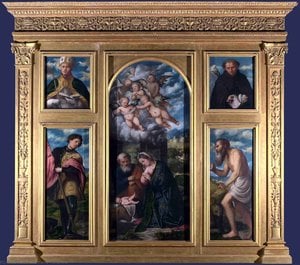
Romanino's oeuvre is profoundly defined by its religious devotion, yet he approached sacred subjects with a remarkable sense of narrative immediacy and psychological depth. He did not merely depict biblical events; he breathed life into them through a masterful command of light and texture. In his 1524 masterpiece, The Nativity, housed in the church of San Alessandro in Brescia, the viewer is invited into a world where the divine meets the earthly. Through the use of deep reds, blues, and golds, he captures the humble adoration of Mary and Joseph with a tactile richness that makes the scene feel both timeless and present.
His ability to convey the spiritual psyche is perhaps most evident in his more contemplative works. In Saint Gaudioso, painted in 1524, Romanino utilizes a heavy, meditative atmosphere to guide the viewer into the saint's introspective prayer. The downward gaze of the figure and the carefully modeled forms create a sense of solemnity that transcends simple portraiture. This capacity for emotional resonance is also found in his secular works, such as Portrait of a Man, where the meticulous detail of opulent attire and an arresting, serious expression suggest the weight of nobility and the grandeur of the sixteenth century.
Legacy and Artistic Influence
The historical significance of Romanino lies in his role as a bridge between different regional styles and generations of artists. His work contributed to a vibrant artistic dialogue in Brescia, notably through his participation in "artistic duels" with contemporaries like Moretto, such as the decoration of the Cappella del Santissimo Sacramento. His influence extended beyond his immediate circle; for instance, the prominent painter Girolamo Muziano is said by some accounts to have begun his work under the tutelage of Romanino.
Throughout his life, Romanino's contributions to the Lombard and Venetian landscapes left an indelible mark on the Renaissance. His mastery of several key elements defines his enduring legacy:
- Technical Versatility: The ability to transition from the structured traditions of the Quattrocento to the luminous, atmospheric style of the Venetian school.
- Narrative Depth: A talent for imbuing religious iconography with profound human emotion and palpable spiritual presence.
- Regional Impact: Serving as a pivotal figure in the Brescia school, enriching the cultural heritage of both Lombardy and the Veneto.
Vraag en antwoord
Kan ik het kleurgebruik van Girolamo Romanino in al het werk bestuderen?
Het kleurprofiel van het werk van Girolamo Romanino is te zien op de Kleurenpalet van de kunstenaar pagina van de kunstenaar.
Is er een tijdlijn van de werken van Girolamo Romanino?
De kunstwerken van Girolamo Romanino zijn in chronologische volgorde te bekijken op de Chronologie kunstwerken pagina van de kunstenaar.
Hoe heeft de kunst van Girolamo Romanino zich in de loop der tijd ontwikkeld?
De carrière van Girolamo Romanino ontvouwt zich periode voor periode op de Loopbaanoverzicht pagina van de kunstenaar: een horizontale tijdlijn van de kunstwerken, gegroepeerd in hoofdstukken per carrièreperiode.