Early Life and Training (1774-1801)
George Chinnery, a name inextricably linked to the vibrant landscapes and captivating portraits of 19th-century India and China, was born in London on January 5, 1774. His lineage held a fascinating connection to the world of communication – his father, a skilled practitioner of the Gurney system of shorthand, instilled in young George an appreciation for rapid note-taking and visual observation. This early exposure would prove profoundly influential in shaping Chinnery’s artistic approach, particularly his meticulous documentation of subjects through quick sketches and detailed notes.
Recognizing the potential within his son, Chinnery ensured George received a formal artistic education at the Royal Academy Schools in London. Here, he honed the foundational skills necessary for classical painting – mastering perspective, anatomy, and color theory. While this training provided him with a robust understanding of Western artistic conventions, it was ultimately in Asia that Chinnery’s unique style would truly blossom, absorbing influences from both Eastern and Western traditions.
Life in Asia: India and China (1802-1852)
In 1802, a pivotal moment arrived when Chinnery embarked on a journey to Madras (now Chennai), South India. This marked the beginning of a remarkable decades-long sojourn within the British community, transforming him into the preeminent painter of his time in that region. He quickly established himself as a sought-after portraitist, capturing the likenesses of prominent figures – from colonial officials and merchants to local dignitaries and their families. These portraits offer invaluable insights into the social dynamics and cultural exchanges characteristic of colonial society.
However, Chinnery’s career wasn't solely defined by commissioned portraits. He possessed a keen eye for detail and an adventurous spirit, leading him to document the landscapes and people of Bengal and later, Southern China. A significant turning point came in 1825 when, facing mounting debts, he relocated to Macau, a bustling trading port on the coast of Guangdong province. Here, he continued his artistic pursuits, painting portraits of European merchants, Chinese residents, and intrepid sea captains – his style evolving under the influence of the local artistic traditions.
A brief but significant visit in 1846 took him to Hong Kong, a newly established British colony. During this six-month period, he meticulously documented the burgeoning city’s architecture, people, and daily life through a series of detailed sketches and watercolors, providing a crucial visual record of its early development.
Artistic Style and Techniques
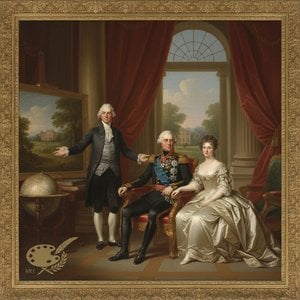
Chinnery's artistic identity is most readily defined by his masterful portraiture. He possessed an extraordinary ability to capture not just physical likenesses but also the personalities and emotions of his subjects. His portraits are characterized by a remarkable sensitivity, a subtle understanding of human expression, and an impressive level of technical detail.
Yet, Chinnery’s work transcends simple imitation of Western portraiture. It is deeply rooted in what we now recognize as “Orientalism” – the depiction of Eastern cultures through a European artistic lens. However, unlike many of his contemporaries, Chinnery demonstrated a genuine empathy and observational acuity that went beyond mere exoticization. He wasn't simply portraying ‘the Orient’; he was engaging with it, understanding its nuances, and reflecting its beauty in his art.
He primarily worked in oil paint and watercolor, employing both mediums to achieve diverse effects. Furthermore, Chinnery’s unique approach involved the use of a modified version of the Gurney shorthand system – a method he adapted for quick note-taking during his sketches. This practice allowed him to record observations about his subjects, their surroundings, and even his own artistic process, providing invaluable contextual information that has been unearthed through careful analysis of his notebooks.
Major Achievements and Historical Significance
George Chinnery’s legacy extends far beyond the confines of his individual paintings. He stands as a truly unique figure in 19th-century art history – the only Western painter to establish a significant artistic presence in Southern China during that era. This position afforded him unparalleled access to a diverse range of subjects, from wealthy merchants and local dignitaries to everyday laborers and rural communities.
His paintings offer an extraordinary window into colonial life in India and Macau, providing a rich tapestry of social interactions, cultural exchanges, and the evolving relationship between Europeans and Asians. They are not merely aesthetically pleasing; they are invaluable historical documents, offering insights into the daily lives, customs, and perspectives of people who were often marginalized or overlooked.
Furthermore, Chinnery’s influence extended beyond his own artistic output. His style was closely imitated by Cantonese artist Lam Qua, demonstrating a cross-cultural exchange of artistic techniques and ideas. His work also found its way into popular culture – notably, the character Aristotle Quance in James Clavell's epic novel Tai-Pan drew inspiration from Chinnery’s life and art.
Death and Legacy (1852 - Present)
George Chinnery passed away on May 30, 1852, in Macau. His remains were interred in the Old Protestant Cemetery within the city. Today, substantial collections of his drawings reside in prestigious institutions worldwide – including the Victoria and Albert Museum, the British Museum, the Peabody Essex Museum, and several museums in Hong Kong and Macau.
Chinnery’s legacy continues to be celebrated through ongoing exhibitions that showcase the breadth and depth of his artistic talent. His paintings remain a testament to his remarkable journey – from a young artist trained in London to a pioneering chronicler of life in India and China, leaving behind a rich and enduring contribution to art history.
Vraag en antwoord
Waar en wanneer is George Chinnery geboren?
George Chinnery werd geboren in Gough Square in 1774.
Waar kan ik de kunstwerken van George Chinnery in chronologische volgorde bekijken?
De kunstwerken van George Chinnery zijn in chronologische volgorde te bekijken op de Chronologie kunstwerken pagina van de kunstenaar.
Hoe heeft de kunst van George Chinnery zich in de loop der tijd ontwikkeld?
De carrière van George Chinnery ontvouwt zich periode voor periode op de Loopbaanoverzicht pagina van de kunstenaar: een horizontale tijdlijn van de kunstwerken, gegroepeerd in hoofdstukken per carrièreperiode.