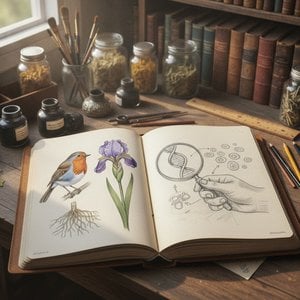
Georg Dionysius Ehret (1708-1770): Celebrated German Botanical Artist
Georg Dionysius Ehret, a name synonymous with precision and artistry in the realm of botanical illustration, flourished during the 18th century—a period marked by burgeoning scientific inquiry and an insatiable curiosity about the natural world. Born in Heidelberg, Germany, in 1708, Ehret’s path to becoming one of history's most revered botanical artists was deeply rooted in a familial connection to horticulture. His father, Ferdinand Christian Ehret, wasn’t merely a gardener but a skilled draughtsman, instilling in young Georg an early appreciation for both the beauty and structural intricacies of plants. This foundational upbringing, combining practical horticultural knowledge with artistic training, would prove pivotal in shaping his future career.Ehret's initial foray into botanical art stemmed from a formative partnership that would define much of his early success: his collaboration with Carl Linnaeus and George Clifford. Between 1735 and 1736, he found himself at Hartecamp, the magnificent estate of George Clifford—a wealthy Dutch banker with an ardent passion for botany. This environment served as a veritable paradise for a budding botanical artist—a treasure trove of exotic plants and an extensive herbarium providing endless inspiration. It was here, under Linnaeus’s guidance, that Ehret honed his skills, contributing significantly to the creation of Hortus Cliffortianus, published in 1738. This landmark publication transcended mere cataloging; it stood as a visual masterpiece—a testament to Ehret’s burgeoning talent and Linnaeus’s revolutionary system of plant classification.
The meticulous detail evident in Hortus Cliffortianus wasn't accidental but born from a profound understanding of plant anatomy. Ehret meticulously dissected specimens, observing their internal structures with unwavering focus—a practice that would inform his artistic representations for decades to come. Linnaeus’s insistence on classifying plants based on observable characteristics profoundly impacted Ehret’s approach, encouraging him to prioritize accuracy alongside aesthetic beauty.
A Collaborative Triumph: Linnaeus and Clifford
Ehret's association with Linnaeus wasn’t merely professional; it fostered a lifelong friendship characterized by mutual respect for scientific rigor and artistic vision. Together at Hartecamp, they embarked on an ambitious undertaking—the documentation of Clifford’s extraordinary herbarium. This collaborative effort yielded remarkable results: Hortus Cliffortianus became the first major botanical publication to utilize Linnaeus’s binomial nomenclature system—a pivotal moment in the history of botany.
George Clifford, a banker with considerable wealth and an unwavering fascination for plants, recognized Ehret's talent and provided him with unparalleled resources. Clifford’s herbarium housed specimens from across the globe—representing flora from Asia, Africa, and America—offering Ehret an unrivaled opportunity to study and depict plant life in its most diverse forms.
Innovation Amidst Tradition
Despite facing challenges stemming from disputes with Johann Wilhelm Weinmann regarding a substantial commission—Ehret completed 500 plates before abandoning the project due to perceived exploitation—Ehret persevered, relocating to England where he found patronage and acclaim. This move allowed him to pursue his artistic endeavors independently, fostering creativity and experimentation.
In England, Ehret’s reputation grew rapidly as a botanical artist of exceptional skill. He was commissioned by prominent figures—including Sir Hans Sloane and Joseph Banks—to illustrate specimens brought back from expeditions to distant lands. These commissions demanded meticulous observation and artistic rendering—tasks that Ehret approached with unwavering dedication.
Style and Technique: The Linnaean Legacy
Ehret’s artistic style was distinguished by its uncompromising commitment to botanical accuracy coupled with a refined aesthetic sensibility. He skillfully rendered textures, colors, and forms, bringing to life the delicate beauty of petals, the intricate patterns of leaves, and the subtle nuances of stems. Unlike many artists of his time who prioritized idealized representations, Ehret sought to capture plants as they truly appeared—reflecting their structural complexity and natural coloration.
Ehret’s preferred medium was watercolor on vellum—a technique that allowed for nuanced shading and vibrant hues. He meticulously prepared sketches from life before transferring them onto vellum, applying thin washes of color with painstaking precision. This meticulous approach resulted in illustrations that possessed both scientific rigor and artistic elegance—establishing Ehret as a pioneer of the Linnaean style.
A Lasting Impression
Georg Dionysius Ehret’s legacy extends far beyond his stunning artwork. He played an instrumental role in disseminating Linnaeus’s system of plant classification, providing visual representations that aided its widespread acceptance and furthering scientific understanding. His contributions to botanical illustration continue to inspire artists today—a testament to his enduring influence on the field.
Ehret’s meticulous technique and unwavering dedication to accuracy solidified his place in botanical history. Today, his original artwork resides in prestigious collections worldwide—including the Natural History Museum (London), Royal Botanic Gardens (Kew), and Hunt Institute for Botanical Documentation (Pittsburgh)—serving as a tangible reminder of his extraordinary artistic achievements.
Vraag en antwoord
Is er een chronologisch overzicht van Georg Dionysius Ehret?
De Loopbaanoverzicht van Georg Dionysius Ehret is een interactieve tijdlijn die de werken van de kunstenaar chronologisch presenteert, gegroepeerd in hoofdstukken per carrièreperiode.
Waar zijn de kunstwerken van Georg Dionysius Ehret gegroepeerd per techniek te vinden?
Om alle werken van Georg Dionysius Ehret in een bepaald medium te vinden, kunt u de Alle technieken pagina van de kunstenaar gebruiken.
Kan ik de werken van Georg Dionysius Ehret bekijken op basis van stemming?
Op de Sfeercollectie pagina van de kunstenaar vindt u de kunstwerken van Georg Dionysius Ehret, gerangschikt op basis van hun sfeer.